

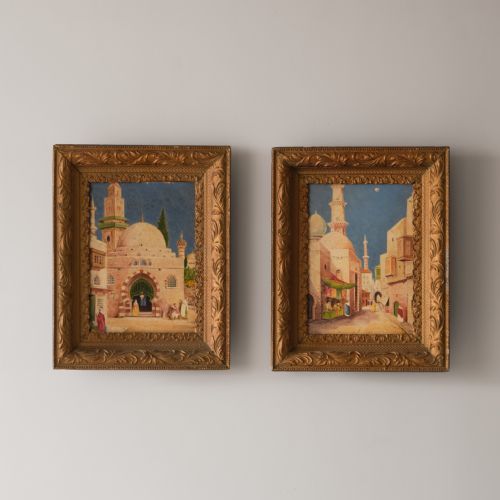



Old Framed Watercolours
Old framed watercolours capture landscape and portrait history directly on paper behind glass, offering an intimate connection to past centuries.
Old Framed Watercolours
Old framed watercolours encompass original works executed on paper using pigment and ink, preserved within protective wood and glass frames. These pieces span centuries from the Regency period through to the mid-twentieth century, capturing landscapes, marine views, and genre scenes.
Buyers seeking old framed watercolours encounter diverse stylistic approaches, ranging from naive topographical records to accomplished Victorian fine art. Common subjects include historic bridges, rural mills, coastal piers, and detailed figure studies.
The materials typically combine delicate paper supports with traditional framing elements such as gilt wood mouldings. Each piece offers a tangible window into past artistic practice and historical observation.
How They Were Made
Artists painted directly onto paper supports using water-soluble pigments, frequently incorporating ink line work to define architectural or figurative details. These works rely on the reflective quality of the white paper shining through translucent washes of colour.
Framing involved protecting the delicate painted surface behind glass, often set within wooden mouldings or gilt frames. This traditional mounting method shields the paper from atmospheric dust and physical damage over generations.
Old Framed Watercolours Retail Price Guide 2026
Typical asking prices for old framed watercolours among the pieces listed under this phrase on Sellingantiques today, from the lower quarter to the upper quarter. They describe what is for sale here now, not the wider market.
One portrait records a remarkably serious three-month-old infant aged three years in ink and watercolour.
What Varies in Quality
Quality rests upon the artist's technical control over pigment application and perspective, distinguishing accomplished academic studies from simpler naive works. Mastery of line and wash creates depth and atmosphere that lesser execution lacks.
Condition and originality dictate standing, particularly the stability of the paper support and the retention of the original frame. Works free from excessive fading or damp staining preserve the artist's intended tonal range more successfully.
Bruce Bairnsfather·Arthur Wilde Parsons·Henry John Kinnaird·John R Houston·Lilian Stannard·Fred Lawson
The Old Framed Watercolours Glossary
- Watercolour
- A painting method where paints are made of pigments suspended in a water-based solution. The paper surface remains visible beneath translucent layers of pigment.
- Naïve Art
- Artwork produced by artists without formal academic training, characterised by charming perspective and direct observation. These pieces often possess a distinct historical immediacy.
- Gilt Wood
- Wood carved and coated with a thin layer of gold leaf or metallic gilt. This material frequently frames nineteenth-century and earlier works.
- Genre Realism
- Artistic representation of subjects from everyday life, typically depicting ordinary people in natural settings. It forms a significant category within Victorian painting.
Old Framed Watercolours: Frequently Asked Questions
How should I display old watercolours at home?
Position framed watercolours away from direct sunlight to prevent the pigments and paper support from fading over time.
Maintain stable indoor humidity levels to protect both the paper and the wooden frame from environmental stress.
How do I identify the period of a watercolour?
Examine the framing materials, paper type, and stylistic conventions used in the composition to establish a baseline era. Signatures and inscriptions often provide direct links to active exhibition dates or specific artists.
Comparing subject matter with documented historical styles helps narrow down the decade of production.
What is the difference between naive and fine art watercolours?
Naive watercolours display unacademic perspective and direct charm, often created by self-taught hands recording local scenes or personal histories.
Victorian fine art watercolours employ rigorous academic techniques, sophisticated tonal gradations, and precise anatomical or architectural rendering.
Are these watercolours original or reproductions?
The pieces recorded here are original hand-painted works executed directly on paper by artists and illustrators.
Close examination under magnification reveals individual brushstrokes, ink lines, and pigment pooling characteristic of unique drawings.