

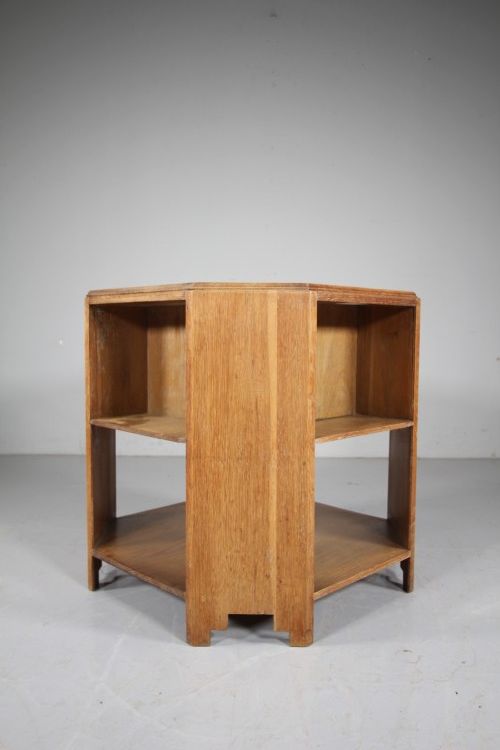


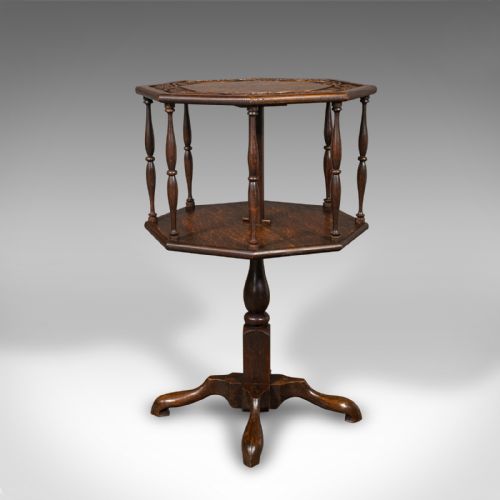


Octagonal Bookcase
An octagonal bookcase offers eight accessible sides of timber and glass, turning books and objects into a central room display.
Octagonal Bookcase
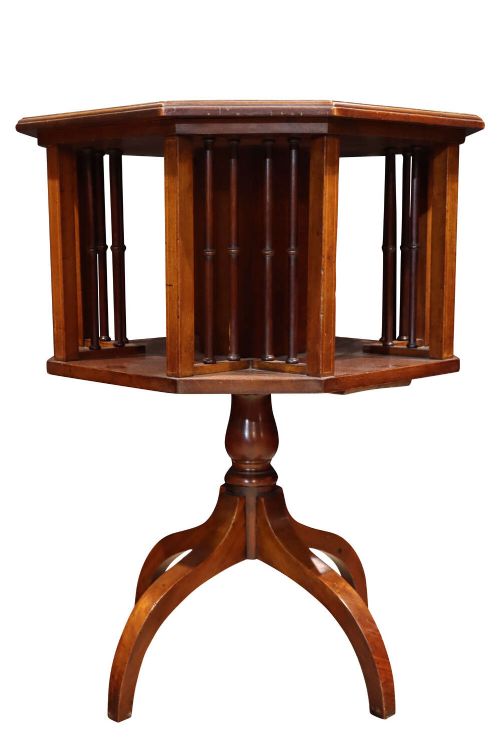
The octagonal bookcase combines compact multi-sided storage with the surface utility of a table, often standing free in the centre of a room rather than against a wall. The pieces you encounter span from the Victorian and Edwardian eras into the robust geometric forms of the Art Deco period.
Most examples lean towards revolving book tables or tiered book stands constructed in oak, walnut, and mahogany. These functional library items double as display platforms for smaller volumes and decorative objects.
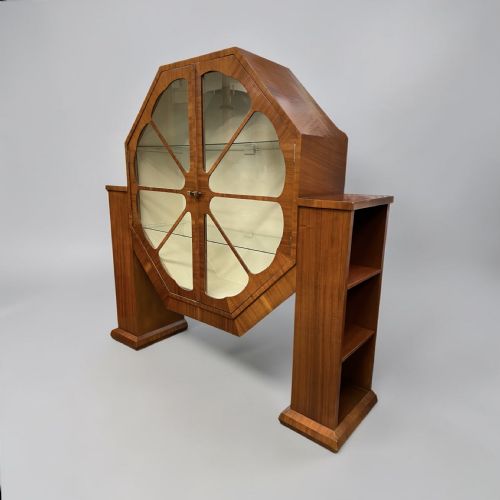
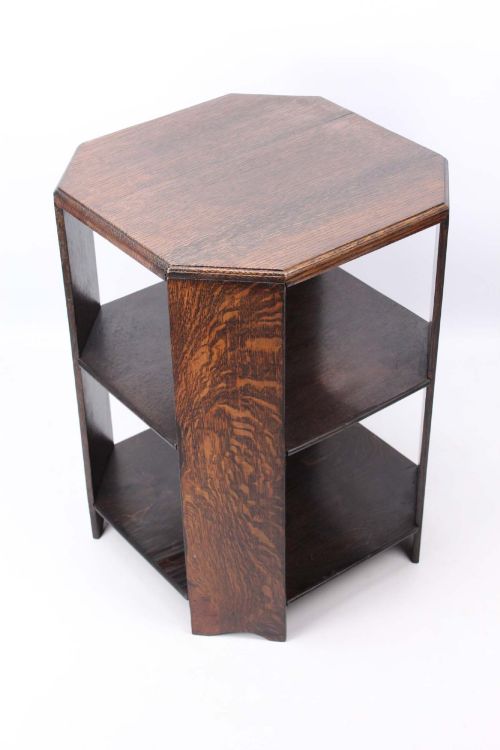
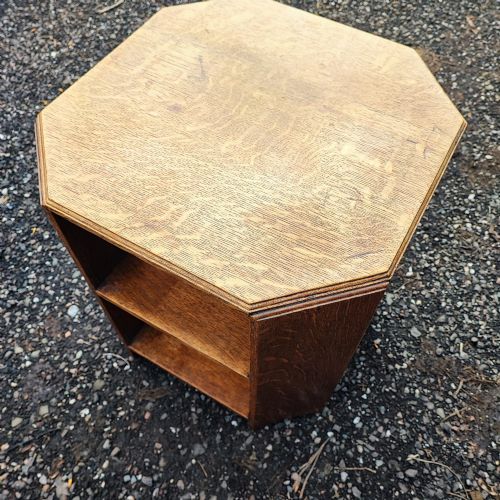
Earlier nineteenth-century models appear alongside Arts and Crafts oak pieces and 1930s walnut designs. This mix of periods gives buyers a choice between classical wood tones and streamlined twentieth-century veneering.
How they were made
Makers relied primarily on solid oak, walnut, and mahogany, frequently applying burr walnut and figured veneers to catch the light on multi-faceted surfaces. Selected pieces incorporate brass fittings and glass panels to enclose display compartments.
Revolving mechanisms demand precise interior carpentry to ensure smooth rotation without binding across eight separate bays. Joinery traditions shifted from heavy Victorian framing to cleaner Art Deco silhouettes by the nineteen-thirties.
Octagonal Bookcase Retail Price Guide 2026
Typical asking prices for octagonal bookcase among the pieces listed under this phrase on Sellingantiques today, from the lower quarter to the upper quarter. They describe what is for sale here now, not the wider market.
Listings feature four distinct historical styles spanning the Victorian era through to Art Deco walnut and Arts and Crafts oak.
What varies in quality
The sophistication of the timber selection dictates the visual success of the piece, particularly where figured walnut veneers create book-matched patterns across multiple panels. Plain solid woods rely entirely on crisp corner joints and well-balanced proportions.
The underlying mechanism of a revolving model defines its lasting utility, separating smooth, silent rotation from stiff or rattling movement. Superior cabinet work conceals the heavy pivots necessary to support heavy loads of books on eight sides.
Heals
The Octagonal Bookcase Glossary
- Book-matched
- A method of arranging veneer sheets to mirror each other, creating symmetrical patterns across flat cabinet surfaces. This technique highlights the natural grain of walnut and mahogany.
- Revolving mechanism
- The internal pivot system allowing a bookcase to turn freely on its base. Quality examples distribute weight evenly across the entire multi-sided frame.
- Skyscraper
- A descriptive term for stepped, vertical Art Deco furniture forms. It applies to tiered revolving book tables with distinct diminishing levels.
- Partridgewood
- A dense tropical timber valued for its speckled, partridge-like grain pattern. It appears on select nineteenth-century standing library pieces.
- Occasional table
- A small, movable table designed for specific subsidiary uses like holding books or display items. Many octagonal variants double as low library book stands.
Octagonal Bookcase: Frequently Asked Questions
How do I care for a walnut veneer octagonal bookcase?
Keep walnut veneer pieces away from direct heat sources and strong sunlight to prevent the thin timber layers from lifting or fading over time. Apply a microcrystalline wax sparingly to maintain the finish without building up heavy residues on the faceted panels.
Dust the eight vertical bays regularly with a soft, dry cloth rather than using silicone sprays that can penetrate older polished surfaces. Check the revolving action periodically to ensure the central pivot remains free of accumulated dust and debris.
Were these multi-sided bookcases made for homes or offices?
These eight-sided pieces were primarily designed for domestic libraries, studies, and drawing rooms where books needed to be accessible from multiple seating positions. Their compact footprint made them suitable for placing beside armchairs or in the middle of smaller reading rooms.
Commercial library spaces occasionally utilised smaller revolving tables, but the decorative veneers and display cabinets point firmly towards comfortable private interiors. They served both as working furniture and as sophisticated display platforms for prized volumes.
How do I tell an Edwardian piece from a 1930s Art Deco one?
Edwardian models frequently utilise traditional mahogany or polished oak with subtle mouldings, reflecting classical furniture styles of the early twentieth century. Art Deco examples lean heavily on figured walnut veneers, geometric tiered structures, and smooth, unadorned planes.
Look at the overall silhouette and base construction to read the period accurately. The transition from turned wooden columns to stepped skyscraper tiers marks the shift between these two eras.
Can an octagonal bookcase hold heavy hardbacks safely?
Most multi-sided revolving stands are engineered to balance moderate loads of standard octavo and quarto volumes across their opposing bays. Distributing heavier books evenly around the circumference prevents any strain on the internal pivot mechanism.
Avoid overloading single sections, as an uneven weight distribution can cause the rotating mechanism to bind or wear prematurely. Solid wood variants handle heavier loads more robustly than veneered alternatives.