

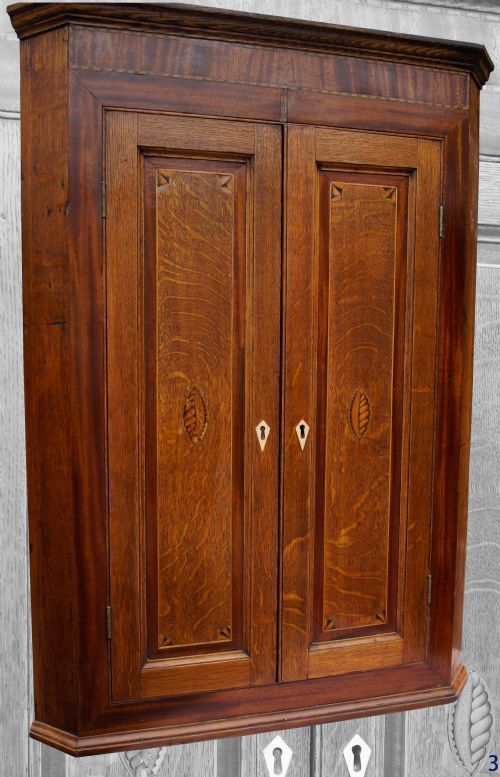


Oak Corner Unit Wall Mounted
These oak corner unit wall mounted pieces are space-saving hanging cupboards crafted to fit domestic room angles, offering period storage and display.
Oak Corner Unit Wall Mounted
An oak corner unit wall mounted search brings up hanging corner cupboards and cabinets designed to utilise neglected room junctions. These wall-hung pieces clear floor space while providing enclosed shelving at eye level or below.
The versions met most frequently on this page date from the Georgian era and the eighteenth century, constructed primarily in solid oak with occasional fruitwood or mahogany crossbanding. Forms range from simple panelled doors to bow-fronted profiles and carved Victorian interpretations.
How they were made
Joiners built these wall-mounted cupboards using solid timber boards assembled with pegged mortise and tenon joints to withstand the stress of hanging. Panel doors, sometimes curved into a bow-front, demonstrate regional cabinet-making techniques across English and Welsh workshops.
Materials include dense oak augmented by fruitwood, mahogany crossbanding, and contrasting wood inlay. Iron hinges and brass escutcheons secure the doors, while internal wooden shelves provide fixed storage for ceramics or glassware.
Oak Corner Unit Wall Mounted Retail Price Guide 2026
Typical asking prices for oak corner unit wall mounted among the pieces listed under this phrase on Sellingantiques today, from the lower quarter to the upper quarter. They describe what is for sale here now, not the wider market.
Several cupboards retain their original tiny iron keys, proving that eighteenth-century household items sometimes managed to avoid being lost down the back of a settle.
What varies in quality
Quality rests upon the choice of timber and the sophistication of the exterior facade, such as figured grain in mahogany crossbanding or crispness in eighteenth-century carving. Simpler English country pieces rely on honest board construction and original brass hardware.
Structural integrity in a wall-hung cabinet depends on the original hanging brackets and the condition of the timber joints where the sides meet the backboards. Superior examples maintain rich patination and untouched surface finishes developed over centuries of use.
The Oak Corner Unit Wall Mounted Glossary
- Crossbanding
- A border strip of veneer laid around the perimeter of a door or panel so that the grain runs at right angles to the central wood. This technique creates a neat framing effect on Georgian furniture.
- Fruitwood
- A dense, light-brown timber gathered from orchard trees like apple or pear, utilised by country cabinet-makers for smaller cupboards and decorative highlights. It ages to a warm, mottled tone.
- Bow front
- A convex, outwardly curved front profile seen on specific corner cabinets. This shape softens the hard lines of a room corner and increases internal storage capacity.
- Escutcheon
- A protective plate surrounding the keyhole of a cupboard door, usually cast in brass. It prevents the wood from splitting around the lock mechanism.
Oak Corner Unit Wall Mounted: Frequently Asked Questions
How do I hang a heavy antique corner cupboard?
These wall-mounted cabinets require secure fixing points driven directly into solid masonry or substantial wall studs using appropriate steel brackets. Because the piece holds weight, the internal backboards and hanging fixings must bear the load safely.
Professional installation is recommended to protect antique joints from twisting under the combined weight of the solid oak timber and interior contents.
Were these always meant for walls?
Yes, the listings show hanging cupboards and wall-mounted cabinets specifically constructed with bracket systems or suspension points for elevated placement. They sit above floor-standing furniture to utilise room angles efficiently.
Floor-standing corner cupboards exist in period furniture, but the pieces on this page are defined by their wall-hung design.
How can I tell an eighteenth-century cabinet from a later revival piece?
Eighteenth-century pieces display hand-cut timber joints, pegged construction, and authentic surface patination built up through decades of wax and handling. Tool marks on the interior boards differ noticeably from later mechanised production.
Revival pieces, such as those from the Victorian period, often incorporate heavier machine-carved decoration or standardised ironwork that reflects nineteenth-century manufacturing methods.
What is mahogany crossbanding on an oak cupboard?
Crossbanding involves applying thin strips of mahogany veneer around the edges of oak doors to create a contrasting border frame. Cabinet-makers used this decorative method during the Georgian period to elevate plain timber fronts.
The contrasting dark grain of the mahogany highlights the lighter tones of the primary oak boards.