
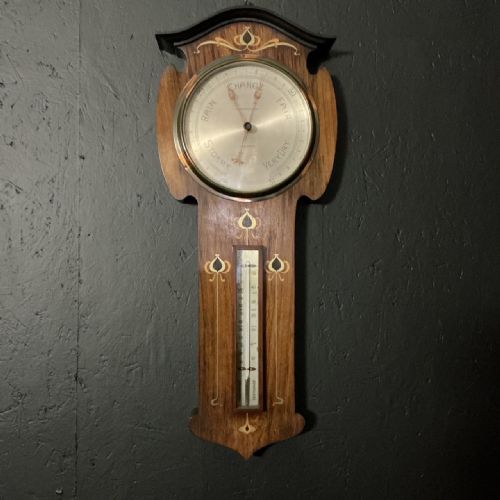


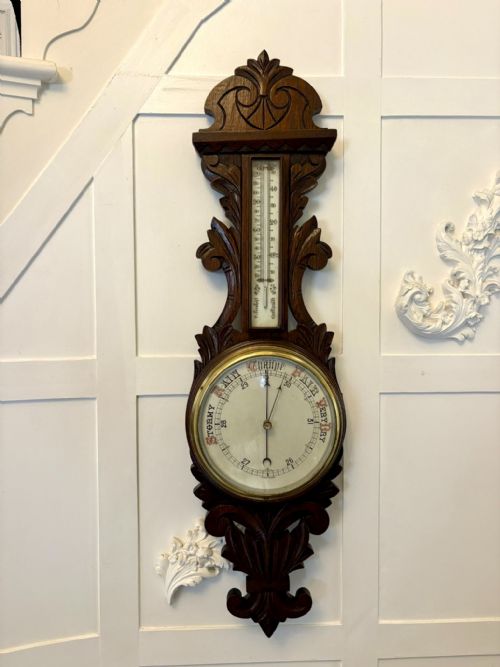


Oak Aneroid Weather Glass
An oak aneroid weather glass records atmospheric pressure through a sealed metal capsule, housed in timber that brings both utility and presence to a wall.
Oak Aneroid Weather Glass
When you search for an oak aneroid weather glass, you examine scientific instruments designed to measure atmospheric changes without the use of liquid mercury. These wall-hanging barometers often incorporate thermometers or chart drawers, combining practical meteorology with domestic furnishing.
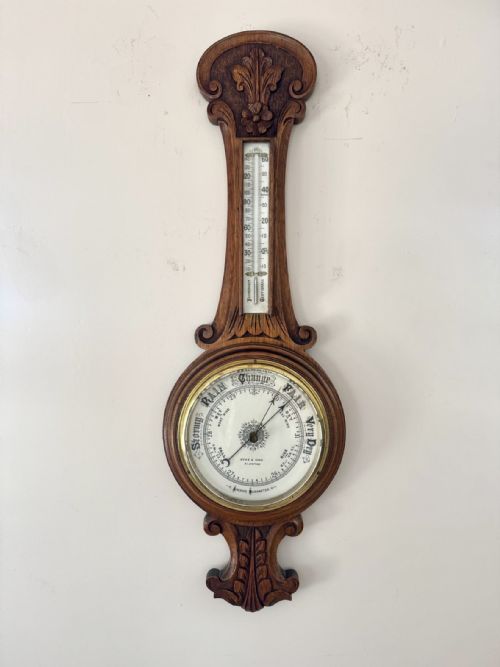
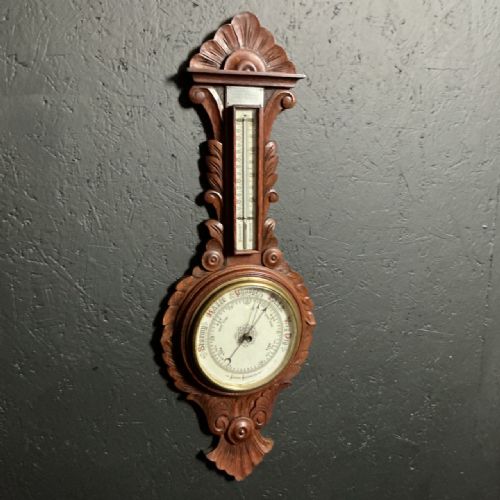
The pieces on this page span the Victorian and Edwardian eras, stretching from the mid-nineteenth century into the early twentieth century. You will frequently encounter carved timber banjo formats, geometric cases, and Black Forest variants alongside specialised barographs.
Makers such as Negretti & Zambra and James Pitkin signed these instruments, aligning precision mechanics with robust cabinet-making. The surviving examples demonstrate how households monitored approaching weather shifts through reliable mechanical dials.
Materials and Construction
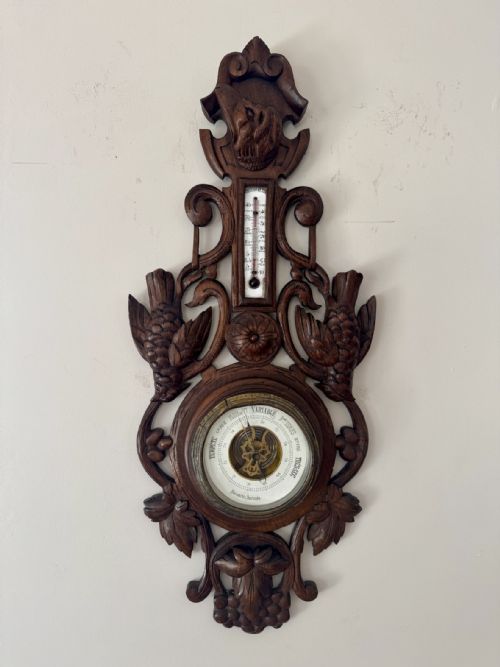
Cabinet makers utilised solid oak and carved wood to house the delicate brass mechanisms, occasionally incorporating bevelled glass to protect the porcelain or ceramic dials. The timber frames received detailed chisel work, particularly evident in the foliage and bird motifs found on Black Forest pieces.
Internal aneroid movements rely on a flexible metal vacuum capsule that expands or contracts with barometric shifts, linked directly to the indicator hand. This mechanism eliminates the need for hanging cisterns of liquid, allowing for compact wall mounting in domestic settings.
Some Victorian pieces feature carved birds peering down at the weather dial, as if keeping a permanent watch on the pressure.
Distinctions in Execution
The refinement of the wood carving distinguishes standard production from superior examples, with deep relief work and well-defined subjects indicating higher craftsmanship. Simpler circular frames contrast with elaborate banjo shapes that incorporate carved birds and geometric panelling.
Signed movements by established scientific instrument makers add authority to a piece compared to anonymous workshop output. The clarity of the ceramic or porcelain dial and the presence of integrated thermometers or chart drawers further elevate the standing of an individual instrument.
Hyde & Sons Sleaford·Negretti & Zambra·Baines Harrogate·W Watson & Sons·James Pitkin London
The Oak Aneroid Weather Glass Glossary
- Aneroid barometer
- A scientific instrument that measures atmospheric pressure using a flexible metal capsule rather than liquid mercury. The expansion and contraction of the sealed capsule moves the pointer across the dial.
- Barograph
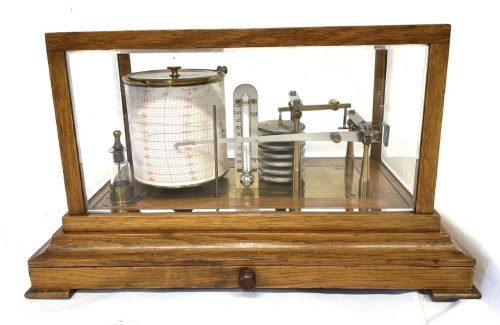
- A recording barometer that draws a continuous line of atmospheric pressure onto a rotating paper chart over a week. These housed units frequently include a drawer to store spare charts.
- Black Forest
- A style of wood carving originating from the mountain region in Germany, characterised by deep naturalistic foliage, animals, and birds. These carved frames often surround the barometer dial.
- Banjo barometer
- A wall-mounted weather glass shaped like the stringed instrument, featuring a circular dial at the top and an extended trunk that frequently houses a thermometer.
- Bevelled glass
- Glass with an angled edge polished around the perimeter, fitted into the brass bezel to protect the barometer face. This edge treatment adds depth and catches ambient light.
Oak Aneroid Weather Glass: Frequently Asked Questions
How does an aneroid barometer work?
An aneroid barometer measures changes in atmospheric pressure using a small, flexible metal box called an aneroid capsule, which has had the air partially removed. As the air pressure rises or falls, the capsule flexes inward or outward.
This physical movement connects through a series of delicate levers and springs to the pointer on the dial. Because it contains no liquid, the instrument can be mounted securely on a wall in any orientation.
What is the difference between a barometer and a barograph?
A standard barometer indicates the current atmospheric pressure through a single pointer moving across a marked dial face. It shows you the immediate reading at the moment you look at it.
A barograph adds a mechanical drum driven by a clockwork mechanism that records pressure changes onto a paper chart over seven days. This continuous ink trace allows you to view the pressure trend over time rather than just a snapshot.
Where should I hang a wall barometer?
Hang your barometer on an interior wall away from direct sunlight, radiators, and draughty doors. Sudden temperature fluctuations can affect the internal mechanical parts and alter the reading.
Ensure the wall fixing is secure, as these timber-cased instruments carry significant weight, particularly larger carved oak banjo models and barographs.
How do I date an oak barometer?
Dating relies on stylistic clues, case construction methods, and the signature of the maker inscribed on the dial or movement. Victorian pieces often feature heavy geometric carving or Black Forest motifs, while Edwardian examples can display lighter Arts and Crafts influences.
Checking the typography of the dial lettering and the presence of registered design marks also helps narrow down the period of manufacture.