

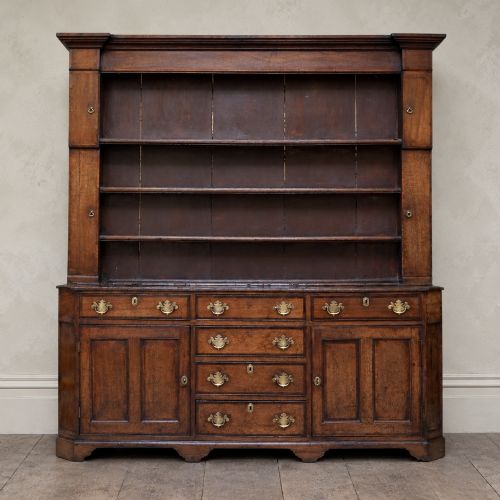
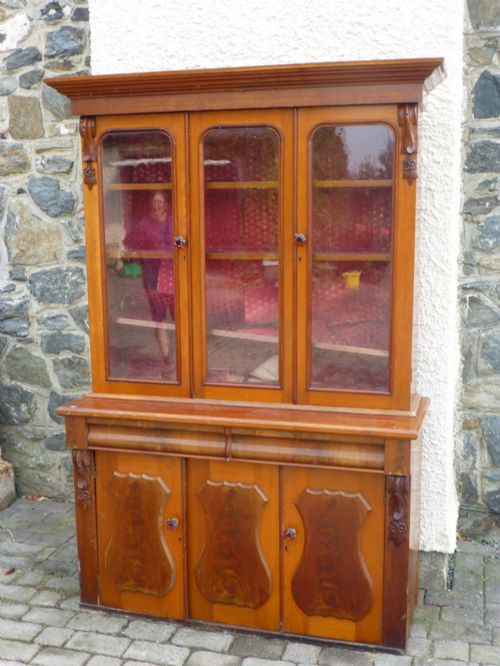
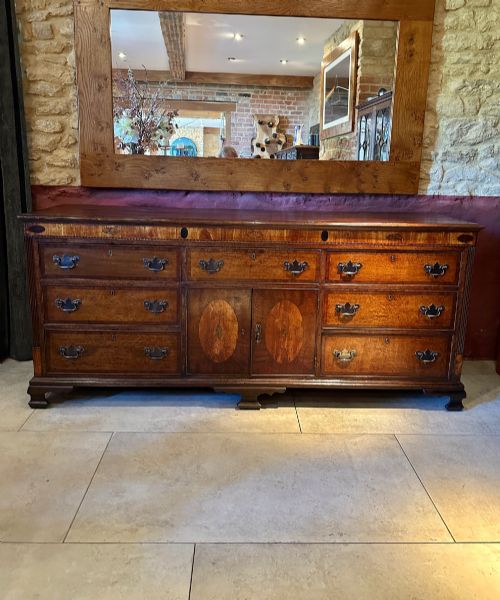


Oak and Mahogany Sideboard
These oak and mahogany sideboard examples combine robust country timbers with refined formal veneers, offering practical storage with distinct regional character.
Oak and Mahogany Sideboard
An oak and mahogany sideboard brings together the structural strength of sturdy oak carcases and the rich visual grain of mahogany veneers. Buyers seeking this combination often encounter robust vernacular forms alongside more polished formal serving furniture.
The pieces appearing under the banner of an oak and mahogany sideboard span several distinct eras, stretching from Georgian proportions through to Victorian interpretations. Forms range from heavy dresser bases and fitted kitchen cupboards to bow-fronted serving tables and mirrored cabinets.
Regional variations play a significant role in defining these items, with vernacular pieces showing distinct local cabinet-making traditions. Welsh and Lancashire workshops frequently utilised native timber frames alongside imported decorative veneers to create substantial storage units.
Materials and construction methods
Makers built the primary carcases and internal framing using durable timbers like oak and pine, ensuring long-term stability for heavy domestic use. Secondary timbers such as pine frequently appear inside drawer linings and backboards, reflecting standard workshop economy of the period.
Craftsmenship relied on contrasting the pale or warm medium-brown tones of solid oak with the deep reddish-brown hues of mahogany veneer. Crossbanding, stringing inlays, and brass hardware further enhanced the visual interplay between these two principal woods.
Oak and Mahogany Sideboard Retail Price Guide 2026
Typical asking prices for oak and mahogany sideboard among the pieces listed under this phrase on Sellingantiques today, from the lower quarter to the upper quarter. They describe what is for sale here now, not the wider market.
Secret drawers hidden behind faux book spines or within cornice mouldings occasionally wait to surprise anyone inspecting these old kitchen cupboards.
Distinguishing quality in construction
Superior examples demonstrate meticulous timber selection, where figured mahogany veneers align harmoniously across drawer fronts and cupboard doors. Inferior items often display clumsy timber matching or awkward proportions between the heavy oak framework and the decorative mahogany surface.
Original hardware and untouched secondary timbers elevate a piece well above those altered by modern restorations or replacement elements. The integration of crossbanding and inlay work reveals the relative skill and ambition of the original workshop.
The Oak and Mahogany Sideboard Glossary
- Crossbanding
- A border technique where narrow strips of veneer are laid perpendicular to the grain of the central panel. This frames the primary timber and adds a decorative geometric edge to drawer fronts and tabletops.
- Vernacular
- Furniture made by local regional craftsmen using traditional methods rather than adhering to metropolitan academic styles. These items often incorporate indigenous timbers suited to local building customs.
- Dresser base
- A low cabinet featuring drawers or cupboards, historically used for food preparation and storage before plate racks were added. They form the foundational lower section of many traditional kitchen dressers.
- Bow front
- A convexly curved front on a chest of drawers or sideboard that projects outward in a smooth arc. This curved design softens room angles and maximises internal storage capacity.
- Kneehole desk
- A compact writing table featuring a central recess for the legs, flanked by pedestals of smaller drawers. They provide a tidy workspace while maintaining a formal architectural presence.
Oak and Mahogany Sideboard: Frequently Asked Questions
What periods do these pieces date from?
The inventory spans the eighteenth and nineteenth centuries, taking in Georgian elegance, Regency refinement, and later Victorian revivals. Earlier examples often stem from regional vernacular traditions.
Later Victorian items introduce stylistic elements like Gothic Revival or Art Nouveau details while retaining the foundational mix of oak and mahogany.
How were these items used originally?
Kitchen dressers and sideboard bases served as central working hubs for storing tableware, linens, and provisions in large households. They combined surface prep space with deep drawer storage.
Serving tables and small side cabinets functioned in dining halls and formal reception rooms to hold silver, serving dishes, and drinks during gatherings.
How do I live with these pieces?
Their robust timber construction makes them exceptionally practical for modern living rooms, hallways, and dining spaces requiring substantial surface area and storage. They anchor a room with rich texture and historical depth.
Keep them away from direct heat sources and sudden humidity shifts to protect the mahogany veneers and traditional oak framing from warping.
How can I tell different styles apart?
Georgian and Regency designs favour clean architectural lines, symmetrical drawer arrangements, and subtle stringing inlay. They prioritise proportion and classic classical restraint.
Victorian and Gothic Revival pieces tend toward heavier mouldings, mirrored backs, or multi-wood constructions that showcase a more eclectic decorative approach.