

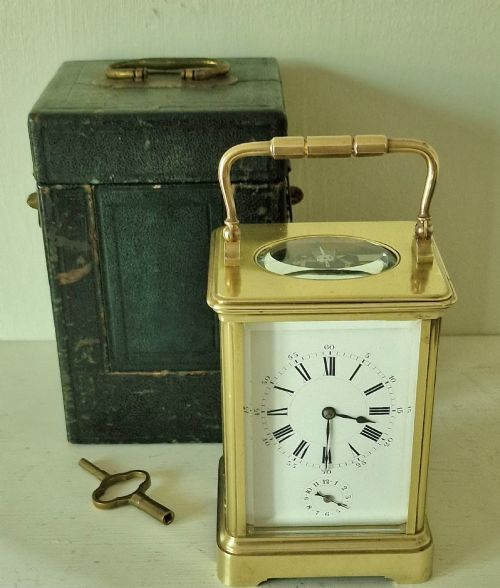


Nineteenth Century French Horology
Nineteenth century french horology brings together precision timekeeping and ornamental brass, enamel, and rosewood for the collector.
Nineteenth Century French Horology
When you search for nineteenth century french horology, you encounter portable and domestic timepieces originating from France during the eighteen hundreds. The selection is dominated by carriage clocks, alongside mantel clocks, wall clocks, and desk clocks.
Most examples date from the later decades of the century, spanning the eighteen sixties to nineteen hundred. These pieces range from simple platform escapement models to complex striking and repeating mechanisms housed in brass and glass cases.
Materials and construction
Brass, gilt bronze, and glass form the primary structure for the predominant carriage clocks on this page. Cases utilise heavy bevelled glass panels held within brass or gilt frames to display the movement within.
Internal components combine steel and brass, driven by coiled springs, while dials frequently employ white enamel with black Roman numerals. Cabinet pieces incorporate rosewood and marquetry wood alongside ormolu mounts.
Nineteenth Century French Horology Retail Price Guide 2026
Typical asking prices for nineteenth century french horology among the pieces listed under this phrase on Sellingantiques today, from the lower quarter to the upper quarter. They describe what is for sale here now, not the wider market.
The documented pieces span the nineteenth century, with particular concentration in the decades between eighteen sixty and nineteen hundred.
Factors that define quality
Quality rests upon the complexity of the movement and the finish of the case work. Examples with striking mechanisms, repeating functions, or calendars demonstrate higher manufacturing ambition than simple time-only models.
The refinement of the platform escapement and the inclusion of signed maker movements distinguish standard production pieces from workshop highlights. Heavy corniche or gorge brass cases indicate superior weight and material deployment.
C. Detouche Paris·Antoine Redier of Paris·Gontard & Bolviller Paris·Henry Marc·Drocourt·Holingue·Henry Jacot
The Nineteenth Century French Horology Glossary
- Carriage clock
- A portable spring-driven timepiece designed for travel during the nineteenth century. These clocks usually feature a glass-panelled brass case and a folding handle on top.
- Platform escapement
- The tiny horizontal spring and balance wheel assembly mounted visibly on top of the movement. It regulates the speed of the clock.
- Striking mechanism
- An internal gear train that sounds the hours and sometimes quarters on a bell or gong. This adds audible function to visual timekeeping.
- Repeater
- A mechanism operated by pushing a button on the case to repeat the last struck hour or quarter on demand. It allows time reading in the dark.
- Corniche
- A traditional rectangular brass carriage clock case style featuring moulded top and bottom framing. It is one of the most frequently encountered housing designs.
- Gorge
- A stepped or tiered brass carriage clock case profile. This design adds architectural depth to the upper and lower borders of the glass panels.
Nineteenth Century French Horology: Frequently Asked Questions
How do I wind a carriage clock?
Insert the winding key into the arbour socket located on the base or backplate of the movement. Turn it gently clockwise until you feel resistance, taking care not to over-wind the mainspring.
For clocks with striking or alarm trains, remember to wind both arbours if the movement has multiple trains. Keep the original key with the clock where possible to avoid damaging the square arbour pins with incorrect tools.
What is the difference between a striking and a repeating clock?
A striking clock sounds the hours automatically as they pass using an internal hammer and gong or bell. This happens without user intervention.
A repeater includes an additional mechanism activated by pressing a button on the top or side of the case. This action causes the clock to sound the most recent hour or quarter immediately on demand.
Where were carriage clocks placed originally?
These timepieces were made for travellers during the nineteenth century, designed to sit securely in carriages or hotel rooms. The folding handle facilitated safe transport between locations.
Over time, many transitioned into domestic desk and mantel use within Victorian homes. Their portable nature allowed owners to move them easily between rooms.