



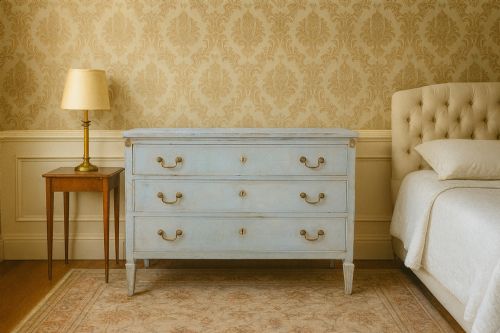


Neoclassical Style Chest
A neoclassical style chest brings architectural symmetry and refined proportion into a room, offering practical storage through disciplined classical design.
Neoclassical Style Chest
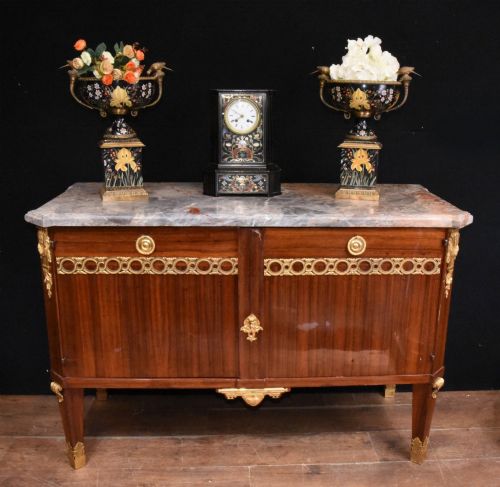
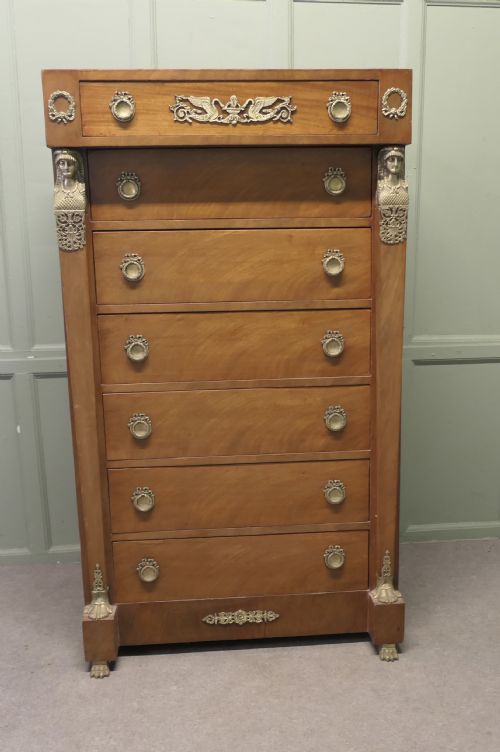
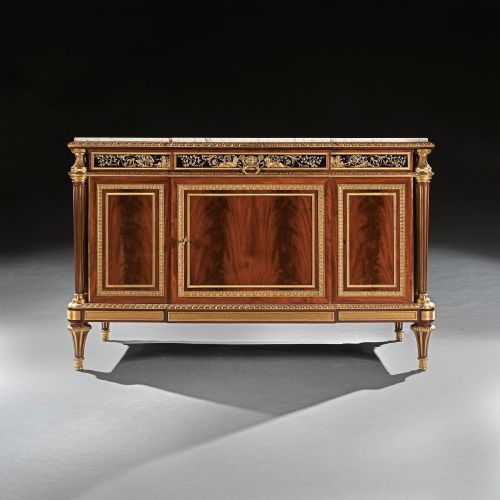
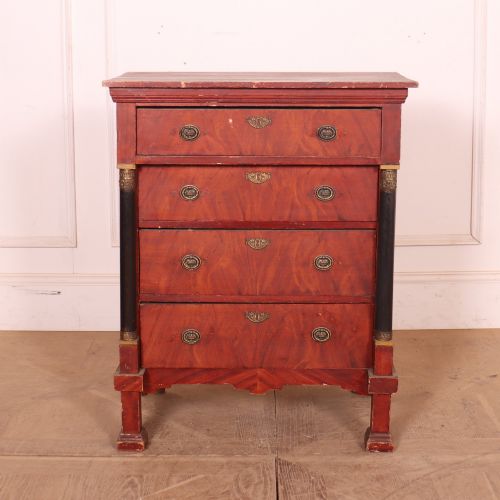
A neoclassical style chest draws upon classical antiquity, presenting structured forms like commodes, chests of drawers, and bedside tables that rely on clean lines and balanced proportions. These pieces emerge across the eighteenth and nineteenth centuries, alongside twentieth-century revivals, reflecting European centres such as France, Italy, Sweden, Holland, and Austria.
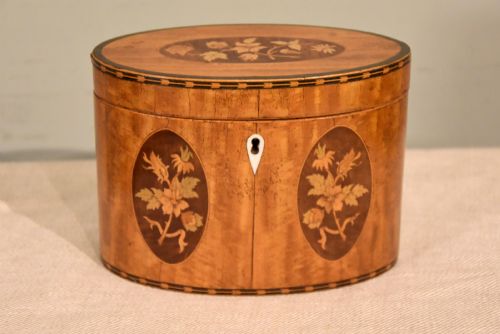
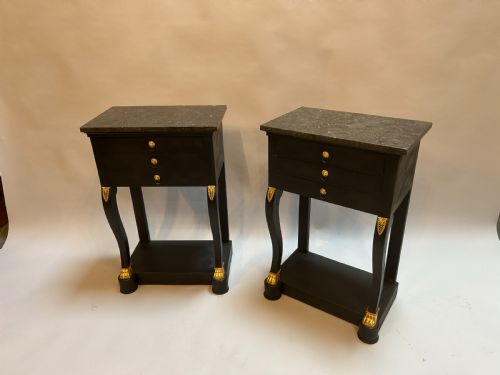
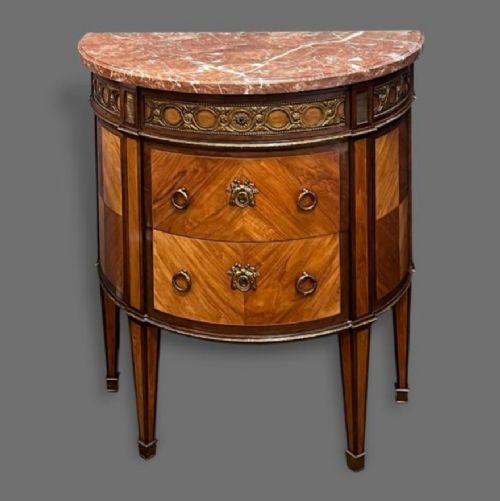
The most common form on this page is the commode or chest of drawers, often featuring marble tops, serpentine or breakfront shapes, and fitted drawer arrangements. Alongside standard chests, the selection includes related bedside tables, tea caddies, benches, and wine coolers sharing the same classical lineage.
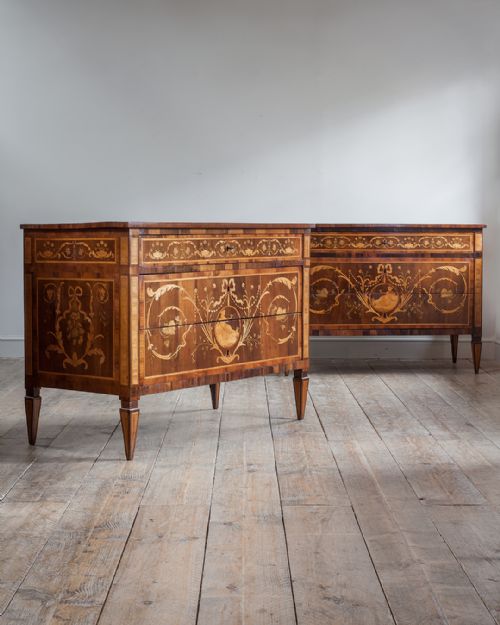
Regional variations shape these pieces significantly, from the light painted surfaces of Swedish Gustavian models to the rich veneers of French Empire, Dutch, and Italian examples. Walnut, satinwood, mahogany, and birch provide the primary carcasses, decorated with paint, parquetry, or marquetry.
Materials and construction
Cabinetmakers built the carcasses of these chests using timbers like walnut, mahogany, satinwood, birch, and fruitwood, frequently applying detailed parquetry or intricate veneer patterns across the drawer fronts and sides. Pine and oak served for internal framing and secondary drawer linings, ensuring structural stability for the heavy carcasses.
Surface ornamentation relied heavily on polished marble tops, gilded or chased ormolu mounts, and painted finishes in muted tones. Inlaid stringing and contrasting exotic woods defined the geometric panels, while cast brass handles and escutcheons secured the functional operation of the drawers.
Neoclassical Style Chest Retail Price Guide 2026
Typical asking prices for neoclassical style chest among the pieces listed under this phrase on Sellingantiques today, from the lower quarter to the upper quarter. They describe what is for sale here now, not the wider market.
Listings feature neoclassical style chests spanning the eighteenth, nineteenth, and early twentieth centuries, constructed from walnut, satinwood, paint, and marble.
Judging quality in execution
The distinction between tiers rests upon the precision of the cabinetwork, visible in the tightness of the veneer joints, the crispness of the hand-carved or cast ormolu mounts, and the integration of the marble top. Superior examples demonstrate a careful selection of grain patterns that match symmetrically across the front of the chest.
The refinement of secondary details, such as hand-cut dovetailing inside the drawer boxes and the weight of the cast brass hardware, separates standard production from exceptional pieces. The handling of painted surfaces or the depth of the marquetry inlay further indicates the skill of the workshop.
Henry Dasson·Weisweiler·Riesener
The Neoclassical Style Chest Glossary
- Commode
- A low chest of drawers, often featuring decorative mounts and a marble top. This form originated in France and remains central to continental furniture design.
- Ormolu
- Gilded bronze used for decorative mounts, feet, and keyhole escutcheons. It provides metallic contrast against dark woods and painted surfaces.
- Parquetry
- Geometric patterns formed by small pieces of wood veneer fitted together. It decorates the flat surfaces of many continental chests.
- Serpentine
- A curved line that sweeps inward at the centre and outward at the ends. This profile appears frequently on the fronts of Italian and French commodes.
- Gustavian
- The Swedish interpretation of neoclassical design, characterised by pale painted finishes and restrained classical detailing. These pieces date primarily from the late eighteenth century and nineteenth-century revivals.
Neoclassical Style Chest: Frequently Asked Questions
What is a neoclassical style chest?
A neoclassical style chest is a storage piece influenced by the art and architecture of classical Greece and Rome, prioritising symmetry, straight lines, and balanced proportions over ornate curves.
These pieces typically manifest as commodes, chests of drawers, or bedside tables, constructed from woods like walnut, satinwood, and mahogany, often finished with marble tops and bronze mounts.
Where were these chests made?
These chests originate from various European countries, including France, Italy, Sweden, Holland, and Austria. Each region developed distinct characteristics, such as the painted finishes of Swedish workshops or the rich veneers of French cabinetmakers.
Craftsmen adapted classical motifs to local tastes, resulting in distinct stylistic sub-categories like Gustavian, French Empire, and Dutch neoclassical designs.
How do I style a neoclassical chest?
A neoclassical chest works well as a focal point in a living room, hallway, or bedroom, where its architectural lines and surface materials can stand out. Pairing the piece with simple, contemporary decor allows the historic veneers, ormolu mounts, and marble tops to command attention without visual competition.
The flat surfaces provide practical space for lamps, art objects, or mirrors, maintaining the balanced aesthetic characteristic of the period.
How do I tell different periods apart?
Differentiating periods relies on examining the construction methods, timber selections, and decorative vocabularies employed by the maker. Eighteenth-century pieces generally show hand-cut joinery and period-specific veneer techniques, whereas nineteenth-century revival items often incorporate machine assistance or reinterpret earlier styles like the French Empire.
Regional finish details, such as eighteenth-century paint layers on Swedish pieces compared to later revival coats, also provide chronological markers.