


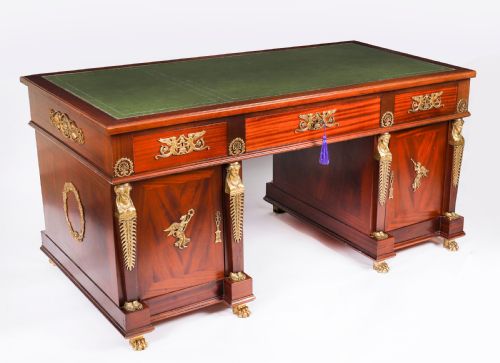


Neoclassical Office Desk
A neoclassical office desk brings architectural symmetry and refined proportion to a workspace through classical mounts and rich timbers.
Neoclassical Office Desk
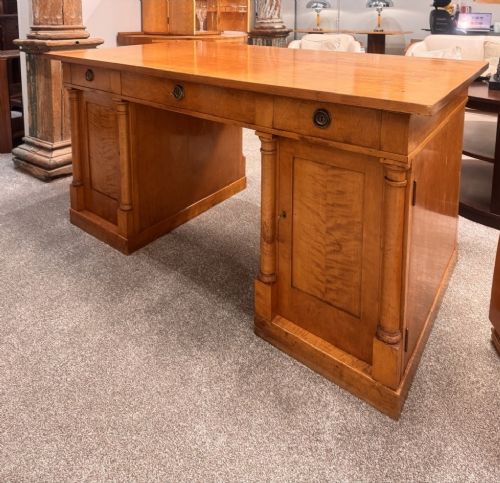
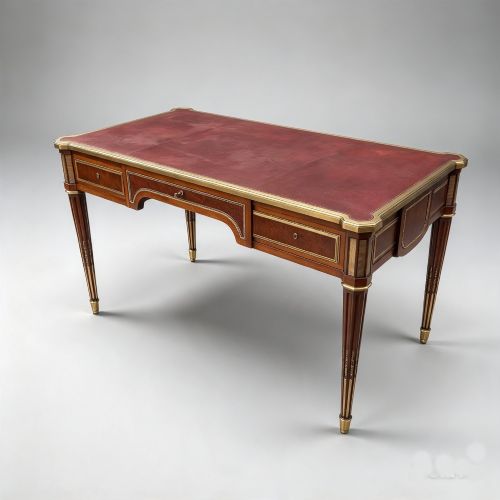
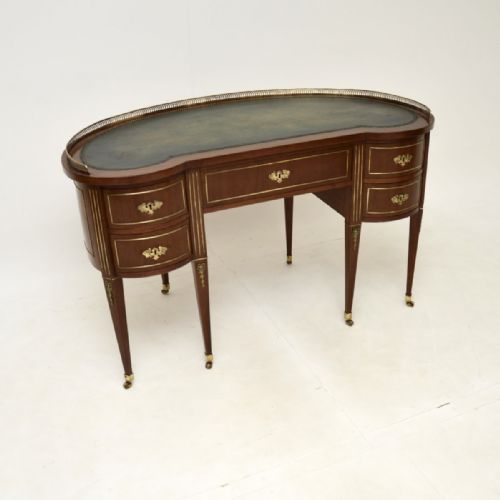
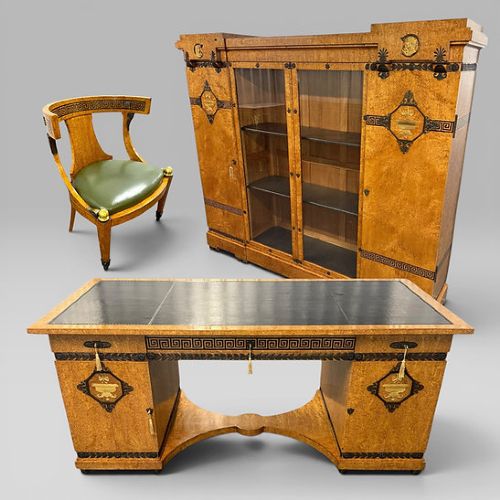
A neoclassical office desk gathers writing tables, pedestal desks, and bureau plat forms executed in styles ranging from French Empire and Louis XVI to Sheraton Revival and Austrian Empire. These pieces combine functional workspace surfaces with classical decorative vocabularies drawn from historical antiquity.
The version most commonly met on this page is the nineteenth century French Empire or revival pedestal desk, typically fitted with a leather writing surface and mounted in gilt bronze or ormolu. Alongside these stand matching desk chairs and library armchairs in mahogany, birch, and satinwood.
How they were made
Construction relies upon dense hardwoods such as mahogany, walnut, birch, and satinwood, frequently paired with inset leather writing surfaces and cane or velvet upholstery on accompanying seating. Cabinetmakers shaped these timbers into pedestals, writing tables, and specialised forms like the Carlton House desk.
Decorative enrichment is achieved through cast brass, gilt bronze, and ormolu mounts applied to structural angles, drawer fronts, and friezes. Painted finishes also appear on specific regional examples from Sweden.
Neoclassical Office Desk Retail Price Guide 2026
Typical asking prices for neoclassical office desk among the pieces listed under this phrase on Sellingantiques today, from the lower quarter to the upper quarter. They describe what is for sale here now, not the wider market.
Some desks come accompanied by a matching fauteuil du bureau designed for sitting comfortably while issuing imperial decrees.
What varies in quality
Quality rests upon the crispness of the cast bronze or ormolu mounts and the precision with which they integrate into the wooden structure. Finer examples display deeply chased metalwork and meticulously selected timber veneers.
The integrity of the original leather writing surface and the structural joinery of the pedestal or writing table further distinguish superior pieces from standard workshop output.
Mercier Frères
The Neoclassical Office Desk Glossary
- Bureau plat
- A freestanding writing table with a rectangular top and drawers in the frieze, developed in France during the seventeenth century. These tables lack pedestals and rely on slender legs.
- Ormolu
- Gilded bronze applied to furniture as decorative mounts and feet. The technique involves coating metal in a gold amalgam and firing it.
- Pedestal desk
- A heavy freestanding desk comprising two supporting pedestals of drawers beneath a top surface. They provide substantial storage capacity.
- Carlton House desk
- A form of writing desk featuring a fitted superstructure of small drawers and compartments arranged in a curve around the back and sides of the writing surface. The configuration offers numerous pigeonholes.
- Frieze
- The middle horizontal member of a classical entablature, often adapted on desks to house one or more shallow drawers beneath the writing surface.
Neoclassical Office Desk: Frequently Asked Questions
What is a bureau plat?
A bureau plat is a freestanding writing table featuring a rectangular top and drawers integrated into the frieze.
Unlike pedestal desks, these tables stand on four legs and offer a lighter visual profile within a room.
How do I care for the leather top?
Leather writing surfaces require gentle cleaning with a slightly damp cloth and occasional application of appropriate leather cream.
Avoid excessive moisture and direct sunlight to prevent cracking and fading over time.
What woods were commonly used?
Cabinetmakers utilised dense timbers including mahogany, walnut, satinwood, and birch for framing and veneering.
These woods provided a stable foundation for applied ormolu mounts and polished finishes.
How do I identify Empire style?
Empire style pieces display architectural symmetry, rectilinear forms, and classical bronze or ormolu mounts.
Design motifs draw heavily from ancient Roman and Greek ornament.