





Neoclassical Mantel Garniture
These neoclassical mantel garniture sets bring classical balance to a room, pairing a central timepiece with matching decorative vases, urns, or candelabras.
Neoclassical Mantel Garniture
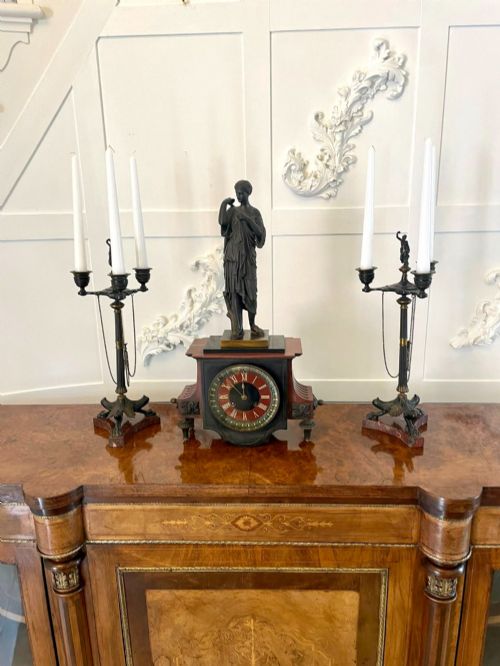
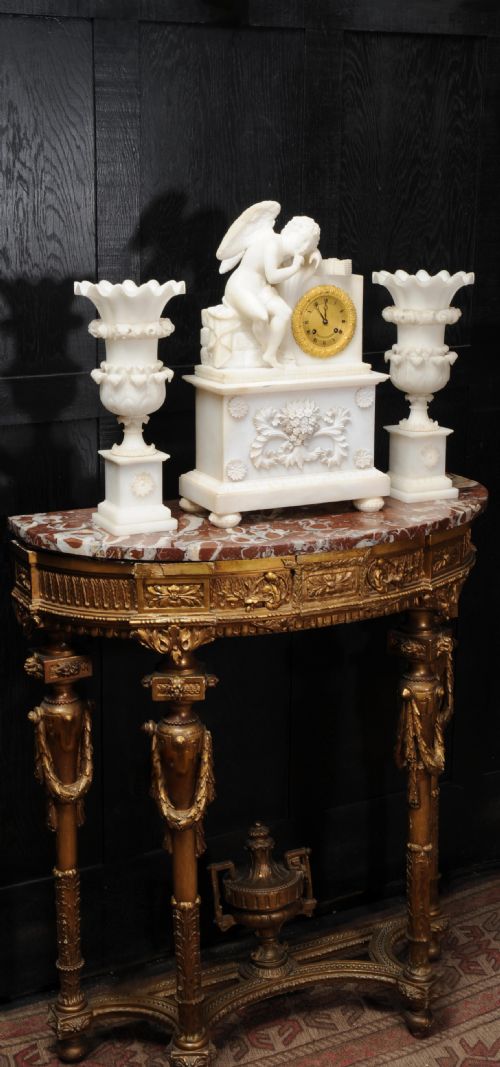
A neoclassical mantel garniture comprises a central timepiece accompanied by matching side pieces such as urns, vases, candelabras, or cassolettes. These coordinated sets are designed to sit harmoniously upon a fireplace mantel or console table, creating a balanced decorative display.
The pieces appearing here span from the eighteenth century through the Victorian era, heavily drawing upon French Louis XVI, Regency, and French Empire styles. You will frequently encounter three-piece sets featuring marble bodies mounted with metalwork.
Makers such as AD Mougin Paris and Ferdinand Berthoud contribute to the heritage of these objects, which often utilise white, sienna, or porphyry marble paired with patinated bronze.
How they were made
Gilding, chasing, and founding define the metal elements of these garnitures, utilising materials such as ormolu, gilt bronze, gilt metal, and brass. Artisans cast intricate neoclassical motifs in bronze before applying mercury gilt or polished finishes to highlight architectural details.
Marble working forms the structural core of many pieces, requiring precise stone-cutting for white marble, alabaster, sienna marble, and porphyry plinths or urn bodies. Enamel dials and fine porcelain components further complete the complex assembly of these multi-part sets.
Neoclassical Mantel Garniture Retail Price Guide 2026
Typical asking prices for neoclassical mantel garniture among the pieces listed under this phrase on Sellingantiques today, from the lower quarter to the upper quarter. They describe what is for sale here now, not the wider market.
Some garnitures include cupid figures after Etienne Maurice Falconet, adding a touch of romance to the rigid geometry of neoclassical marble.
What varies in quality
The crispness of the bronze chasing and the depth of the ormolu gilding distinguish superior examples from simpler productions. Finer garnitures exhibit deeply articulated classical foliage, precisely fitted marble elements, and robust mechanical movements signed by established makers.
The integration of the side pieces with the central clock determines the visual cohesion of the set. High-tier works maintain uniform patination and harmonious stone selection across all components, whereas standard pieces show greater variation in material matching.
AD Mougin Paris·Ferdinand Berthoud
The Neoclassical Mantel Garniture Glossary
- Garniture
- A set of ornamental objects designed to match and be displayed together on a mantelpiece. It typically consists of a central clock flanked by two vases, urns, or candelabras.
- Cassolette
- A decorative vessel that doubles as a burner for perfumes, featuring a reversible lid with a solid side and a pierced side. They frequently appear in marble and ormolu within neoclassical sets.
- Ormolu
- Gilded bronze produced by applying a mercury and gold amalgam to a bronze base and heating it. This technique yields a durable, rich golden surface characteristic of fine period metalwork.
- Porphyry
- An igneous rock with large crystals embedded in a fine-grained groundmass, typically deep purple or red in colour. It was prized in antiquity and reused in neoclassical decorative arts.
- Ewer
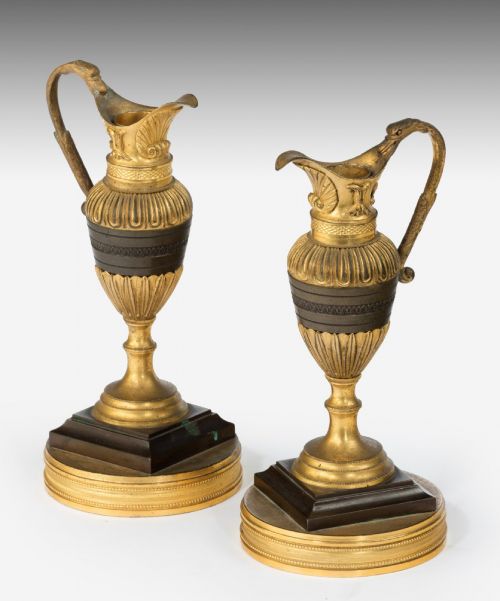
- A large jug with a wide spout and a curved handle, often rendered in bronze or marble as a decorative garniture element. These vessels mimic classical Greek and Roman water carriers.
Neoclassical Mantel Garniture: Frequently Asked Questions
How do you style a garniture set?
Place the central clock in the exact centre of the mantelpiece to anchor the display. Position the matching urns, vases, or candelabras symmetrically on either side to complete the balanced neoclassical composition.
Ensure the objects have adequate clearance from heat sources and foot traffic to protect delicate marble and gilt surfaces.
What materials were used?
Neoclassical garnitures rely heavily on natural stones such as white marble, sienna marble, alabaster, and porphyry for their main bodies and plinths. These stone elements are combined with cast metals like bronze, ormolu, brass, and gilt metal.
Additional details often incorporate enamel for clock faces and occasionally porcelain for decorative lidded vases.
How do I identify the period?
Examine the styling cues, such as Louis XVI, French Empire, or Regency motifs, alongside the construction of the clock movement and the type of marble utilised. Eighteenth-century pieces often feature hand-chased ormolu and early mechanical signatures.
Later Victorian interpretations adapt these classical French aesthetics with varied brass mounts and machine-finished details.