


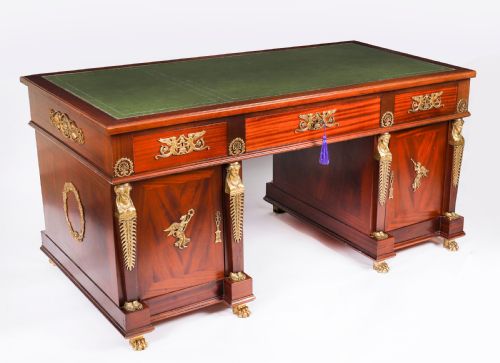


Neoclassical Executive Desk
A neoclassical executive desk commands the room with architectural precision, offering disciplined grandeur and grand proportions for the serious study.
Neoclassical Executive Desk
A neoclassical executive desk represents a grand synthesis of classical antiquity and functional workspace design, drawing upon centuries of revivalist taste. These pieces most frequently emerge from French, Austrian, and English workshops spanning the Georgian, Regency, and nineteenth century periods.
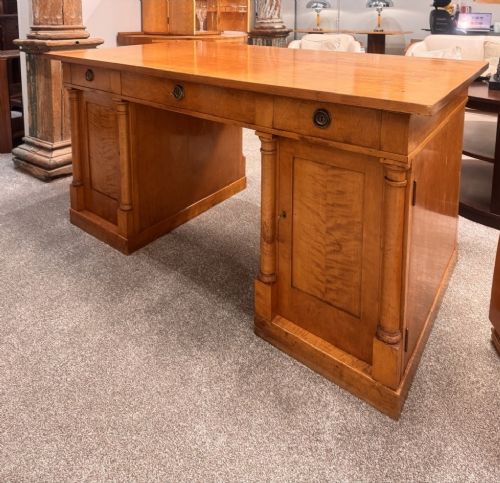
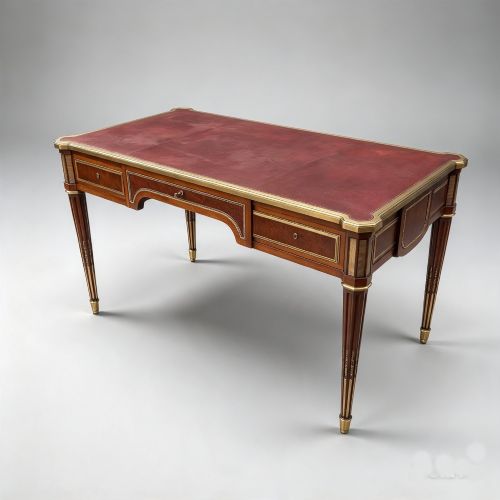
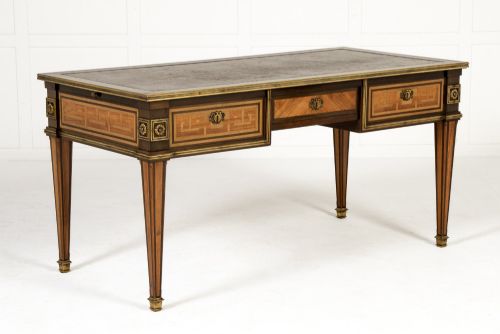
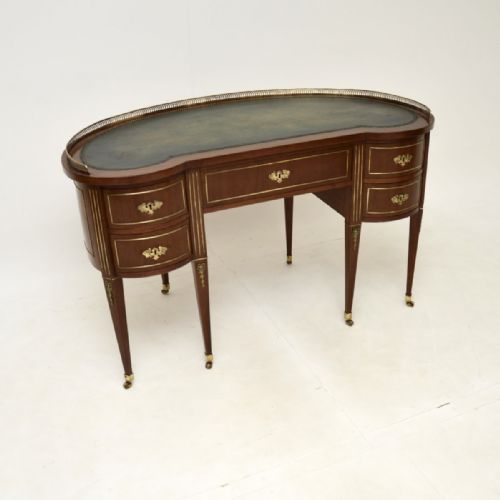
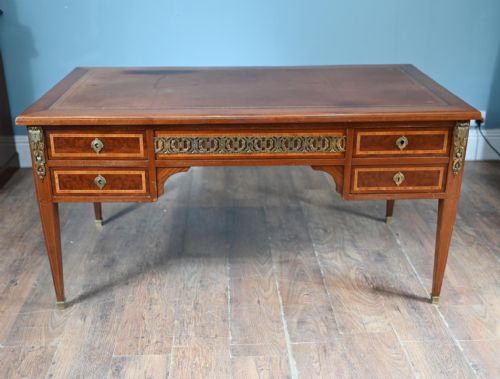
The primary forms on this page include the bureau plat, the pedestal desk, and accompanying library tables. They are built to command a room, offering generous writing surfaces paired with disciplined architectural lines.
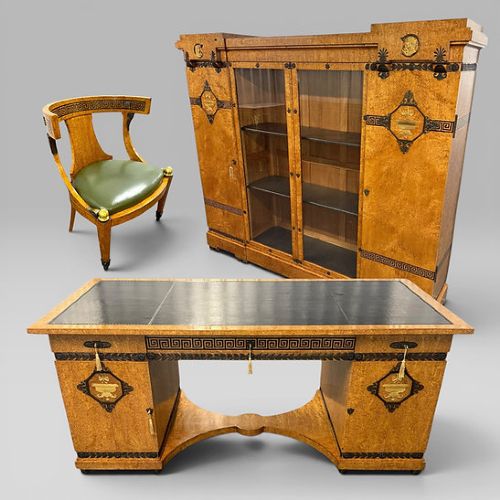
Buyers will encounter distinct regional interpretations, ranging from the restrained symmetry of French Directoire and Louis XVI models to the bolder military influence of Empire styles. Mahogany and walnut provide the structural foundation for these imposing pieces of furniture.
Materials and Construction
Makers utilised dense timbers such as mahogany, walnut, birch, and satinwood as the foundational carcass, often framing them with finely tooled leather writing inserts. These woods were selected for stability and grain movement, ensuring the large top surfaces remained flat under heavy daily use.
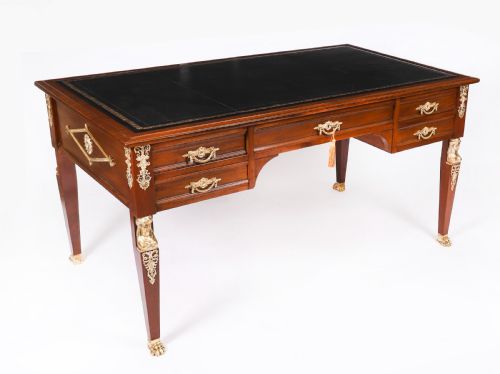
Cast and chased ormolu and gilt bronze mounts define the ornament, applied rigorously to corners, friezes, and drawer surrounds to accentuate the structural geometry. Brass hardware frequently secures the drawers and protects the vulnerable feet from floor wear.
Neoclassical Executive Desk Retail Price Guide 2026
Typical asking prices for neoclassical executive desk among the pieces listed under this phrase on Sellingantiques today, from the lower quarter to the upper quarter. They describe what is for sale here now, not the wider market.
Listings feature nineteenth-century French and Austrian pieces alongside Georgian and Regency examples, constructed from mahogany, walnut, and birch.
Evaluating the Workmanship
Quality rests upon the crispness of the cast bronze or ormolu mounts and the precision with which they are fitted to the timber carcass. Superior examples display deep, sharp chasing in the metalwork rather than soft, repetitive casting.
The selection of cabinet timbers and the integrity of the secondary woods inside the drawers reveal the maker's commitment to durability. Finer desks demonstrate seamless veneer matching and substantial brass locking mechanisms that operate with smooth resistance.
Mercier Frères·Henry Dasson·Richard Bridgens
The Neoclassical Executive Desk Glossary
- Bureau plat
- A freestanding writing table fitted with drawers across the frieze, designed to sit in the centre of a room rather than against a wall.
- Ormolu
- Gilt bronze ornamentation applied to furniture, created by mercury gilding cast bronze components to achieve a brilliant, lasting metallic lustre.
- Pedestal desk
- A large, heavy form comprising two independent stacks of drawers supporting a shared top surface, sometimes known as a partner's desk when fitted on both sides.
- Satinwood
- A luminous, fine-grained exotic timber utilised for contrasting veneers and delicate inlay work on high-status neoclassical case furniture.
- Fauteuil de bureau
- An upholstered desk chair designed to match the architectural style and wood finishes of the primary writing furniture.
Neoclassical Executive Desk: Frequently Asked Questions
What is a bureau plat?
A bureau plat is a rectangular writing table featuring one or more rows of drawers beneath the top surface. It is traditionally finished on all sides so it can float in the middle of a room.
These pieces served as administrative centres for statesmen and writers, prioritising surface area and legroom over bulky enclosed cabinetry.
How do I care for leather desk tops?
Leather writing surfaces require gentle cleaning with a slightly damp cloth and occasional treatment with specialist leather balms to prevent cracking. Avoid harsh chemical cleaners and direct sunlight.
Protective blotters help preserve the original gold tooling along the perimeter edges from daily wear and friction.
Where were these desks placed?
They were historically positioned in the centre of private studies, libraries, or grand offices where the owner could receive guests. Their finished backs allowed them to be viewed from any angle within a large room.
Today, they function similarly in executive home offices or spacious studies as both workspace and statement furniture.
How do I identify Empire style pieces?
Empire style furniture is characterised by heavy classical motifs, symmetrical designs, and extensive use of cast ormolu mounts depicting military trophies, swans, or laurel wreaths. The timber is often dark mahogany contrasted against bright gilded bronze.
These designs emerged during the early nineteenth century across France and Austria, drawing direct inspiration from ancient Roman and Greek archaeology.