


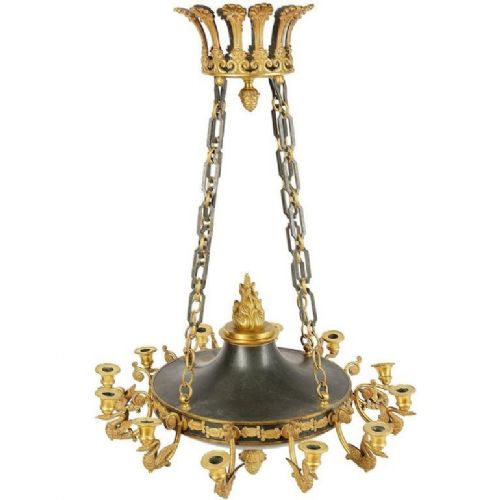

Neoclassical Bronze Chandelier
These neoclassical bronze chandeliers bring architectural symmetry and classical form to a room through balanced proportions and crisp cast ornament.
Neoclassical Bronze Chandelier
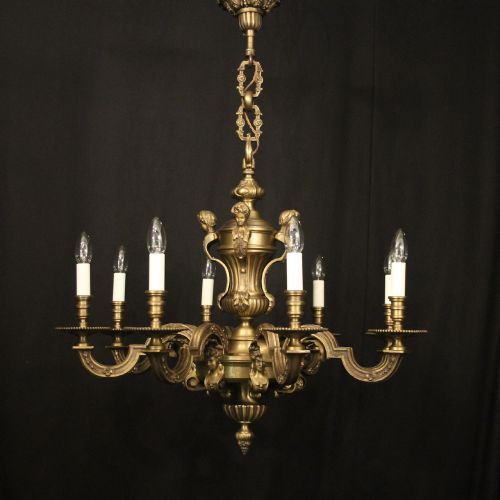
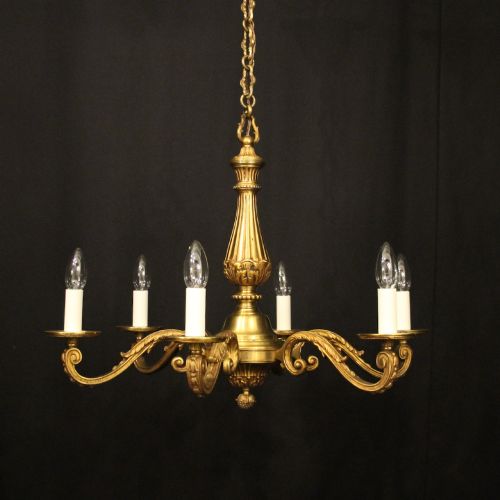
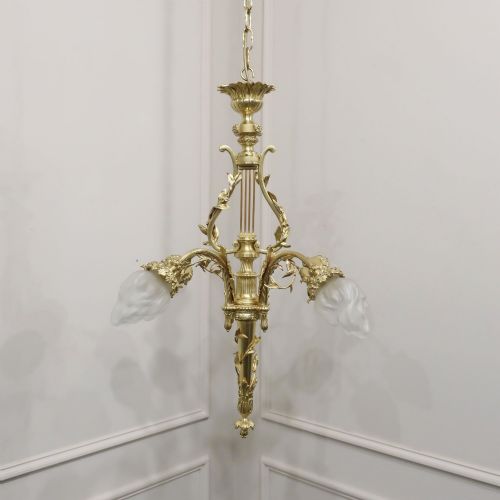
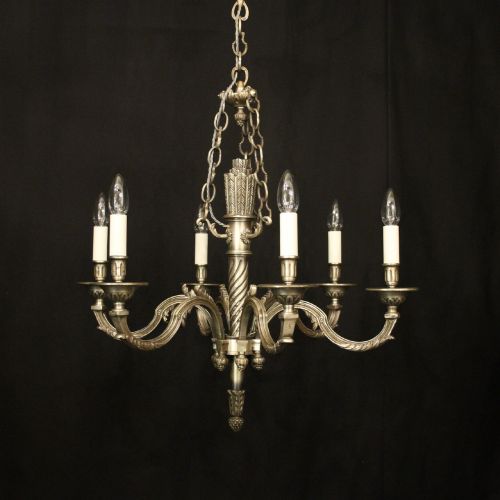
A neoclassical bronze chandelier provides commanding overhead illumination while anchoring a room with classical ornament drawn from the 19th century and early 20th century. Buyers searching this phrase will most frequently encounter French chandeliers featuring six to nine lights, alongside pendant lanterns and double-tiered configurations.
The aesthetic draws heavily on French Neoclassical, French Empire, and Louis XVI Revival styles. Pieces span from the 19th century through the 1920s and 1930s, often incorporating lyre motifs, hexagonal geometries, and classical architectural detailing.
How they were made
Makers utilised cast bronze, brass, and metal as the structural foundation for these fixtures. Molten metal was poured into detailed moulds to create crisp decorative elements before assembly.
Surfaces were finished through gilding, ormolu application, silver gilding, or patination to achieve distinctive golden, silvered, or dark bronze tones. These treatments highlighted the relief work on arms, bands, and central stems.
One extraordinary hexagonal lantern is specifically noted as being after the lanterns in the Palace of Versailles.
What varies in quality
The crispness of the casting marks the division between standard production and superior execution, particularly in the rendering of acanthus leaves, classical figures, and geometric mounts. Sharper relief work and clean chasing reveal the hand of a more skilled metalworker.
Surface treatments also distinguish pieces, with heavy fire gilding or dense ormolu retaining a warmer, deeper lustre than lighter metallic finishes. The complexity of the armature, such as double-tiered frames or multi-arm configurations, dictates the ambition of the design.
The Neoclassical Bronze Chandelier Glossary
- Ormolu
- Gilded bronze produced by applying a mercury-gilding paste to cast bronze before firing. This technique creates a rich, matte gold surface characteristic of fine classical lighting.
- Patinated bronze
- Metal treated with chemical solutions to darken the surface tone. This process accentuates the underlying contours and creates contrast against gilded mounts.
- Lyre chandelier
- A lighting fixture shaped around the symmetrical silhouette of a stringed musical instrument. This motif is frequently seen in French neoclassical designs.
- Colza hanging light
- A specialised suspension lamp engineered to burn colza oil before the widespread adoption of electricity. These fixtures often feature heavy bronze reservoirs and sophisticated burner assemblies.
- Louis XVI Revival
- A decorative movement looking back to the 18th-century reign of Louis XVI. It emphasises straight lines, classical symmetry, and restrained architectural ornament.
Neoclassical Bronze Chandelier: Frequently Asked Questions
How do I date a neoclassical bronze chandelier?
Dating relies on examining the casting methods, wiring channels, and stylistic cues present in the metalwork. Pieces span the 19th century through the 1930s, with revival periods often borrowing earlier motifs.
Closer inspection of suspension loops, socket types, and surface patination helps differentiate nineteenth-century examples from early twentieth-century interpretations.
Are these chandeliers suitable for low ceilings?
Most multi-arm fixtures and pendant lanterns require adequate vertical clearance to hang properly without dominating the space. Standard configurations are best suited for rooms with substantial ceiling heights.
Checking the overall drop from the ceiling rose to the lowest point of the frame ensures proper placement above furniture or open floor areas.
What is the difference between ormolu and gilt bronze?
Ormolu specifically refers to historical mercury gilding on bronze, producing a distinctive matte gold finish. Gilt bronze is a broader term encompassing various methods of applying gold leaf or plating to a bronze base.
Both finishes were utilised across French neoclassical lighting to provide a durable, luminous surface that reflected candlelight effectively.
How are multi-tiered chandeliers supported?
Double-tiered and larger multi-light chandeliers rely on robust central stems and heavy-duty ceiling fixings to bear the combined weight of the bronze armature. Professional installation is essential to anchor the fixture securely into ceiling joists.
The weight varies depending on whether the primary material is cast bronze, brass, or heavier ormolu mounts.