





Navy and Rust Rug
A navy and rust rug brings deep indigo and earthy red tones together, grounding a room with enduring Persian style.
Navy and Rust Rug
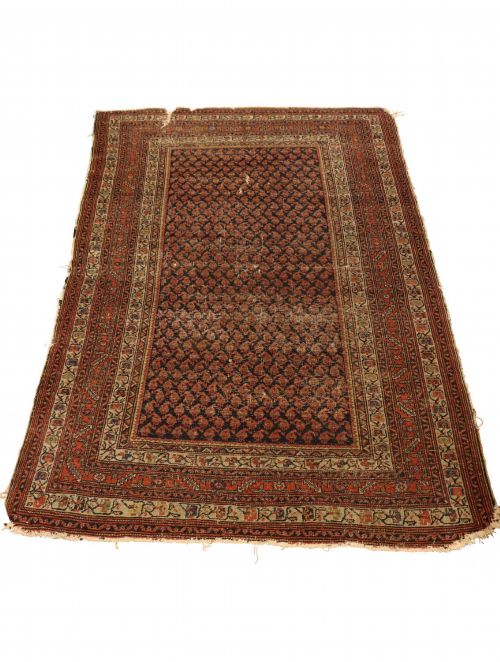
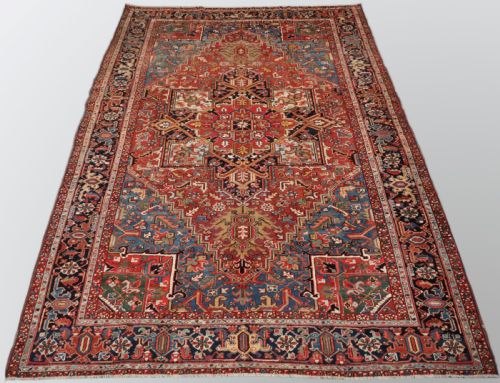
A navy and rust rug draws on a rich palette of deep blues and reddish-browns, most often found in traditional Persian carpets and village weaving traditions. When searching for a navy and rust rug, buyers frequently encounter pieces originating from Heriz, Karaja, Sarouk, and Baluch workshops.
The selection ranges from room-sized carpets dating back to the late nineteenth century down to smaller tribal rugs produced into the nineteen-twenties. These floor coverings rely on time-honoured motifs, including geometric medallions, boteh patterns, and all-over floral variants.
How they were made
These floor coverings are constructed primarily from hand-knotted wool pile secured on cotton foundations. Artisans tied individual knots by hand, creating dense surfaces designed to withstand heavy foot traffic over generations.
Dyes derived from natural sources yielded the characteristic deep indigo and rust hues seen across these pieces. The combination of sturdy wool and tight knotting ensures the structural integrity of each carpet.
Navy and Rust Rug Retail Price Guide 2026
Typical asking prices for navy and rust rug among the pieces listed under this phrase on Sellingantiques today, from the lower quarter to the upper quarter. They describe what is for sale here now, not the wider market.
Nomadic weavers sometimes worked outdoors in the dust, leaving tiny fragments of desert sand permanently trapped deep inside the wool pile.
What varies in quality
Quality rests in the precision of the knotting and the clarity of the design work, where finer village and city carpets display sharper geometric and floral lines. The depth and saturation of the natural dyes also set superior examples apart.
Scale and proportion dictate value, as large room-sized carpets require considerably more labour and planning than smaller tribal formats. The overall balance of the navy ground against the rust detailing determines visual impact.
The Navy and Rust Rug Glossary
- Heriz
- A region in northwest Persia known for producing large carpets with bold geometric medallions and strong rust and navy colourways. These pieces often feature durable wool and robust foundations.
- Boteh
- A stylised almond or paisley motif representing a bush or floral spray, frequently repeated across traditional Persian fields. It appears in many nineteenth-century village and tribal weaves.
- Baluch
- A term for rugs woven by nomadic or semi-nomadic groups, typically featuring darker palettes, geometric repeats, and wool construction. They originate from the border regions of Persia and surrounding areas.
- Sarouk
- A village and district in central Persia famous for finely knotted carpets with dense floral sprays and rich reddish tones. They often utilise cotton foundations for added stability.
- Hand-knotted
- A method where individual lengths of yarn are tied manually to warp threads by hand. This traditional technique produces a flexible, durable pile that distinguishes authentic antique rugs from machine-made alternatives.
Navy and Rust Rug: Frequently Asked Questions
How do I place a navy and rust rug?
These carpets suit traditional living rooms, dining spaces, or studies where their rich indigo and red tones can anchor the furniture scheme.
Allow enough surrounding floor space to let the border designs remain visible beneath or beside your seating arrangements.
Are these rugs durable enough for hallways?
Many examples, particularly those originating from Heriz or Baluch traditions, feature dense wool piles designed to handle regular foot traffic.
Using a quality underlay helps protect the cotton foundation and prevents slipping in high-use areas.
How do I identify a Heriz carpet?
Heriz carpets typically display large, prominent central geometric medallions set against expansive fields of navy or rust.
They also tend to feature heavy, durable knotting and substantial room-sized formats suited to formal reception rooms.
What is a tribal rug?
Tribal rugs are smaller, nomadic floor coverings woven by regional groups using memory-based geometric patterns rather than fixed cartoon designs.
They frequently incorporate rich earthy dyes and spontaneous local motifs reflecting the weaver's immediate surroundings.