


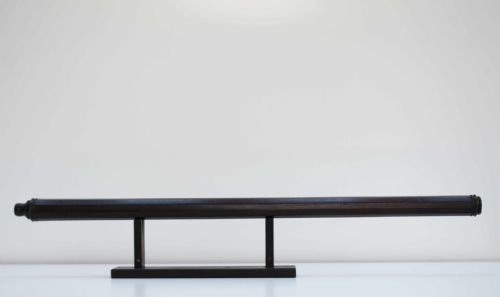
Nautical Spyglass Scope
A nautical spyglass scope is a portable optical instrument designed for maritime use, offering magnification through brass tubes wrapped in leather or left bare.
Nautical Spyglass Scope
A nautical spyglass scope appears primarily in multi-draw brass configurations, often wrapped in leather for grip during maritime use. These instruments span periods from the mid eighteenth century through the Edwardian era, featuring makers such as Ross of London, Newton & Co, and Broadhurst Clarkson & Co.
Forms range from simple two-draw and three-draw handheld tubes to complex four-draw cased models on stands and adjustable tabletop nickel plated telescope variants. English makers dominate the selection, producing terrestrial and day or night viewing instruments suited for naval and officer of the watch duties.
Materials and construction methods
Makers utilised heavy brass for the extending draw tubes and main barrels, pairing the metal with stitched leather sleeves for tactile handling aboard vessels. Glass lenses provide the optical magnification, housed within sliding sections that collapse for storage.
Listings feature brass as the primary metal, paired with leather, glass, and occasional wood housings like mahogany and oak across multiple periods.
Factors influencing optical and build quality
Optical clarity and the precision of the draw tube alignment separate standard working instruments from finer examples produced by established London and provincial makers. The tightness of the fit when extended determines how steadily the glass holds its focus during use.
Signatures etched onto the brass draw tubes by recognised opticians elevate the standing of a piece compared to unmarked anonymous instruments. The condition of the original leather covering and the preservation of the internal lenses dictate the overall integrity of the spyglass.
Voigtländer & Sohn AG Braunschweig·Ross of London·Broadhurst Clarkson & Co·Chadburn Brothers of Sheffield·John Gilbert
The Nautical Spyglass Scope Glossary
- Draw
- A sliding tubular section that pulls out from the main barrel to lengthen the telescope. Multi-draw designs allow long focal lengths to collapse into compact portable sizes.
- Achromatic
- An optical lens design corrected to bring red and blue light to the same focal point, reducing false colour fringes around images. Non-achromatic lenses lack this correction.
- Terrestrial
- An optical system configured to show upright images for land or sea viewing, unlike astronomical scopes that invert the picture.
- Decagonal
- Having ten sides. This geometric shaping appears on specific historical barrel designs from the eighteenth century.
Nautical Spyglass Scope: Frequently Asked Questions
How do I use a multi-draw telescope?
Pull each brass section fully outward until the tube locks or seats firmly in place, starting from the smallest eyepiece end.
Adjust the final section gently while looking at a distant object until the image sharpens into clear focus.
What is an officer of the watch telescope?
This specific designation refers to naval instruments carried by deck officers for signalling, identifying ships, and monitoring weather or hazards at sea.
They are typically built with robust brass and leather to withstand harsh maritime environments.
Why do some spyglasses have leather sleeves?
Leather provides a secure, non-slip grip for cold or wet hands aboard a rolling ship deck and protects the brass from minor dents.
It also insulates the metal against rapid temperature changes that could affect the user's grip.
How do I date an antique spyglass?
Examine the maker's signature engraved on the draw tube and cross-reference the workshop's active trading dates.
The number of draws, typography style, and presence of materials like nickel plating also offer strong clues to the period of manufacture.