



Nautical Brass Ornaments
These nautical brass ornaments are maritime desk accessories and scale models that bring tangible maritime history straight to your workspace.
Nautical Brass Ornaments
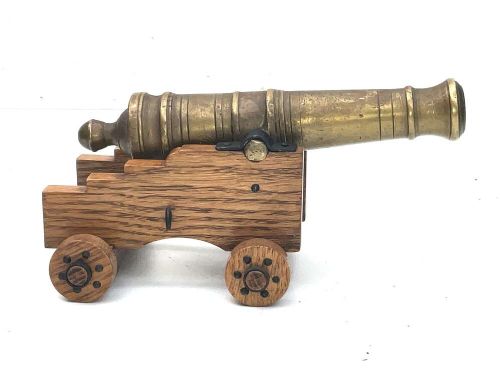
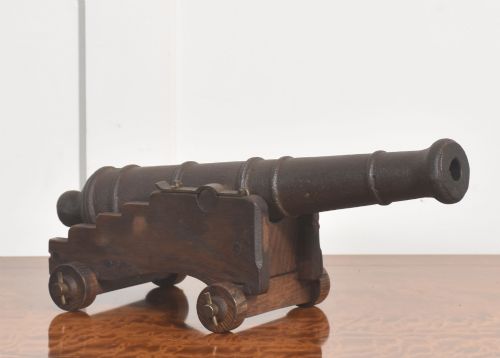
The assortment on this page leans heavily towards small-scale artillery and vessel representations, including brass barrelled ship of the line cannons and divers helmets. These pieces reflect Victorian and Edwardian maritime traditions, often mounted on wooden carriages made of oak or mahogany.
Beyond desk cannons, the selection incorporates utilitarian items adapted for display, such as ship bells and patented anchor models. These objects bridge the gap between working maritime equipment and decorative desk ornaments from the Georgian, Victorian, and Edwardian eras.
How they were made
Maker techniques rely on metalcasting, producing solid bronze and brass components for cannons, anchors, and helmets. These metal elements are frequently paired with turned and polished wooden carriages constructed from oak or mahogany.
Surface finishing involves hand polishing to achieve a bright metallic sheen on the bronze and brass sections, contrasting with the dark grain of the underlying wood. Individual pieces display engineer-made precision or handmade construction, utilising cast iron and copper alongside primary brass materials.
Nautical Brass Ornaments Retail Price Guide 2026
Typical asking prices for nautical brass ornaments among the pieces listed under this phrase on Sellingantiques today, from the lower quarter to the upper quarter. They describe what is for sale here now, not the wider market.
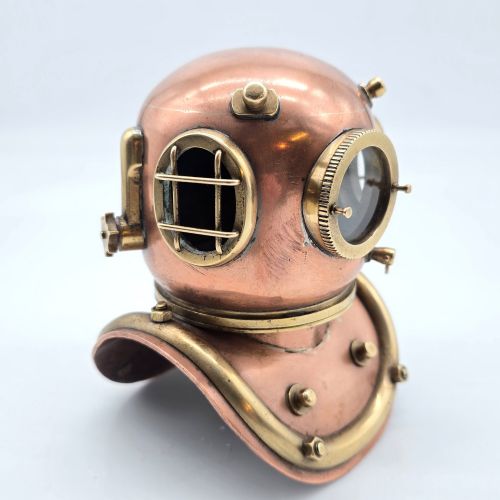
Someone once needed a miniature divers helmet small enough to sit on a desk, measuring just thirteen centimetres high.
What varies in quality
Quality differences rest primarily in the precision of the scaling and the fidelity of the mechanical details, such as the construction of miniature carriages and anchor mechanisms. Engineer-made pieces display meticulous attention to functional proportions compared to simpler decorative castings.
The choice of secondary materials also dictates the grade of the piece, with solid mahogany or oak undercarriages and heavy polished bronze demonstrating superior manufacturing standards over lighter metal combinations.
The Nautical Brass Ornaments Glossary
- Signal cannon
- A small ordnance piece used historically to fire blank charges for salutes or signaling, commonly reproduced as a desk ornament.
- Ship of the line
- A type of powerful warship built from the seventeenth through the nineteenth centuries, frequently depicted in scale models.
- Stockless anchor
- An anchor design without traditional crossbars, patented in various forms and reproduced in miniature scale models.
- Divers helmet
- A heavy protective headpiece worn by deep-sea divers, sometimes produced as miniature engineer-made display items.
Nautical Brass Ornaments: Frequently Asked Questions
What are nautical brass ornaments?
These pieces are small-scale maritime models and desk accessories, including cannons, anchors, bells, and helmets.
They originate mostly from the nineteenth and early twentieth centuries, reflecting Victorian and Edwardian seafaring traditions.
How were desk cannons used?
Miniature cannons served primarily as decorative desk ornaments, paperweights, or conversation pieces for maritime enthusiasts and officers.
Some working signal cannons were utilised for actual auditory signaling, while others were built strictly as static display models.
What materials are common?
The primary metals utilised are brass, bronze, copper, and cast iron, often paired with wooden components.
Carriages and bases are frequently constructed from durable hardwoods such as oak and mahogany to support the heavy metal elements.
How do I identify the period?
Dating relies on stylistic markers from Victorian maritime, Edwardian, and Georgian periods, alongside specific manufacturing techniques.
Inscribed names of vessels, patent types, or specific construction methods help narrow down the production era to the nineteenth or early twentieth century.