



Natural Pearl Cluster Ring
A natural pearl cluster ring brings together lustrous organic pearls and sparkling diamonds in durable gold and platinum settings.
Natural Pearl Cluster Ring
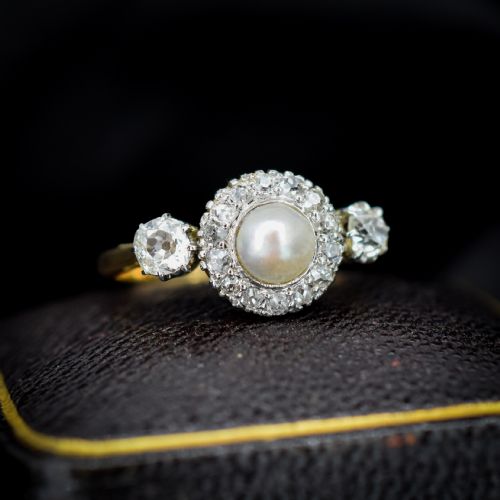
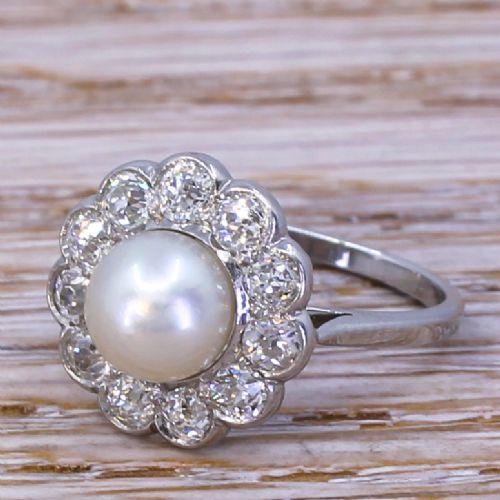
A natural pearl cluster ring centres on a saltwater or freshwater pearl surrounded by a border of smaller gemstones, most frequently old cut or rose cut diamonds. These pieces span multiple decades from the Victorian and Edwardian eras through Art Deco and Mid-Century periods.
The most common form on this page pairs a central natural pearl with a surrounding halo of diamonds, mounted on a slender shank of 18ct yellow gold, white gold, or platinum. Designs range from compact daisy clusters to geometric Art Deco arrangements and crossover styles.
Makers across the late nineteenth and twentieth centuries utilised these materials to create balanced floral and symmetrical motifs. Each piece reflects the prevailing aesthetic of its decade, from intricate Edwardian filigree to clean mid-century lines.
How they were made
Goldsmiths constructed these rings using durable precious metals, mounting stones in combinations of yellow gold, white gold, and platinum. Platinum became particularly favoured during the Edwardian and Art Deco periods for its strength in delicate, lace-like settings.
Gems were set by hand using claw, bezel, or millegrain techniques to secure diamonds and pearls firmly within the cluster. Central pearls were often half-drilled and secured onto a central peg with adhesive or mechanical pins.
Some pearls grew naturally flat on one side just to fit a nineteenth-century tailor's button design.
What varies in quality
The quality of a natural pearl cluster ring depends heavily on the orient, lustre, and skin of the central pearl. Fine examples display a smooth, unblemished surface with deep, iridescent play of light across the nacre.
Proportion and stone matching also separate standard pieces from exceptional ones. Master jewellers ensured that surrounding diamonds matched in colour and cut, creating a cohesive frame that enhances rather than overpowers the central pearl.
The Natural Pearl Cluster Ring Glossary
- Natural pearl
- A pearl formed organically in a mollusc without human intervention, prized for its unique lustre and scarcity. These contrast sharply with cultured varieties produced through seeded nucleation.
- Old cut diamond
- A hand-faceted diamond cut before modern automated standards, typically featuring a smaller table and a high crown. They display a characteristic warm, candlelit sparkle.
- Rose cut diamond
- A historic diamond cut with a flat base and a domed crown of triangular facets arranged in a star shape. This style was widely utilised during the Victorian and Edwardian periods.
- Millegrain
- A decorative jewellery technique involving a line of tiny raised metal beads along the edge of a setting. This subtle texture adds a refined, softened border to platinum and gold mounts.
- Crossover ring
- A ring design where the shank sweeps up to cross over itself, often displaying two main stones or a cluster alongside a contrasting element. This flowing style gained popularity during the Belle Epoque.
Natural Pearl Cluster Ring: Frequently Asked Questions
Can I wear my cluster ring every day?
While diamonds and gold or platinum settings withstand daily wear, natural pearls require extra care due to their organic nature. Pearls are softer than gemstones and susceptible to scratching from hard surfaces or household chemicals.
Reserve the ring for daily activities that do not involve heavy manual work, gardening, or swimming to protect the nacre from lasting damage.
How can I tell an Edwardian ring from an Art Deco one?
Edwardian rings typically feature flowing floral motifs, openwork platinum filigree, and delicate millegrain detailing. They lean towards romantic, organic shapes like daisies and soft curves.
Art Deco pieces shift towards geometric symmetry, sharp lines, and structured arrangements with calibrated stones. The settings become bolder, embracing the machine age aesthetic of the 1920s and 1930s.
What is a button pearl?
A button pearl is a pearl that grew with a flattened or slightly domed back and a curved top, resembling a traditional coat button. This natural shape sits low and flat against the finger when mounted.
Jewellers frequently utilised button pearls in cluster rings because their profile fits neatly into the centre of a diamond halo without protruding excessively.