


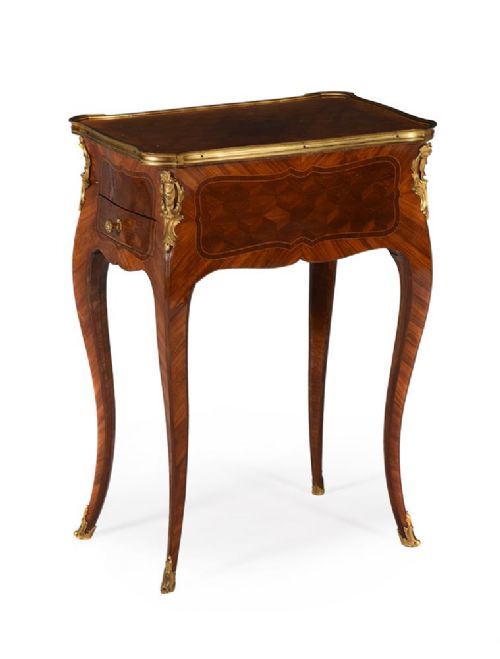
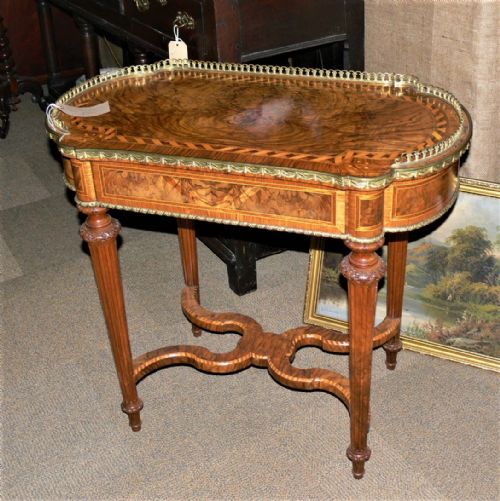
Napoleon III Parquetry Table
A Napoleon iii parquetry table brings complex geometric wood patterns and bright ormolu mounts straight into a room.

Napoleon III Parquetry Table
A napoleon iii parquetry table is a decorative French piece dating largely from the nineteenth century, including specific years around 1860 and 1870. Buyers searching for this phrase find a variety of forms designed for refined reception rooms and private chambers.
The selection here includes side tables, occasional tables, centre tables, and larger writing desks or bureau plat models. Work tables and dressing tables also appear, combining practical compartments with elaborate surface decoration.
Most examples lean heavily into Louis XV and Louis XVI revival styles, often incorporating French rococo motifs alongside geometric floor patterns. These pieces reflect the eclectic and opulent taste of the Second French Empire.
How they were made
Cabinetmakers constructed these tables using dense timbers such as kingwood, rosewood, walnut, and tulipwood to form contrasting geometric parquetry patterns. Individual wood veneers are meticulously cut and fitted together to create intricate visual depth on the tabletop.
Mounts made of ormolu, gilt bronze, and brass accent the corners, edges, and legs, highlighting the structural curves. Lacquer and vernis martin panels occasionally feature on specialised writing cabinets and dressing pieces to add painted pictorial charm.
Some work tables doubled as discreet dressing stations, letting owners conceal their powder pots while waiting for morning callers.
What varies in quality
The precision of the parquetry layout sets finer examples apart from simpler pieces, particularly in the tightness of the wood joints and the complexity of the geometric arrangement. Richer selection of exotic timbers like kingwood and tulipwood indicates higher ambition in the workshop.
The Napoleon III Parquetry Table Glossary
- Parquetry
- A geometric mosaic of wood veneer used to cover floors or furniture surfaces. It differs from pictorial marquetry by relying on repeating angles and shapes.
- Ormolu
- Gilt bronze applied to furniture mounts and decorative hardware. The technique involves coating bronze in a gold amalgam and heating it.
- Kingwood
- A dense, richly figured exotic wood prized by French cabinetmakers for high-end parquetry. It displays deep brown tones with lighter golden streaks.
- Bureau Plat
- A freestanding writing table fitted with drawers across the frieze. These desks are finished on all sides to sit comfortably in the middle of a room.
- Vernis Martin
- A type of simulated Japanese lacquer developed in France during the eighteenth century. It utilises multiple layers of varnish to achieve a glossy, translucent finish.
Napoleon III Parquetry Table: Frequently Asked Questions
Where should I place a centre table?
A centre table is designed to stand free in the middle of a room rather than pushed against a wall. This allows the parquetry on the top and the mounts on all four sides to be fully appreciated from any angle.
Ensure there is enough walking space around the perimeter so the table functions as a natural focal point without obstructing movement.
How do I care for rosewood and kingwood?
Exotic veneers respond poorly to direct sunlight and rapid humidity changes, which can cause the wood to dry out or split. Keep these tables away from radiators and windows.
Dust them gently with a dry, soft cloth and avoid commercial polishes that contain silicones or harsh solvents.
What is a work table used for?
Work tables were originally designed for sewing, needlework, and correspondence, often featuring internal compartments or a fabric bag suspended beneath. Today they serve well as compact occasional tables beside seating.
The lidded compartments make them useful for storing small everyday items out of sight.
How do I spot Louis XV revival style?
Louis XV revival pieces feature prominent asymmetrical curves, cabriole legs, and naturalistic rococo leaf or scroll motifs in their ormolu mounts. The lines are flowing and organic rather than straight and architectural.
This style dominated much of the mid-nineteenth-century French furniture production seen on this page.