

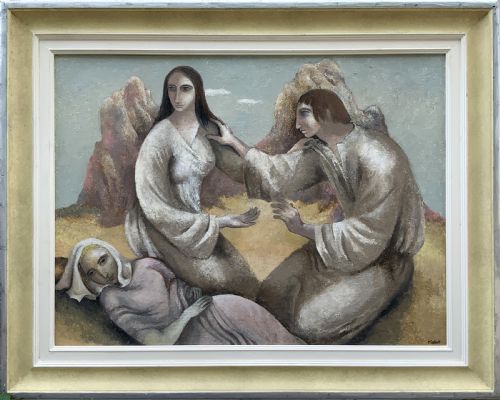


Muted Grey Artwork
Muted grey artwork brings together paintings and watercolours that capture subtle atmospheric tones across multiple decades.
Muted Grey Artwork
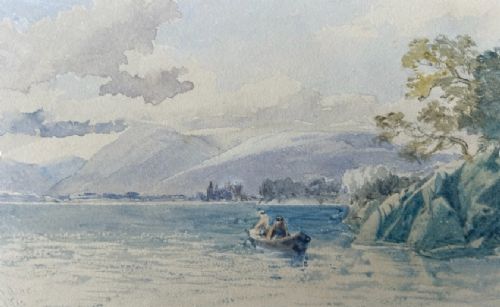
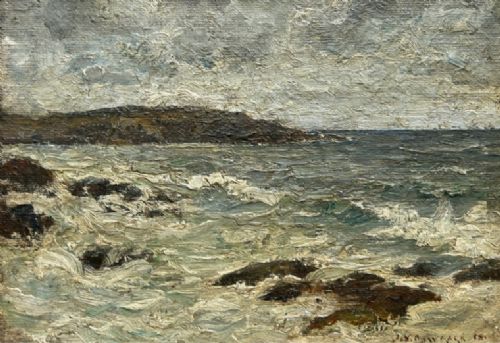
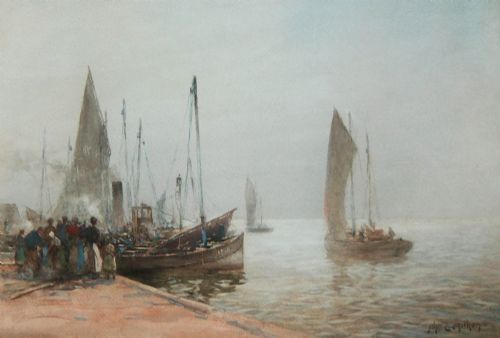
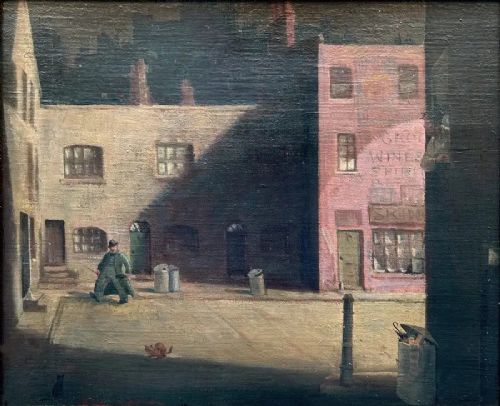
When you search for muted grey artwork, you encounter paintings and watercolours spanning the nineteenth century through to the mid twentieth century. These pieces record landscapes, coastal views, and town scenes executed in restrained palettes that emphasise atmospheric conditions. The selection includes works created within British Impressionism, Post Impressionism, Victorian, Edwardian, and Mid Century Modernist movements.
You are most likely to meet watercolours on paper and oil paintings on canvas or board originating from British and European hands. The subjects range from Scottish lochs and Yorkshire dales to quiet streets and maritime harbours rendered in subdued tones. Many carry signatures or attributions to named painters alongside unsigned examples from the same periods.
Materials and construction
The works utilise traditional grounds such as paper, stretched canvas, and wooden boards as supports for watercolours and oil paints. Watercolour pigment is applied to paper with varying degrees of wash, whilst oil paint is handled with smooth brushwork or heavier impasto texture depending on the artist. These combinations determine how light is absorbed and reflected across the surface of each piece.
Framing and mounting methods vary according to the period, with older watercolours set behind glass within period mounts and frames. Oil paintings on canvas are typically stretched over wooden frames, sometimes retained in their original mouldings which show the wear of time.
Several artists braved freezing northern winters to capture snow laden landscapes and windswept coastal harbours in subdued monochrome tones.
Distinctions in execution
Quality rests upon the sureness of the handling and the precision with which the tonal values convey light and atmosphere. Stronger works demonstrate confident brushwork and a coherent composition that holds the eye within the frame, whereas weaker examples can feel tentative or formulaic in their execution.
The preservation of the pigment and the condition of the support also define the standing of a piece. Works that retain their original colour balance without excessive fading or discolouration offer a more faithful representation of the creator's intent.
Thomas Miles Richardson Jnr·James E Aitken·Francisco Sancha·Christine Nesbit·Albert Ludovici Jnr·Fred Lawson·Arthur Reginald Smith·Cuthbert Crossley·Tom Clough·James Orrock·James Watson·Ernest Higgins Rigg·Henri Joseph Harpignies·Florence Hess·John Mitchell·A G Hayward·Ernest F Hill·Edmund Morris Wimperis·Thomas James Lloyd·Rowland Henry Hill·Hirst Walker·Fred Mayor·Fred Stead·Donald McIntyre·William Lee Hankey
The Muted Grey Artwork Glossary
- Impasto
- Paint applied thickly to a canvas or board, standing out in relief from the surface and catching the light. This technique adds tactile depth to the imagery.
- Watercolour
- A paint consisting of colour pigments suspended in a water soluble vehicle, traditionally applied to paper. It relies on the white of the paper to provide luminosity.
- Board
- A rigid flat panel made from wood, pasteboard, or composite material used as a support for oil paintings instead of stretched canvas.
- Monogram
- A motif made by overlapping or combining two or more letters to form a single symbol, often used by artists to sign their work in place of a full name.
- Genre painting
- Artwork that depicts aspects of everyday life by portraying ordinary people engaged in common activities. These scenes offer a record of social history.
Muted Grey Artwork: Frequently Asked Questions
What periods do these artworks cover?
The listings span from the nineteenth century through the Edwardian era and into the mid twentieth century. They capture stylistic shifts from Victorian academic traditions towards early modern and mid century approaches.
Creators working during these decades responded to changing artistic movements whilst maintaining a focus on atmospheric landscapes and coastal scenes.
Are these paintings original works?
Every piece presented is an original painting or watercolour executed by hand rather than a modern reproduction or print. Many bear the signatures, monograms, or dates applied by the artists at the time of creation.
Documentation includes works by identified British and European painters alongside pieces attributed to regional artists and Staithes group members.
How should I display an antique watercolour?
Watercolours require protection from direct sunlight to prevent the pigments from fading over time. Framing them behind conservation grade glass helps shield the paper from ultraviolet light and airborne pollutants.
Positioning them away from damp environments and sudden temperature fluctuations ensures the paper and mount remain stable for years to come.
What surfaces were used for these oil paintings?
Artists utilised both stretched canvas and rigid wooden boards as the primary supports for their oil compositions. Canvas allowed for larger portable works with flexible surfaces, whilst boards provided a firm ground for smaller plein air studies.
Both materials show the distinct ageing characteristics associated with oils from the nineteenth and twentieth centuries.