




Moonlit Landscape Art
Moonlit landscape art captures nocturnal scenes through oil and watercolour, bringing atmospheric evening light and shadowy coastlines directly into your interior.
Moonlit Landscape Art
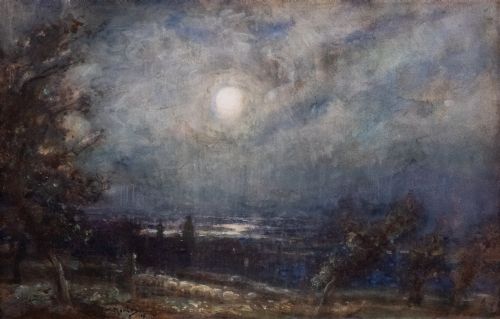
Moonlit landscape art encompasses oil paintings, watercolours, and charcoal works on canvas and paper depicting evening scenes, marine views, and nocturnal settings. These pieces date from the nineteenth century through to the mid-twentieth century, capturing historical British and European landscapes under night skies.
You are most likely to encounter Victorian and Edwardian works, including maritime impressionism, coastal watercolours, and Scottish romanticism. Painters of these periods focused heavily on moonlight reflecting over water, rivers, and castles.
Common subjects range from tranquil lakes and Highland lochs to busy coastal shipping lanes and quiet rural streets. The selection bridges formal academic output and atmospheric interpretations by regional schools.
Materials and methods
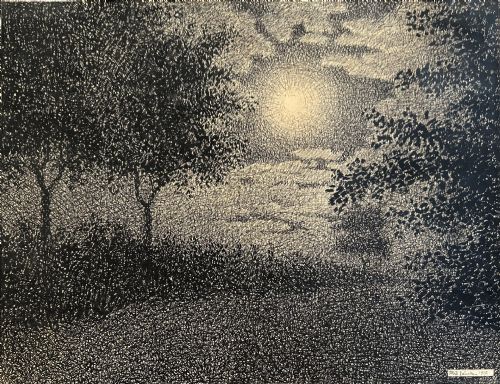
Artists relied primarily on oil on canvas and watercolour on paper, often framing finished works with gilt surrounds. Charcoal served for detailed tonal studies, establishing deep contrasts between dark night skies and illuminated water.
Brushwork varies from tight, controlled Victorian maritime realism to looser mid-century impressionistic applications. Pigments were layered to build up the luminosity of the moon and its reflection against dark landmasses.
Moonlit Landscape Art Retail Price Guide 2026
Typical asking prices for moonlit landscape art among the pieces listed under this phrase on Sellingantiques today, from the lower quarter to the upper quarter. They describe what is for sale here now, not the wider market.
Several artists clearly spent long, freezing nights staring at Medway fishing boats just to capture the moon on the water.
Assessing quality and execution
Quality rests in the handling of light and shadow, where superior works successfully convey the eerie, silvery glow of moonlight without losing structural detail in the landscape. Weaker examples lean towards flat tonal planes and heavy, unconvincing darks.
The precision of perspective and the atmospheric depth of the sky separate accomplished named artists from uncredited period school pieces. Strong composition anchors the nocturnal elements, ensuring the viewer's eye navigates the dark canvas naturally.
Hans Harlander·Thomas William Morley·William Manners·James Bell Anderson·Thomas Bush Hardy·George Cole·Hubert Thornley·Walter Meegan·William Crampton·Henri Joseph Harpignies
The Moonlit Landscape Art Glossary
- Nocturne
- A painting depicting a night scene or an evening landscape. This term gained particular currency during the Victorian period.
- Maritime Impressionism
- A style focusing on seascapes and coastal shipping with an emphasis on light and movement rather than strict topographical accuracy. It is frequently seen in nineteenth-century marine works.
- Gilt frame
- A wooden picture surround covered with gold leaf or gold-coloured paint. Many period oil paintings retain their original gilded presentation.
- Scottish Romanticism
- An artistic movement emphasising wild landscapes, dramatic weather, and moody topography. Works in this vein often depict misty lochs and highland castles.
Moonlit Landscape Art: Frequently Asked Questions
How do I date a moonlit landscape painting?
Dating relies on stylistic clues, framing methods, and artist signatures where available. Nineteenth-century works often feature distinct Victorian rigging or costume details in marine subjects.
Mid-twentieth-century pieces tend to show looser brushwork and simplified compositions characteristic of later impressionist revivals.
Where should I hang a dark oil painting?
These works require careful placement away from direct glare to prevent reflections on the glass or varnished canvas. Positioning them on medium-toned or dark walls enhances the moody atmospheric quality.
Use dedicated picture lighting to draw out the subtle silver tones of the moonlight against the darker background.
What is the difference between oil and watercolour moonlights?
Oil paintings on canvas offer richer pigment depth and heavier impasto, allowing artists to build physical texture into moonlit clouds and waves. Watercolours on paper present a more delicate, translucent quality where the white of the paper often represents the moon itself.
Both mediums command distinct handling of contrast to make night scenes legible.
Are pairs common in nineteenth-century art?
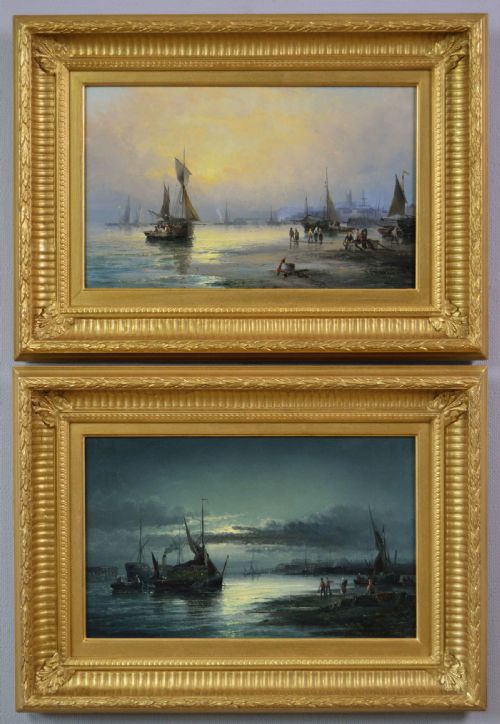
Artists frequently produced companion pieces depicting matching coastal or river scenes, often showing opposing tides or changing weather. These pairs were designed to hang symmetrically in Victorian parlours.
Finding a matching pair of moonlit marine paintings remains a notable discovery for collectors.