





Miniature Wooden Caddy
These miniature wooden caddy examples are compact vessels and chests crafted for dry leaves or small treasures, offering tactile historical charm for any collector.
Miniature Wooden Caddy
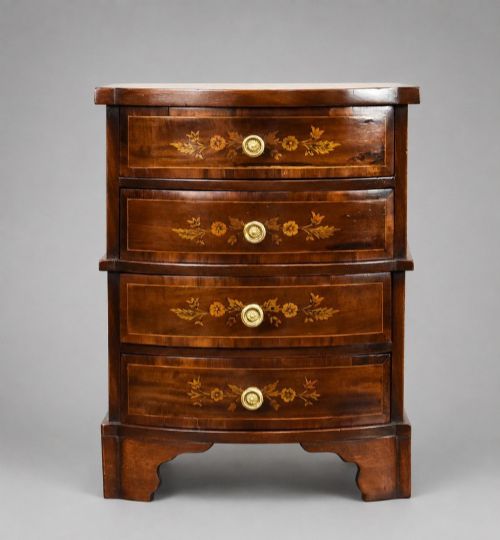
A miniature wooden caddy brings domestic scale to larger furniture forms like sideboards, chests of drawers, and tabletop cabinets. These pieces often serve as diminutive tea caddies, perfume boxes, or small storage chests shaped during the Georgian, Regency, and Victorian eras.
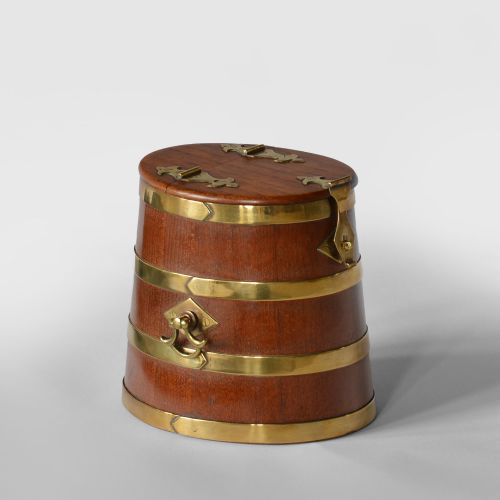
The versions most commonly met on this page span the Georgian period, the nineteenth century, and the Edwardian era. Makers frequently imitated grander domestic furniture, resulting in miniature sideboards, bow-front chests, and coopered naval rum barrels.
While some pieces function strictly as tea caddies, others double as gentlemen's table cabinets or decorative boxes. Their small stature makes them versatile display objects that capture the cabinetry skills of their respective periods.
Materials and construction
Makers relied heavily on dense tropical hardwoods like mahogany and rosewood, often applying wood veneer over a secondary wood base. These surfaces were frequently enhanced with intricate inlaid wood, marquetry, and mother-of-pearl detailing.
Metal mounts in brass provided structural reinforcement and decorative contrast, particularly on coopered barrels and bound cabinets. French fruitwood and oak also appear, showing how regional timber choices shaped the final character of each box.
Joinery techniques ranged from standard box construction to specialised coopered stave work for barrel forms. Surface treatments preserved the natural grain while highlighting contrasting tones in the inlaid elements.
Miniature Wooden Caddy Retail Price Guide 2026
Typical asking prices for miniature wooden caddy among the pieces listed under this phrase on Sellingantiques today, from the lower quarter to the upper quarter. They describe what is for sale here now, not the wider market.
Listings feature items spanning the Georgian, Regency, and Edwardian periods, constructed in mahogany, rosewood, oak, and fruitwood.
Assessing craftsmanship and finish
Quality rests primarily in the precision of the miniature scale work and the crispness of the joinery. Superior examples maintain correct proportional relationships to full-sized furniture rather than appearing merely clumsy or chunky.
The refinement of surface decoration distinguishes finer pieces, particularly where marquetry, inlaid wood, and brass bindings meet flush with the surrounding timber. Finer vessels utilise well-figured timber grains that suit the reduced physical dimensions.
Mappin and Webb
The Miniature Wooden Caddy Glossary
- Marquetry
- Decorative veneer work formed by fitting together small pieces of wood, shell, or other materials to create pictorial patterns on a surface.
- Coopered
- Constructed from staves of wood joined edge-to-edge and bound with hoops, typically associated with barrels and casks.
- Veneer
- A thin layer of finely figured wood applied to a base timber to provide a more decorative exterior surface.
- Regency
- A British stylistic period spanning the early nineteenth century, characterised by classical restraint and polished dark woods.
- Bracket clock
- A portable household clock designed to sit on a bracket or table, often featuring striking mechanisms.
Miniature Wooden Caddy: Frequently Asked Questions
How were these caddies used originally?
These small vessels primarily served to store dry tea leaves securely under lock and key in the domestic parlour. Other variations functioned as perfume boxes, gentlemen's table cabinets, or decorative tabletop storage.
Because tea was a costly commodity, the caddy was often kept in a prominent place in the home. Their diverse forms allowed them to double as ornamental conversation pieces.
How do I date a wooden caddy?
Dating relies on examining the timber species, construction methods, and prevailing stylistic influences such as Georgian or Regency design. The presence of specific hardware, like brass stringing or mother-of-pearl inlay, also points toward certain decades.
Comparing the proportions and joinery to known furniture periods helps establish an approximate time of manufacture. Edwardian and nineteenth-century pieces often show distinct mechanical fastenings compared to earlier hand-built examples.
Where should I place a caddy at home?
These pieces suit placement on flat surfaces such as sideboards, mantelpieces, or dedicated display tables where their fine woodwork can be admired. Their small footprint allows them to fit easily into modern interior shelving without dominating a room.
Keep them away from direct sunlight and extreme temperature fluctuations to protect delicate wood veneers and historic finishes. Occasional gentle dusting helps maintain the polished surface of the timber.