


Miniature Georgian Commode
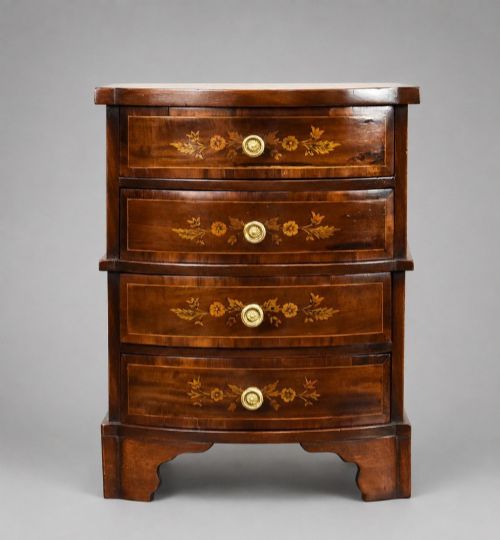
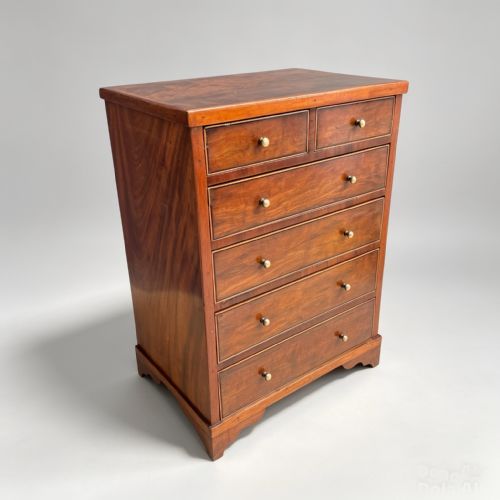
These miniature georgian commode examples are finely scaled chests of drawers built to showcase cabinet-making skill.
Miniature Georgian Commode
A miniature georgian commode search brings up diminutive chests of drawers spanning the eighteenth century through the Edwardian era. You will most frequently encounter mahogany and oak forms, alongside walnut, rosewood, and exotic timbers.
The objects range from authentic eighteenth-century examples to later George II style revivals and Edwardian marquetry interpretations. These pieces serve primarily as tabletop display items or detailed cabinet-maker samples.
Forms include bow fronts and straight fronts, mirroring full-size furniture down to the smallest drawer handles and brass fittings. Their compact scale makes them practical for tabletop placement in modern rooms.
How they were made
Cabinet-makers utilised dense hardwoods such as mahogany, oak, walnut, and rosewood for the main structures. Many examples incorporate intricate decorative elements like boxwood stringing, bone details, and intricate marquetry.
Surfaces frequently display figured veneers, burr yew, and amboyna, highlighting the skill required to scale down large woodworking techniques. Metal components typically consist of small brass handles and escutcheons fitted to working miniature drawers.
Some miniature drawers are so precisely fitted they require a gentle tug to release the tiny vacuum holding them shut.
What varies in quality
Quality differences lie in the choice of timber and the precision of the veneer work, distinguishing finely figured burr yew or amboyna from simpler oak or mahogany. The refinement of the miniature brass hardware and the crispness of the joinery further separate standard items from superior examples.
The fidelity of the proportions to full-size Georgian furniture dictates the overall success of the piece. Subtle details like fine boxwood inlay and precise dovetailing elevate the standing of a miniature chest.
The Miniature Georgian Commode Glossary
- Commode
- A low chest of drawers or cabinet originating in the eighteenth century. In miniature form, it replicates the proportions of the full-sized domestic furniture.
- Marquetry
- Decorative veneer work forming intricate patterns using various coloured woods. This technique appears on Edwardian interpretations.
- Bow front
- A convexly curved front facade on a chest of drawers. This stylistic choice adds visual movement to miniature furniture.
- Apprentice piece
- A small-scale furniture item created to demonstrate a craftsman's skill to a guild. These objects show the same rigorous construction methods as standard furniture.
Miniature Georgian Commode: Frequently Asked Questions
What is a miniature georgian commode used for?
These small chests function primarily as decorative objects for tabletops and shelves. Historically, cabinet-makers created them as salesman samples or demonstration pieces to show prospective clients.
Today, collectors appreciate them for their intricate detail and ability to fit into smaller display spaces. They require no special installation and sit securely on flat surfaces.
How do I date a miniature chest?
Dating relies on identifying the primary timber used, such as eighteenth-century oak and mahogany or later Edwardian marquetry. Construction methods, drawer linings, and hardware styles also provide clear chronological markers.
Comparing the decorative motifs to full-size furniture of the same period helps confirm the era. Stylistic revivals, such as George II style pieces made around nineteen hundred, often combine earlier forms with later manufacturing traits.
Are miniature chests fragile?
Constructed from dense hardwoods like mahogany and walnut, these items are structurally robust despite their small scale. Delicate elements such as thin boxwood stringing or small brass handles simply require careful handling during cleaning.
Keeping them away from direct sunlight and sudden temperature changes protects the wood and veneer surfaces. Normal household dusting is sufficient for daily maintenance.
What woods were used for miniature furniture?
Cabinet-makers utilised a wide range of native and exotic timbers depending on the period. Common choices include mahogany, oak, walnut, and rosewood.
More decorative items feature burr yew, amboyna, and inlaid marquetry panels. Details often incorporate contrasting woods like boxwood alongside bone.