




Middle Eastern Weaving
Middle Eastern weaving encompasses traditional rugs, bags and textiles crafted from wool, cotton and metal thread across nomadic and village cultures.
Middle Eastern Weaving
Middle Eastern weaving brings together floor coverings, storage pieces and garments originating from Persia, Anatolia and Egypt. The selections here span the nineteenth and twentieth centuries, taking in nomadic, village and workshop output.
Rug and carpet forms dominate the selection, alongside smaller utility items such as saddle bags, cushions and rug bags. Textile items also include traditional garments like Qajar dynasty jackets alongside solid silver Bedouin bracelets.
Nomadic and tribal workshops produce distinct village rugs, prayer rugs and large palace carpets. Wool forms the primary structural material across these diverse regional styles.
Materials and Construction
Makers construct these textiles using wool and cotton foundations, employing hand-knotted pile and flatweave techniques. Metallic thread appears in specific garments and decorative pieces to create contrast against the textile base.
Nomadic weavers utilise locally sourced wool spun by hand, yielding varied textures across tribal rugs and flatweave bag faces. Solid silver is worked independently for wearable items such as cuffs and bangles.
Middle Eastern Weaving Retail Price Guide 2026
Typical asking prices for middle eastern weaving among the pieces listed under this phrase on Sellingantiques today, from the lower quarter to the upper quarter. They describe what is for sale here now, not the wider market.
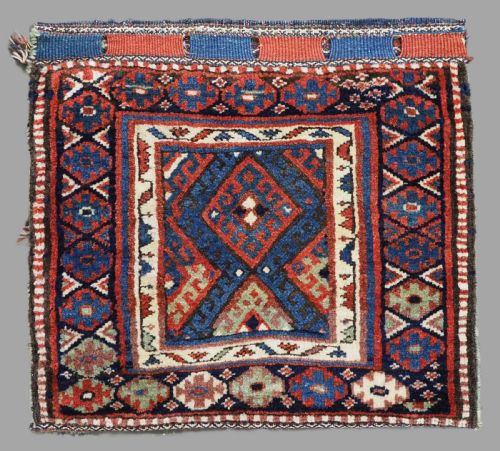
Even sturdy nomad camels needed stylish luggage, as proved by the surviving nineteenth-century saddle-bags.
Factors That Determine Quality
Knot density and structural integrity separate standard village pieces from finer workshop carpets like Kashan or Tabriz. The precision of the drawing and the consistency of the weave dictate the overall execution.
The survival of original plain weave backs on bags and complete borders on carpets preserves the integrity of the piece. Superior examples retain their pile depth and structural crispness without excessive restoration.
Benlian
The Middle Eastern Weaving Glossary
- Flatweave
- A textile constructed without a knotted pile, created by interweaving warp and weft threads directly. This technique appears on the backs of bags and specific utilitarian coverings.
- Pile
- The upright yarn ends forming the soft surface of a carpet or rug. Knotting wool around the foundation warps creates this wearable and decorative layer.
- Warp
- The vertical foundation threads stretched lengthwise on a loom before weaving begins. Weft threads intersect these structural elements to hold the structure together.
- Abaya
- A traditional loose over-garment or long jacket. Surviving examples incorporate decorative wool and metal thread materials.
Middle Eastern Weaving: Frequently Asked Questions
How do I care for antique Middle Eastern rugs?
Vacuum gently without a beater bar and keep the textile away from direct sunlight to preserve the wool pile.
Rotate the rug periodically to ensure even wear across high-traffic areas in your home.
What is the difference between village and nomad rugs?
Nomadic pieces reflect spontaneous tribal designs and portable looms, whereas village pieces follow established regional traditions.
Village rugs often display more rigid geometric structures compared to fluid tribal compositions.
How were antique saddle bags used?
Nomadic communities utilised these paired compartments for transport and storage during seasonal migrations across harsh terrain.
Today they function effectively as decorative cushions or wall hangings within interior spaces.
How do I identify a prayer rug?
Prayer rugs feature a distinctive mihrab arch motif designed to indicate the direction of Mecca during daily worship.
Collectors place these focused compositions on walls or select low-wear floor locations.