


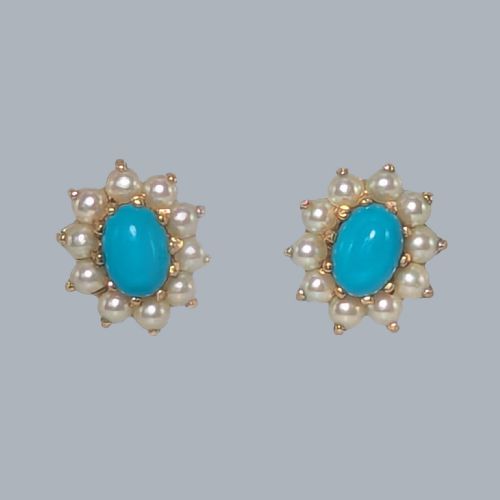


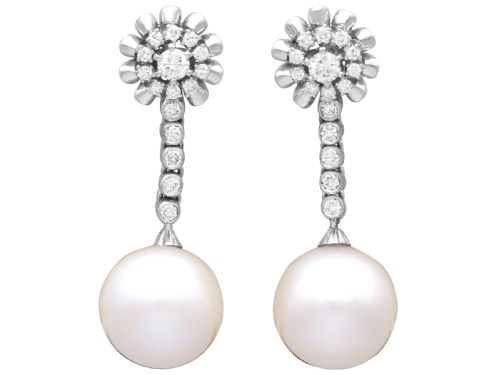

Mid Century Cluster Earrings
Mid century cluster earrings gather diamonds, pearls and coloured stones into tightly massed geometric or floral arrangements.
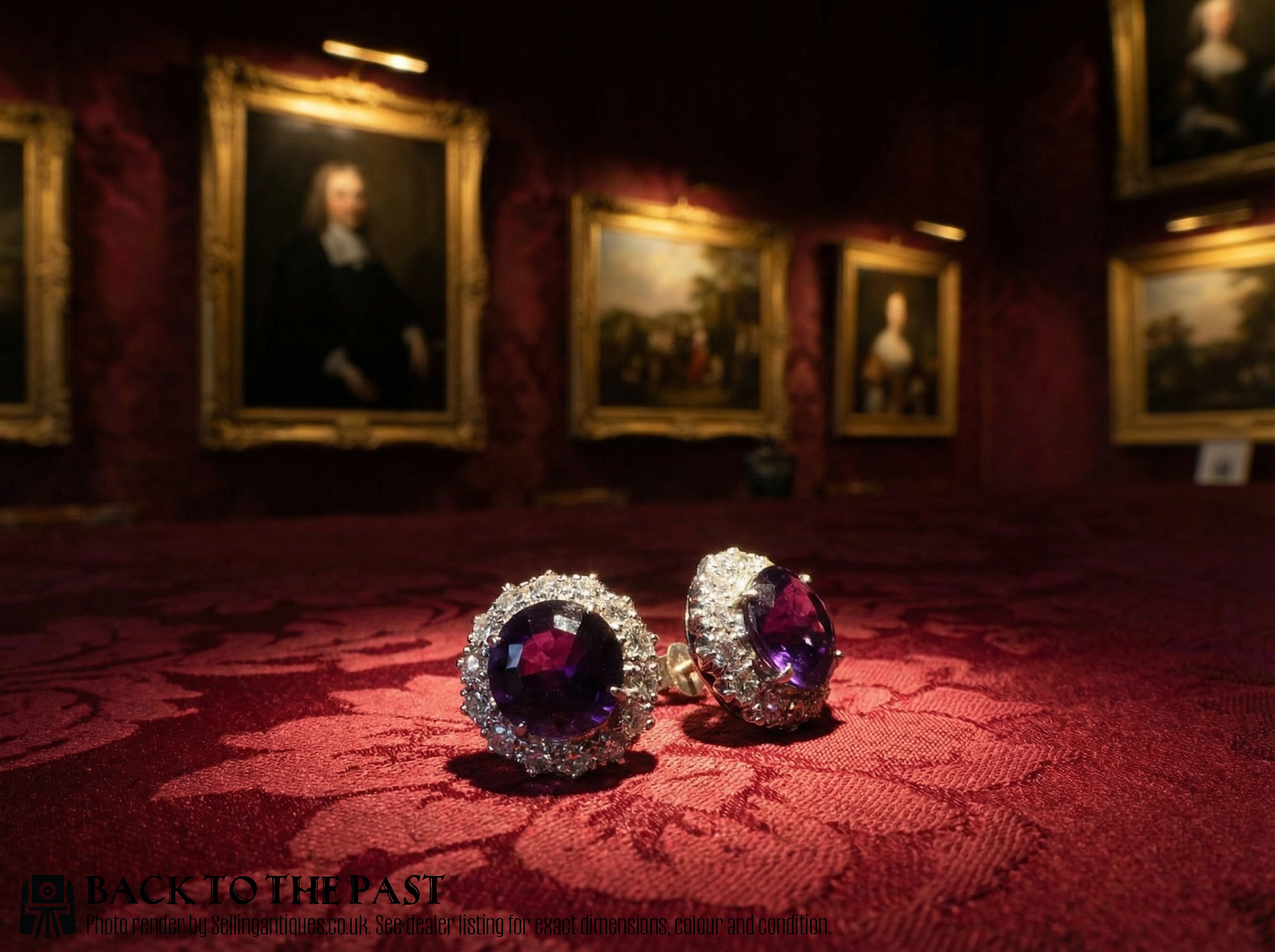
Mid Century Cluster Earrings
Mid century cluster earrings bring together central stones surrounded by smaller gems, forming compact floral, daisy, sunburst or target motifs. The pieces originate primarily from the 1950s and 1960s, though examples also draw on earlier Art Deco and Retro influences.
Earrings in this grouping appear in stud, drop, clip-on and screwback formats, allowing for diverse fastening preferences. Materials span 18ct white gold, 9ct gold, 14ct gold, platinum and silver alongside diamonds, pearls, emeralds, sapphires, rubies, turquoise and aquamarines.
Materials and construction methods
Goldsmiths set diamonds and coloured stones into white gold, yellow gold and platinum mounts designed to maximise light reflection within tight geometric or floral clusters. Central gems anchor the design while melee diamonds or smaller pearls form concentric borders.
Workshops employed secure claw and bezel settings alongside specialised clip-on and screwback mechanisms suited to the heavier weight of multi-stone formations.
Screwbacks ensure that even the grandest diamond and pearl cluster stays firmly attached while you dance.
Distinctions in quality
Quality rests upon the calibre of the central stones, the precision of the surrounding stone symmetry, and the overall integrity of the metalwork. Heavier gold or platinum mounts provide durable foundations for dense groupings of brilliant, single or transitional cut diamonds.
The refinement of the claw or bezel work and the matching of secondary pearls or coloured gems determine the visual harmony and structural longevity of each piece.
Christian Dior
The Mid Century Cluster Earrings Glossary
- Cluster
- A jewellery arrangement where a central stone is encircled by a border of smaller gems. This layout creates a concentrated focal point resembling a flower or geometric rosette.
- Daisy design
- A specific cluster formation featuring a central round stone surrounded by petal-like gems. The configuration mimics the natural symmetry of a daisy flower.
- Clip-on
- A fastening mechanism that secures an earring to the earlobe via a hinged tension paddle rather than a pierced post. This style gained widespread popularity during the mid-century decades.
- Screwback
- A mechanical fastening utilising a threaded post and a small screw cap to adjust tension on the unpierced earlobe. It provides a secure hold for heavier drop and cluster designs.
- Transition cut
- A diamond cut utilised during the period between old European cuts and modern brilliant cuts. It bridges transitional facets to optimise light return.
Mid Century Cluster Earrings: Frequently Asked Questions
How do I wear clip-on cluster earrings?
Clip-on earrings rest directly against the earlobe using a hinged tension mechanism designed for unpierced ears. Adjust the tension correctly to ensure comfortable all-day wear without slipping.
Position the pad evenly across the lobe before securing the hinge. This distributes the weight of the cluster stones evenly across the tissue.
What defines a target cluster earring?
Target clusters feature concentric rings of contrasting coloured gemstones or diamonds surrounding a distinct centre stone. The pattern draws the eye inward in a circular graphic format.
This style emerged strongly in mid-century design, often pairing rubies, sapphires or emeralds with bright diamond borders against white gold or platinum.
How are screwback earrings adjusted?
Screwback mechanisms utilise a threaded post paired with a small rotating nut that tightens against the back of the lobe. Turn the nut gently until the earring rests securely in place.
Avoid over-tightening the screw component to prevent pinching the ear tissue while maintaining a stable fit for heavier pearl and diamond drops.
Are these earrings meant for pierced ears?
Many mid-century cluster earrings feature non-pierced fastenings such as clip-ons or screwbacks reflecting the preferences of the era. Other examples utilise standard posts or screw posts for pierced lobes.
Check the specific listing details to confirm whether a pair requires pierced ears or utilises mechanical closures.