



Meiji Bronze Censer
A meiji bronze censer brings distinct Japanese metalwork into a room, valued for its detailed casting and form.
Meiji Bronze Censer
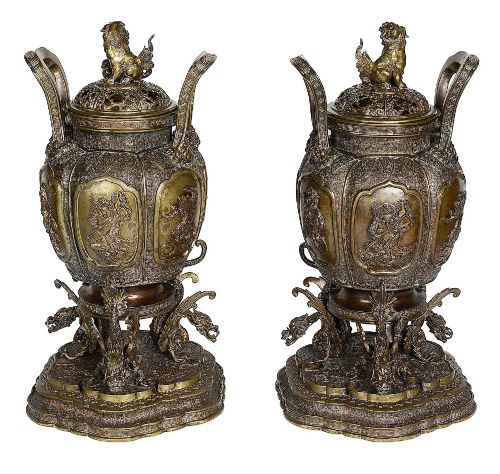
A meiji bronze censer is an incense burner originating from Japan, often taking the traditional form of a koro with a fitted lid and decorative handles. These pieces reflect the artistic output of the Meiji period alongside related items from the late nineteenth and early twentieth centuries.
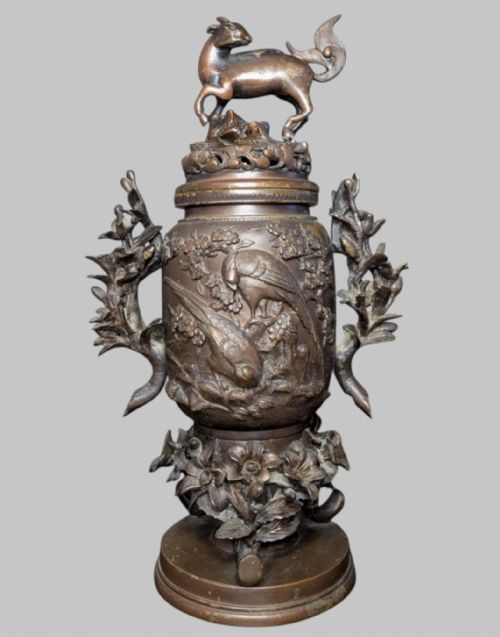
Buyers will encounter various forms on this page, ranging from compact vessels with animal finials to larger planter vessels and garniture sets. Bronze serves as the primary medium, frequently paired with enamel, silver, or gold leaf details.
The objects span styles rooted in Japanese craftsmanship, sometimes showing Victorian influence or regional crossover designations such as Oriental or Edo. Each vessel combines functional burning utility with sculptural display value.
Materials and construction
Artisans formed these vessels using cast bronze, applying patinated finishes or gilding to create deep surface tones. Many pieces incorporate copper and bronze alloys shaped into intricate dragons, ritual motifs, and botanical scenes.
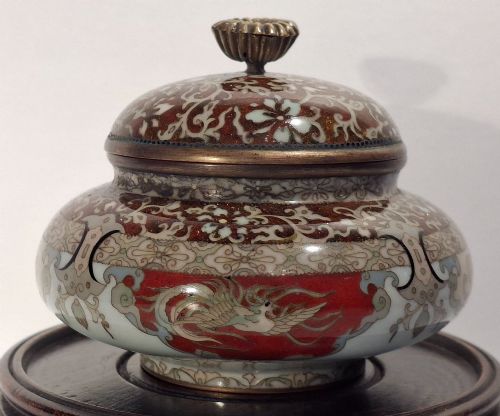
Enamel work appears frequently across the surface, utilising cloisonné and champlevé techniques to inlay colourful designs within metal cells. Cord accents and silver or gold leaf highlights complete the detailed ornamentation.
Meiji Bronze Censer Retail Price Guide 2026
Typical asking prices for meiji bronze censer among the pieces listed under this phrase on Sellingantiques today, from the lower quarter to the upper quarter. They describe what is for sale here now, not the wider market.
Materials documented on this page include standard bronze, patinated bronze, gilt bronze, copper, earthenware, cord, and gold leaf.
Assessing craftsmanship and execution
Quality rests in the crispness of the bronze casting and the precision of the surface decoration. Superior examples display sharply rendered figural elements, such as dragon details or goat finials, without soft edges.
The integration of secondary materials like enamel or silver dictates the upper tier of the range. Smooth, even patination and securely fitted lidded sections distinguish finer pieces from simpler utilitarian vessels.
Tsukamoto Hikokichi·Kizan
The Meiji Bronze Censer Glossary
- Koro
- A traditional Japanese incense burner, typically featuring a lid and tripod legs or a bowl base. These vessels are central to Japanese domestic and ceremonial spaces.
- Cloisonne
- An enamelling technique where metal wire creates raised compartments on the bronze surface to hold coloured enamel paste. This method results in intricate mosaic-like patterns.
- Champleve
- A technique where troughs are dug directly into the bronze body and filled with enamel before firing. It provides a robust, recessed colour finish.
- Patinated Bronze
- Metal treated with chemicals or heat to alter its surface colour and texture, producing aged tones from deep brown to dark green. This finish protects the metal and enhances visual depth.
- Garniture Set
- A coordinated group of decorative vessels designed to be displayed together on a mantelpiece or sideboard. Such sets usually include censers paired with vases or urns.
Meiji Bronze Censer: Frequently Asked Questions
What is a koro?
A koro is a traditional Japanese incense burner designed to hold aromatic woods or resins during burning.
These vessels usually feature a perforated lid that allows smoke to escape while keeping the burning material safely contained inside.
How do I care for a bronze censer?
Bronze censers require minimal intervention, needing only gentle dusting with a soft, dry cloth to remove particle buildup.
Avoid liquid cleaners, polishes, or abrasive cloths that can strip away the original historical patina or damage delicate enamel work.
What materials are used besides bronze?
Many censers incorporate cloisonné and champlevé enamel to add vibrant colour fields across the metal body.
Other examples include silver highlights, gold leaf accents, and decorative cord details integrated into the handles or lids.
Are these pieces strictly from the Meiji period?
While the majority align with the Meiji period and late nineteenth century, listings also span into the early twentieth century and Victorian eras.
Stylistic crossover terms such as Edo or Oriental also appear, reflecting the broader historical reach of Japanese export metalwork.