


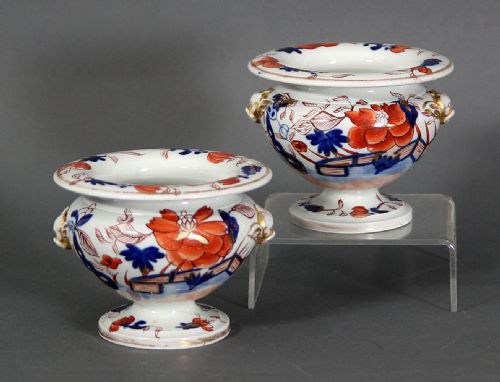


Masons China Tableware
Masons china tableware brings robust nineteenth-century utility to the table, pairing heavy ironstone bodywork with vibrant enamels and gilding.
Masons China Tableware
Masons china tableware comprises nineteenth-century ceramics designed for formal dining and practical service, including tureens, dessert services, and plates. Buyers meeting these pieces on this page will encounter nineteenth-century ironstone forms originating across the Georgian and Victorian eras.
The selection centres heavily on serving vessels such as soup tureens, sauce tureens with ladles, and dessert dishes, alongside sets of plates and salts. These items range from Regency and Victorian periods up to eighteen-eighty, reflecting durable domestic production.
Patterns span traditional schemes like Japan Basket, Old School House, and Green Mandarin, showing both Regency Imari and Victorian Imari aesthetic influences. Each form balances ornamental colour with the heavy substance characteristic of patent ironstone bodies.
Materials and construction
Masons china tableware relies upon a dense ironstone ceramic body that provides substantial weight and durability for frequent domestic use. Potters shaped this robust clay into complex serving vessels, tureens, and plates capable of withstanding heavy handling.
Surface decoration combines hand-applied enamel pigments with gold leaf and gilding over a smooth glaze. Artisans painted intricate patterns directly onto the ceramic before firing, securing deep colour saturation across motifs like Green Mandarin and Japan Basket.
Masons China Tableware Retail Price Guide 2026
Typical asking prices for masons china tableware among the pieces listed under this phrase on Sellingantiques today, from the lower quarter to the upper quarter. They describe what is for sale here now, not the wider market.
Sauce tureens come equipped with their own matching ladles, ensuring your gravy travels in nineteenth-century style.
Judging the quality
Quality in masons china tableware rests upon the crispness of the transfer printing and the precision of the hand-applied enamel work. Superior examples maintain sharp borders within complex patterns like Regency Imari without blurring across the glaze.
The preservation of the gold leaf and gilding separates finer service items from ordinary production. Stronger pieces retain vibrant metallic highlights on handles and rims, whilst lesser examples show thinning from decades of vigorous washing.
The Masons China Tableware Glossary
- Ironstone
- A heavy, durable ceramic body patented in the nineteenth century to rival imported Chinese porcelain. It resists chipping better than earthenware while remaining heavier than true porcelain.
- Imari
- A decorative style characterised by cobalt blue, iron red, and gold highlights, heavily adapted by British makers during the Regency and Victorian periods.
- Tureen
- A large deep serving dish with a lid, used traditionally for serving soup, sauce, or gravies at the dining table. Nineteenth-century examples often include matching ladles and undertrays.
- Enamel
- Vitreous coloured paints applied over the glazed ceramic surface before a final low-temperature firing. This technique secures bright greens, reds, and blues across detailed patterns.
Masons China Tableware: Frequently Asked Questions
What is masons china tableware?
Masons china tableware consists of durable nineteenth-century ceramic dining pieces made from heavy ironstone. These items include serving dishes, plates, and tureens decorated with colourful enamels and gilding.
Potters produced these sets for functional dining rooms, combining the practical strength of ironstone with ornamental styles inspired by Asian ceramics.
How do I use these in daily life?
You can utilise serving tureens and plates for actual dining or display them on sideboards as decorative focal points. Their robust ironstone construction makes them suitable for holding food during special meals.
Careful hand washing preserves the delicate enamel colours and gold leaf highlights against abrasion.
How do I date a piece?
Dating relies upon identifying stylistic markers such as Regency Imari or Victorian patterns alongside the heaviness of the ironstone body. Earlier pieces from the Georgian era often feature distinct hand-painted motifs like Green Mandarin.
Comparing the form of tureens and the application of gilding helps narrow the production window across the nineteenth century.
What patterns are common?
Common patterns include Japan Basket, Old School House, and Green Mandarin, alongside broader Regency and Victorian Imari styles. These designs make heavy use of contrasting enamel colours and gold leaf.
Each pattern reflects the nineteenth-century taste for bold, oriental-inspired motifs applied to durable British ceramics.