



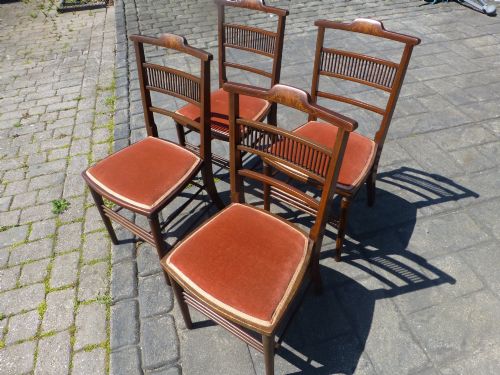
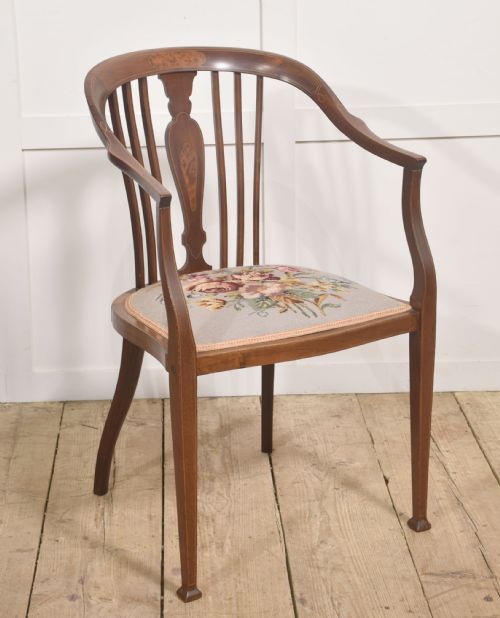


Marquetry Wooden Chairs
Marquetry wooden chairs bring patterned timber work into daily seating, uniting structural framing with intricate decorative veneers.
Marquetry Wooden Chairs
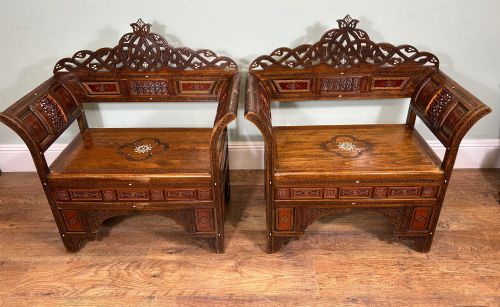
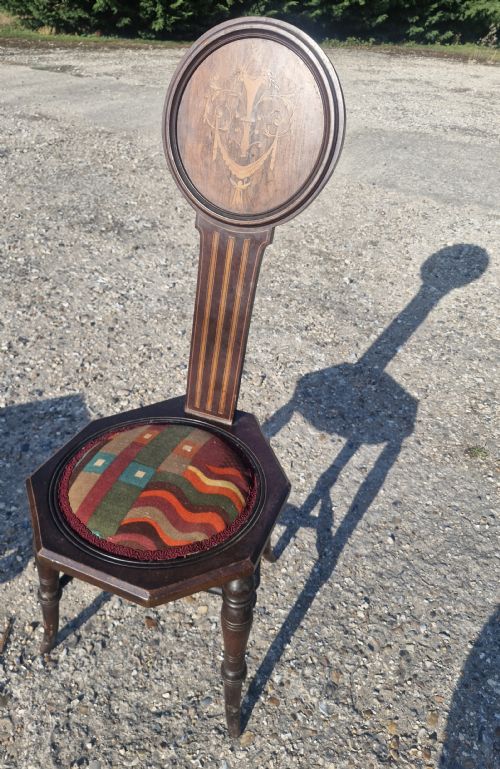
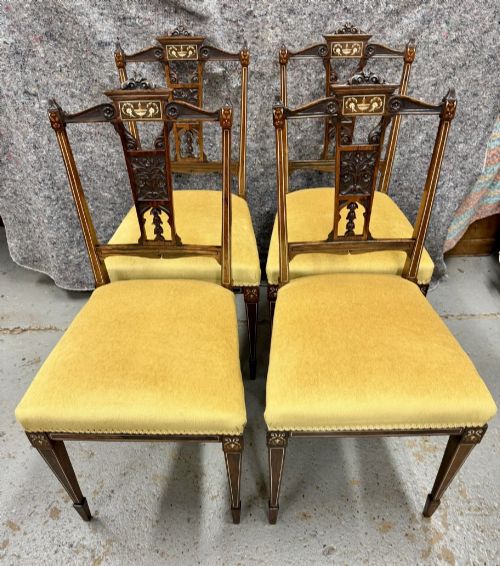
Marquetry wooden chairs encompass a variety of seating forms designed with detailed wood veneer patterns set into the primary timber frame. These pieces range from formal dining sets to occasional chairs, elbow chairs, and library desk seats.
Buyers meet Edwardian and nineteenth-century examples most frequently on this page, often constructed from mahogany, walnut, or beech. The decorative enrichment relies on contrasting woods rather than applied surface carving alone.
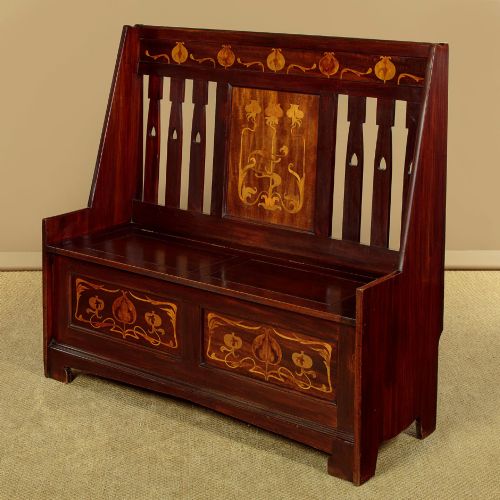
The styles span from Sheraton Revival and Art Nouveau to Moorish Revival and Arts and Crafts movements. Each period interprets timber inlay through its own prevailing aesthetic, balancing structural utility with ornate surface detail.
How they were made
Cabinet makers utilised primary structural timbers like mahogany, walnut, and oak to build the chair frames, ensuring adequate strength for daily seating. Secondary timbers provide internal stability while exterior surfaces receive the decorative treatment.
The decorative surfaces combine boxwood, satinwood, and various contrasting wood veneers cut precisely and fitted together to form pictorial or geometric designs. Brass inlay occasionally appears alongside timber work to add metallic contrast to the composition.
Veneers were glued to the underlying timber core and clamped while setting, then hand-scraped and polished to achieve a smooth finish. Artisans relied on traditional joinery methods, including mortise and tenon joints, to secure the legs, rails, and backs.
Marquetry Wooden Chairs Retail Price Guide 2026
Typical asking prices for marquetry wooden chairs among the pieces listed under this phrase on Sellingantiques today, from the lower quarter to the upper quarter. They describe what is for sale here now, not the wider market.
Periods represented span from the eighteenth century through the Victorian, Edwardian, and Arts and Crafts eras.
What varies in quality
The precision and complexity of the timber cutting dictate the refinement of the decorative surface. Tighter joints between contrasting wood veneers demonstrate greater technical skill from the cabinet maker.
The choice of primary timber and the selection of figured grain affect the visual depth of the frame. Higher quality pieces utilise dense, stable hardwoods that age gracefully and retain structural integrity under regular use.
The integrity of the underlying joinery and the survival of the original polish distinguish superior examples. Pieces that maintain their structural firmness without extensive rebuilding preserve their original character more fully.
James Shoolbred & Co.
The Marquetry Wooden Chairs Glossary
- Marquetry
- Decorative veneer work cut and fitted together to form pictures or geometric patterns on a wooden surface. This technique allows artisans to use multiple contrasting timber species within a single design.
- Satinwood
- A durable, yellowish tropical timber prized for its lustrous grain and used extensively for contrasting inlay work. It provides a bright golden tone against darker woods like mahogany.
- Sheraton Revival
- A late nineteenth-century design movement inspired by the neoclassical furniture of George Sheraton. These pieces often feature light wood inlay and elegant, restrained proportions.
- Carver armchair
- An armchair designed with open sides, historically placed at the head of a dining table. They frequently match a larger set of simpler side chairs.
- Boxwood
- A dense, pale wood commonly utilised for fine stringing and intricate inlay details. Its uniform texture permits sharp, precise cutting.
Marquetry Wooden Chairs: Frequently Asked Questions
How do I clean marquetry chairs?
Dust surfaces regularly with a soft, dry cloth to prevent dirt accumulation. Avoid harsh chemical cleaners that can damage the delicate veneer and polish.
Apply a microcrystalline wax periodically to nourish the wood and protect the inlay work from moisture. Keep the chairs away from direct sunlight and heat sources to prevent timber shrinkage.
Are these chairs suitable for daily use?
Many examples are structurally robust enough for regular seating if the joints remain firm and stable. Lighter occasional chairs function best in low-traffic settings.
Inspect the joinery periodically to ensure the frame handles weight distribution safely. Dining chairs and library desk chairs offer the most reliable support for extended sitting.
What is the difference between marquetry and inlay?
Inlay involves inserting pieces of wood or other materials into a recessed cavity carved directly into solid timber. It tends to feature simpler geometric lines or stringing.
Marquetry covers the entire surface with a pictorial veneer puzzle assembled beforehand on paper. This technique creates complex floral, architectural, or figurative scenes across the wood.
How do I identify Edwardian marquetry?
Edwardian pieces frequently combine mahogany frames with satinwood and boxwood inlay in light, airy Sheraton Revival styles. The manufacturing methods often blend machine precision with hand finishing.
Look for bright, polished finishes and symmetrical floral or ribbon motifs typical of the early twentieth century. The timber framing is generally lighter and more slender than heavier Victorian equivalents.