

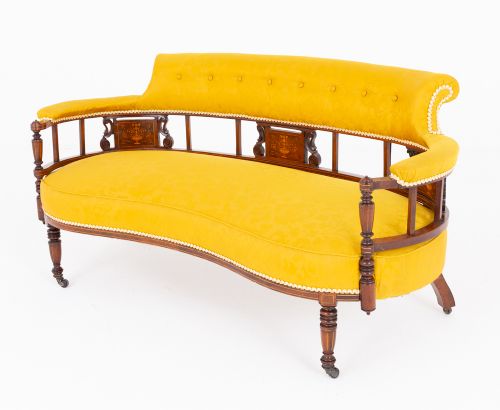


Marquetry Wood Settee
These marquetry wood settee examples combine elaborate inlaid timber surfaces with period seating forms, bringing warmth and intricate pattern into a room.
Marquetry Wood Settee
A marquetry wood settee functions as a principal seating piece while displaying decorative wood inlay across its timber frame. Buyers hunting for a marquetry wood settee encounter forms spanning the Victorian, Late Victorian, and Edwardian eras, alongside specific revival movements like Egyptian Revival and Moorish Revival.
The prevailing examples on this page are Edwardian and Victorian mahogany or rosewood sofas featuring inlaid details. These range from single couches and end of bed seating to matched suites comprising settees and armchairs.
Makers fashioned these pieces using diverse structural layouts, from standard twin-arm sofas to specialised end of bed forms and matching seating groups. Each piece relies on timber framing enriched with contrasting wood veneers and botanical or geometric motifs.
Construction and Materials
Craftsmen built the foundational frames of these settees using dense hardwoods such as mahogany and rosewood. These sturdy timbers provided the structural support required for domestic seating while offering dark, uniform grain that contrasted sharply with lighter decorative elements.
Surface ornamentation relied on meticulous inlay techniques incorporating satinwood, bone, and brass details. Artisans fitted these contrasting materials directly into the primary timber ground to create elaborate floral, ribbon, or geometric marquetry patterns.
Upholstery completed the construction, utilising textiles like damask and various patterned fabrics fixed over sprung or padded seats. This soft furnishing layer balanced the rigid geometry and cold touch of the polished wood and metallic inlays.
Marquetry Wood Settee Retail Price Guide 2026
Typical asking prices for marquetry wood settee among the pieces listed under this phrase on Sellingantiques today, from the lower quarter to the upper quarter. They describe what is for sale here now, not the wider market.
Some Edwardian makers thoughtfully designed slender inlaid couches specifically to sit gracefully at the foot of a grand bed.
Assessing Craftsmanship and Execution
Quality in these pieces rests upon the precision of the timber inlay and the crispness of the surrounding joinery. Superior examples demonstrate tight joints between contrasting wood veneers, where satinwood and bone sit completely flush within the mahogany or rosewood ground without visible gaps or excessive adhesive.
The ambition of the design distinguishes standard production from exceptional work. Pieces incorporating specialised revival motifs, such as Egyptian Revival or Moorish Revival elements, display a more complex sculptural vocabulary than simpler domestic seating.
The Marquetry Wood Settee Glossary
- Marquetry
- Decorative veneer work where pieces of wood, bone, or other materials are assembled in a mosaic pattern to form ornamental designs on a wooden ground. This technique transforms a plain timber surface into a pictorial or geometric display.
- Settee
- An upholstered bench with a back and arms, designed for multiple occupants. It serves as a principal seating form in domestic interiors.
- Satinwood
- A durable, lustrous yellow-brown timber imported from tropical regions, frequently utilised for contrasting inlay work. Its bright tone stands out sharply against darker woods like mahogany and rosewood.
- Damask
- A reversible figured fabric traditionally woven on a drawloom with patterns formed by contrasting warp and weft threads. It provides a textured, patterned upholstery surface suitable for formal period seating.
- Egyptian Revival
- An architectural and decorative style drawing inspiration from ancient Egyptian motifs and iconography. Pieces in this style incorporate distinct cultural symbols and linear forms into nineteenth-century furniture.
Marquetry Wood Settee: Frequently Asked Questions
What periods do these settee pieces come from?
The available selection spans from the late nineteenth century through the Edwardian era. Pieces frequently date to the Victorian period, Late Victorian years, and the early twentieth century.
Specific stylistic influences also include Egyptian Revival and Moorish Revival movements from the nineteenth century.
Which woods are used in these settees?
Primary timber frames are predominantly constructed from dense, dark hardwoods such as mahogany and rosewood. These provide a stable and robust foundation for daily use.
Secondary materials like satinwood, bone, and brass appear specifically as contrasting inlays to create decorative surface patterns.
How were these settees originally used?
These pieces served as formal or comfortable seating in principal rooms of period homes. Certain variations, such as end of bed sofas, were specifically tailored for bedroom placement.
Larger configurations often formed part of matching seating suites alongside accompanying armchairs.
What upholstery materials do they feature?
Upholstery on these seats commonly includes damask and various decorative woven fabrics. These textiles cover padded or sprung seat structures.
The soft furnishings complement the polished timber frames and intricate wood inlays.