
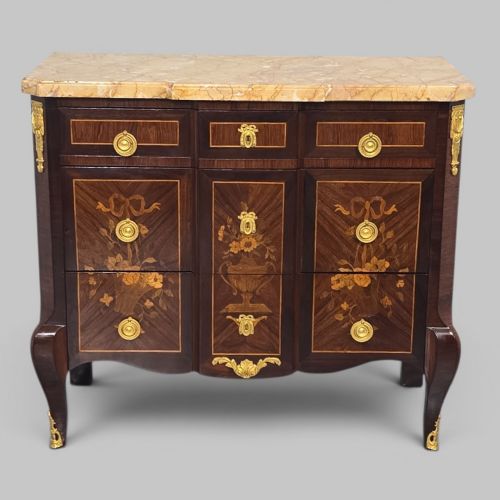


Marquetry Rosewood Commode
These marquetry rosewood commode pieces bring continental elegance to a room, offering striking inlaid surfaces paired with practical storage.
Marquetry Rosewood Commode
A marquetry rosewood commode represents a sophisticated form of French storage furniture, typically functioning as a chest of drawers, cabinet or side cabinet. These pieces frequently emerge in continental designs such as French Louis XV style, French Rococo, Louis XVI, and Louis XVI transitional.
The buyer meets variations ranging from demi-lune cabinets and petite commodes to larger chests of drawers featuring elaborate marquetry inlay. Many examples incorporate marble tops and gilt metal mounts, reflecting the decorative tastes of the eighteenth, nineteenth, and early twentieth centuries.
How they were made
Cabinetmakers constructed these pieces using a carcase of supportive timber veneered with exotic woods including rosewood, kingwood, tulipwood, satinwood, and walnut. Artisans cut and fitted contrasting veneers by hand to create intricate pictorial or geometric marquetry patterns across the drawer fronts and sides.
Finished objects frequently incorporate ormolu or gilt metal mounts to highlight the structural contours, alongside fitted marble slabs shaped precisely to the top of the commode.
Listings feature pieces spanning the eighteenth century through to the 1930s, encompassing marble, ormolu, and multiple exotic wood veneers.
What varies in quality
The fineness of the marquetry cutting and the complexity of the wood grain selection dictate the visual impact of the piece. Crispness in the cast ormolu mounts and the thickness and polish of the fitted marble top further distinguish finer examples.
Structural integrity, including the smoothness of the drawer action and the survival of the original veneer without lifting or excessive shrinkage, marks the difference between standard production and superior craftsmanship.
Mercier Frères
The Marquetry Rosewood Commode Glossary
- Marquetry
- A decorative technique of applying thin veneers of wood in complex patterns to form pictorial designs. Artisans carefully fit contrasting timbers together before gluing the composition to the furniture carcase.
- Commode
- A low chest of drawers or cabinet developed in France during the seventeenth century. The form typically stands on relatively tall legs and serves both decorative and storage functions.
- Ormolu
- Gilt bronze mounts applied to furniture for decorative and protective purposes. The metal is cast, chased, and gilded to provide a bright metallic contrast against dark wood veneers.
- Kingwood
- A dense, richly figured timber featuring dark violet-brown tones with lighter streaks. Cabinetmakers valued this material for contrasting borders and geometric banding in marquetry work.
- Demi-lune
- A half-moon shape characteristic of commodes and cabinets designed to stand flat against a wall. This curved form requires specialised veneer work to follow the radius smoothly.
Marquetry Rosewood Commode: Frequently Asked Questions
Where should I place a commode?
These pieces suit reception rooms, grand hallways, or bedrooms where their decorative marquetry and marble tops can be appreciated. They provide surface display space alongside enclosed drawer storage.
Ensure the room humidity remains stable to protect the delicate wood veneers and underlying timber carcase from warping or cracking over time.
How do I care for the marble top?
Wipe the marble surface regularly with a soft, damp cloth and dry it immediately to prevent water marks or staining. Avoid acidic cleaning products that can etch the polished stone finish.
Lift objects rather than sliding them across the marble or the veneered wood surfaces to prevent scratching.
How can I tell the period?
Examine the construction methods, timber selection, and stylistic cues such as the transition from curved Louis XV lines to the straighter neoclassical forms of Louis XVI. Eighteenth-century pieces display hand-cut joinery and period-specific framing.
Nineteenth and early twentieth-century revivals often utilise similar decorative vocabularies but reveal different secondary timbers and mechanical fastening methods upon closer inspection.
What is the difference between kingwood and rosewood?
Rosewood generally displays a deep brown colour with distinct dark grain patterning, whereas kingwood tends to feature violet-brown tones with lighter golden streaks. Both were favored by cabinetmakers for their rich natural colours and ability to take a high polish.
Combinations of these timbers frequently appear together within the same marquetry panel to create tonal contrast.