



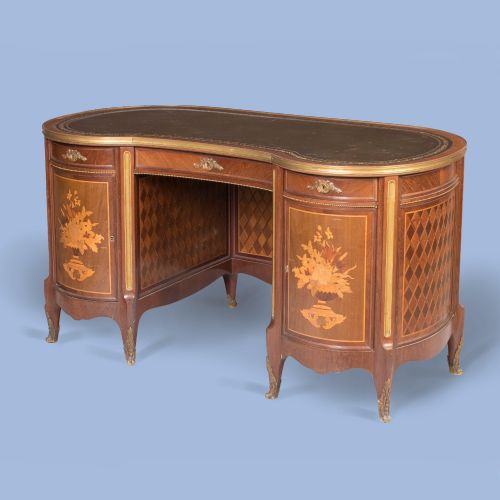


Marquetry Kidney Desk
These marquetry kidney desks combine an intimate serpentine profile with intricate wood-inlay surfaces, offering a refined workspace shaped for comfort and elegance.
Marquetry Kidney Desk
A marquetry kidney desk provides a distinctive curved writing surface designed to curve gently around the user. These pieces emerge across the nineteenth century and into the Edwardian period, drawing upon earlier French and English cabinet-making traditions.
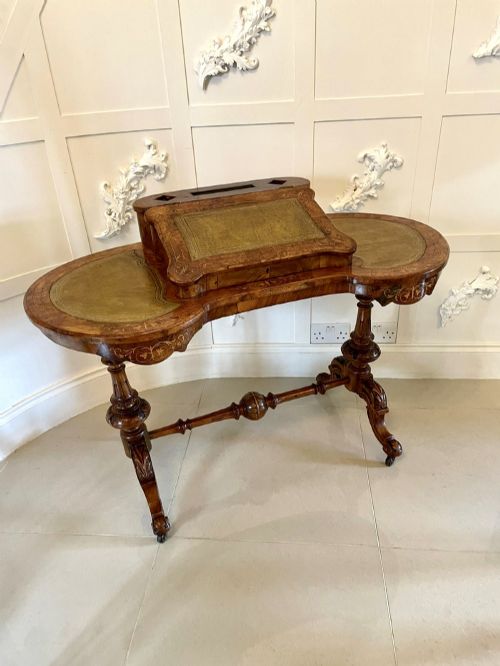
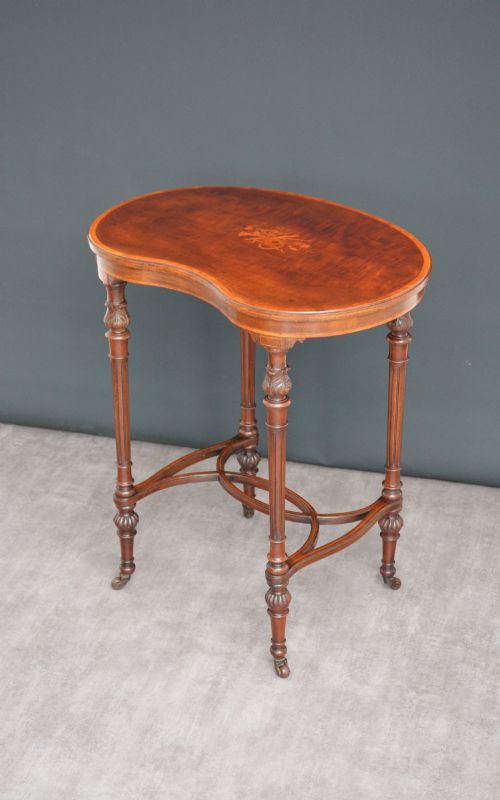
The version most commonly encountered on this page is the mahogany or burr walnut writing table, often detailed with satinwood inlay and standing on slender tapering legs. Examples range from compact occasional side tables to substantial freestanding kneehole desks.
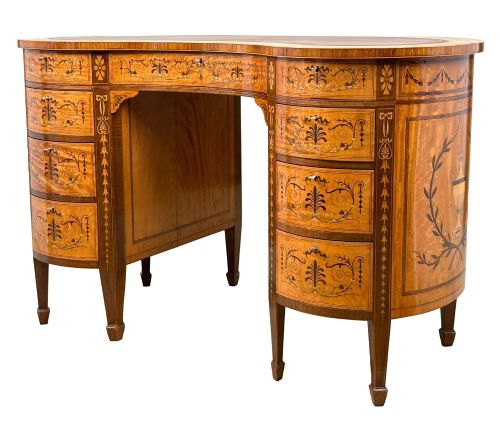
Cabinet makers produced these tables in various revivals, notably Sheraton Revival and Louis XV styles. Their serpentine silhouette makes them particularly suited for placement away from walls, showing decorated backs to the room.
Materials and construction methods
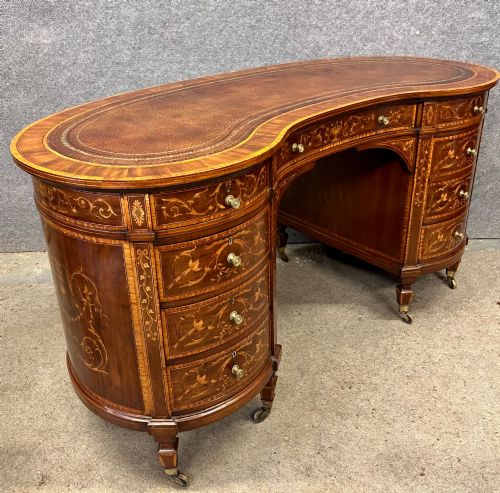
Craftsmen built the carcases using foundational timbers such as mahogany, walnut, and rosewood, applying contrasting veneers of satinwood, kingwood, and burr walnut across the curved tops. Fine floral and geometric marquetry patterns were meticulously hand-cut and pieced together before being set into the primary wood.
Metal components such as cast brass handles, scrolling ormolu mounts, and tooled leather writing surfaces complete the construction. Joinery had to accommodate the difficult curved perimeters of the kidney shape without compromising structural rigidity.
Marquetry Kidney Desk Retail Price Guide 2026
Typical asking prices for marquetry kidney desk among the pieces listed under this phrase on Sellingantiques today, from the lower quarter to the upper quarter. They describe what is for sale here now, not the wider market.
Primary timbers recorded across the collection include mahogany, burr walnut, satinwood, rosewood, and kingwood.
Judging quality and execution
The distinction between standard pieces and exhibition-grade examples rests upon the depth and precision of the marquetry work. Superior items display intricate shading within the veneers, utilising varied timber grains to create naturalistic floral motifs.
Attention to secondary details separates finer workshops from mass production. Well-executed pieces feature matching veneer grains across the drawers, finely chased ormolu mounts, and fully finished backs intended for freestanding placement.
Edwards & Roberts
The Marquetry Kidney Desk Glossary
- Marquetry
- A technique where decorative patterns are formed by fitting together small pieces of tinted or textured wood veneer onto a structural carcase. This meticulous method allows for elaborate pictorial designs on desktop surfaces.
- Kidney desk
- A writing table characterised by a concave front curve that wraps around the seated user. The distinctive kidney outline demands specialised joinery and custom-fitted drawers.
- Ormolu
- Gilded bronze mounts applied to furniture for decorative accent and edge protection. These cast metal ornaments are typical of French revival designs.
- Satinwood
- A lustrous, hard timber featuring a golden-yellow sheen frequently utilised for contrasting inlay work and banding. It provides bright detail against darker grounds like mahogany and rosewood.
Marquetry Kidney Desk: Frequently Asked Questions
What is a marquetry kidney desk?
A marquetry kidney desk is a specialised writing table featuring a curved, bean-shaped top decorated with intricate wood-inlay patterns. These tables were designed to provide a comfortable, wrap-around workspace.
Cabinet makers utilised timbers like mahogany, satinwood, and burr walnut to create these distinctive forms during the nineteenth and early twentieth centuries.
How were these desks used historically?
These desks served as private writing tables or ladies' desks, often positioned near windows or freestanding in the centre of a room. Their compact proportions suited correspondence and light reading.
The finished backs allowed the tables to sit openly in a drawing room or library rather than pushed against a wall.
How do I identify an Edwardian example?
Edwardian examples often display Sheraton Revival influences, featuring bright satinwood banding, delicate floral marquetry, and slender tapered legs. These pieces typically date from around 1890 to 1910.
Makers from this era frequently combined mahogany or rosewood carcases with intricate crossbanding and fine brass hardware.
Are these desks suitable for daily work?
Many of these tables function well for modern laptop use or writing, provided the writing height matches your chair. Their serpentine fronts offer a natural, enclosed seating position.
Protecting the leather insert and delicate veneer surfaces with appropriate care ensures these antique writing tables remain practical.