



Marquetry Demi Lune Console Tables
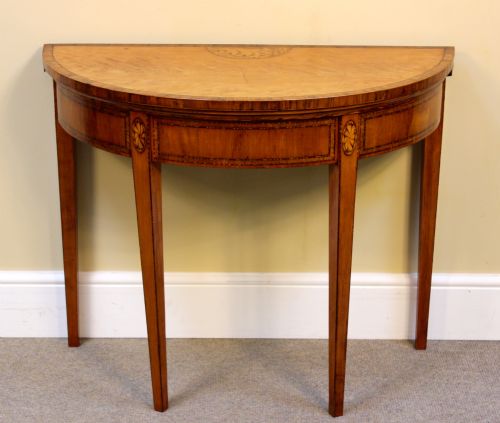
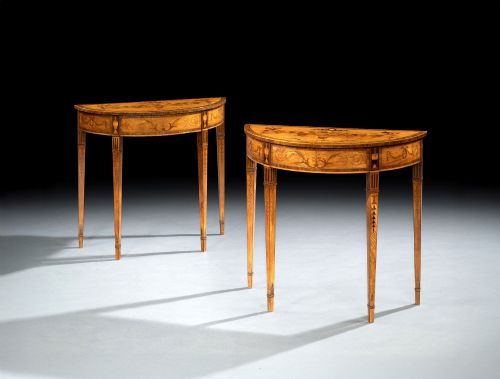
These marquetry demi lune console tables bring half-moon elegance to a hallway or drawing room, prized for their curved timber tops and intricate floral or neoclassical inlays.
Marquetry Demi Lune Console Tables
Marquetry demi lune console tables take their name from their characteristic semicircular shape designed to stand flat against a wall. The form appears most frequently in eighteenth-century George III pieces and nineteenth-century French revival designs.
Makers shaped these semi-circular surfaces to serve various functions, producing dedicated console tables alongside dual-purpose card tables, games tables, and tea tables with folding leaves.
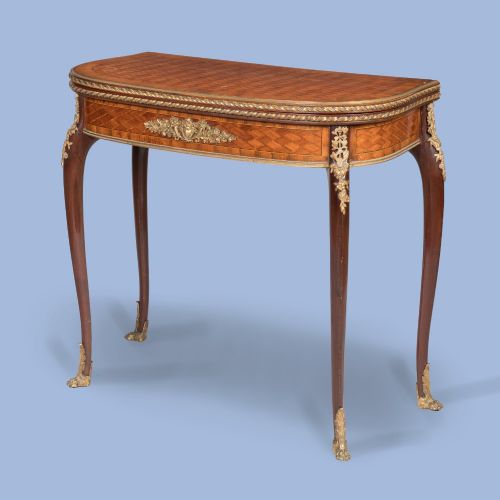
Examples on this page span the Georgian, Victorian, and Edwardian eras, incorporating stylistic influences from Louis XV and Louis XVI alongside Neoclassical patterns.
Materials and construction
Cabinetmakers constructed the carcases using foundational timbers such as mahogany, walnut, and satinwood, applying decorative veneers of kingwood and boxwood across the curved surfaces.
The characteristic surface decoration relies on marquetry inlay, where contrasting wood veneers form pictorial or geometric motifs, occasionally enhanced by ormolu mounts and cast brass details.
Marquetry Demi Lune Console Tables Retail Price Guide 2026
Typical asking prices for marquetry demi lune console tables among the pieces listed under this phrase on Sellingantiques today, from the lower quarter to the upper quarter. They describe what is for sale here now, not the wider market.
Materials range from dark mahogany and burr walnut to bright satinwood, complemented by brass, ormolu, and boxwood details.
Evaluating quality and execution
Quality rests in the precision of the marquetry cutting and the choice of timbers, where tightly figured satinwood and richly grained kingwood elevate an individual piece above standard mahogany alternatives.
The refinement of the neoclassical motifs, the crispness of any giltwood or ormolu mounts, and the structural integrity of the curved framework distinguish exhibition-grade works from everyday domestic furniture.
François Linke·Joseph-Emmanuel Zwiener·Pietro Ferrario
The Marquetry Demi Lune Console Tables Glossary
- Demi-lune
- A half-moon shape used for table tops and cabinet fronts designed to sit flush against a wall. This profile became particularly fashionable during the Georgian and late Victorian periods.
- Marquetry
- The art of applying small pieces of wood veneer to a structure to form decorative patterns or pictures. Craftsmen selected various contrasting timbers to achieve natural shading without paint.
- Ormolu
- Gilded bronze mounts applied to furniture for decorative effect. French nineteenth-century pieces frequently employ these cast bronze details around the apron and legs.
- Satinwood
- A yellow-brown timber with a natural sheen, highly favored by eighteenth-century cabinetmakers for fine veneer work. It provides a bright ground for intricate marquetry designs.
- Parquetry
- Geometric wood inlay forming repeating patterns such as cubes or chequers. It differs from marquetry by using angular shapes rather than pictorial or floral curves.
Marquetry Demi Lune Console Tables: Frequently Asked Questions
How do you style a console table?
These console tables sit flat against a wall, making them ideal for entryways, hallways, or living rooms beneath a mirror or painting. Their shallow depth ensures they remain unobtrusive while providing a surface for decorative objects or lamps.
Many examples include folding leaves, allowing the furniture to function as a compact side table when closed and a larger games table when opened.
What is the difference between marquetry and inlay?
Inlay involves inserting pieces of wood, metal, or shell into a recessed cavity carved directly into a solid wooden surface. Marquetry covers the entire carcase surface with a mosaic of fitted veneers that form a complete picture or pattern.
Most tables on this page use marquetry to create elaborate floral or neoclassical motifs across the satinwood and mahogany tops.
How can you tell a Georgian table from a later copy?
Georgian pieces from the eighteenth century rely on construction methods, timber ageing, and hand-cut joinery specific to the period. Later nineteenth-century revivals and Edwardian copies often incorporate different secondary woods and machine-finished components.
Examining the underside and drawer linings reveals the tool marks and construction details that indicate the true age of the piece.