


Maritime Folk Art Painting
A maritime folk art painting captures the raw energy of the sea through the unpretentious hands of self-taught makers and sailors.
Maritime Folk Art Painting
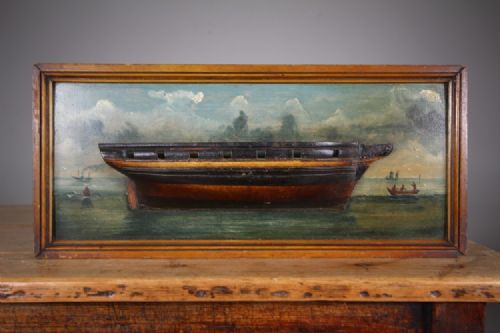
When you search for a maritime folk art painting, you enter a diverse world of visual records documenting ships, coastal life, and maritime toil from the nineteenth and early twentieth centuries. These works emerge primarily as oil paintings, watercolours, and painted wooden panels created by provincial artists, sailors, and local craftsmen who observed the sea from the shore or the deck.
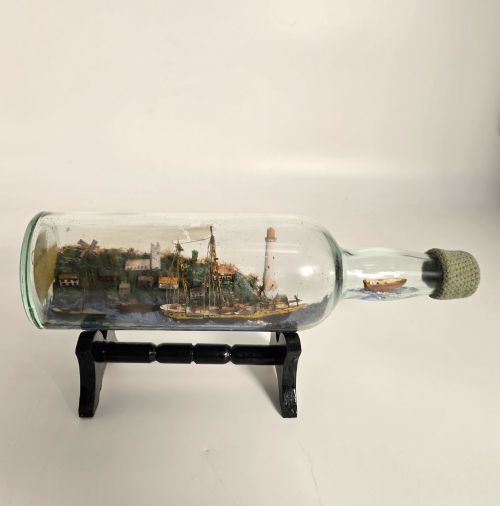
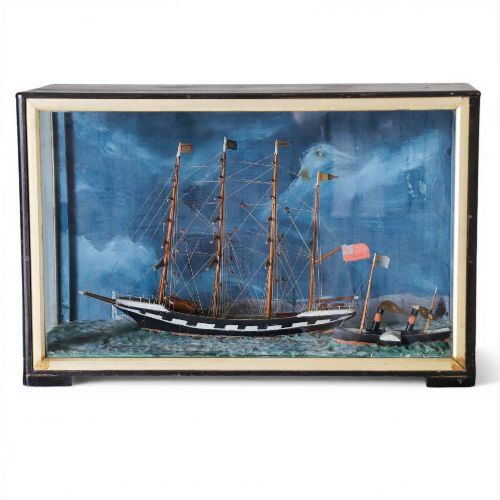
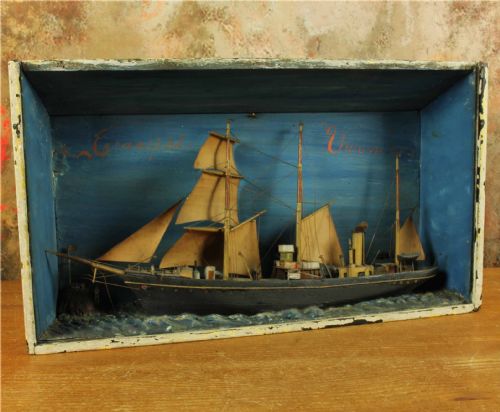
The pieces you are most likely to encounter on this page span the Victorian era up to the 1930s, often blending naive perspective with a strict observational accuracy regarding rigging and hull forms. Alongside flat canvases, the category stretches to encompass painted panels and related diorama works that share the same vernacular aesthetic.
Makers ranged from professional provincial portraitists recording fisher folk to seamen passing time on long voyages with whatever pigments and scrap timber came to hand. Their output avoids the rigid academic conventions of formal marine art, prioritising character, atmosphere, and direct storytelling over technical perfection.
How they were made
These works rely on simple, accessible media applied to whatever suitable surfaces were locally available, predominantly oil paint on canvas, wood panels, and occasional paper supports. Painters utilised basic brushes and standard artist oils alongside house paint or repurposed pigments, building up flat, robust layers designed to withstand humid coastal environments.
Supporting structures and frames frequently incorporate salvaged timber, pine, and glass gathered by coastal communities. The construction methods reflect vernacular carpentry and signwriting techniques, where panels were joined simply and surfaces coated to protect the imagery from salt air and damp.
Some makers painted ships so accurately that retired captains could name the exact rigging blunder from across the room.
What varies in quality
The distinction between ordinary and exceptional pieces rests entirely on the vigour of the composition and the honesty of the materials. Stronger examples display a confident, unstudied handling of light and water, whereas weaker ones tend to stiffen into lifeless mechanical repetition.
Surface preservation and originality play a major role in determining the standing of a piece. Works that retain their original uncleaned paint layers and early framing carry a greater integrity than those dulled by heavy-handed restoration or later overpainting.
James Kyd·William Shayer·James G. Faulds·Liverpool Ship Building Co.
The Maritime Folk Art Painting Glossary
- Oil Paint
- A slow-drying paint made of pigment particles suspended in a drying oil, commonly linseed. This medium allows for rich blending and textured impasto that survives well on wood panels and canvas.
- Panel
- A flat piece of wood used as a rigid support for painting instead of stretched canvas. Pine and various hardwoods served this purpose frequently in provincial workshops.
- Naive
- A stylistic term describing art produced by someone without formal academic training. It is characterised by a charming disregard for linear perspective and a direct focus on narrative detail.
- Seascape
- A painting or other work depicting the sea, ships, or coastal views. These subjects formed the core output of marine-focused folk artists documenting local waters.
- Watercolour
- A painting method in which the paints are made of pigments suspended in a water-based solution. These works on paper require protection behind glass to prevent moisture damage.
Maritime Folk Art Painting: Frequently Asked Questions
What is maritime folk art?
Maritime folk art encompasses objects, paintings, and models created by self-taught makers, sailors, and coastal residents to record ships and coastal life. These pieces celebrate the sea through unpretentious materials and direct observation rather than academic rules.
They offer a raw and honest window into nineteenth and early twentieth-century maritime culture, shaped by the hands of people who lived and worked near the water.
How do I date these paintings?
Dating relies heavily on the style of the vessels depicted, the framing methods, and the type of canvas or wood panel used. Costume details on any figures included also provide reliable chronological clues.
Changes in shipbuilding technology reflected in the art help narrow down the period, moving from early nineteenth-century sailing ships to later steam vessels and twentieth-century craft.
Where were these pieces made?
They originated in coastal ports, fishing villages, and aboard ships across Britain, Ireland, and continental Europe. Local craftsmen and travelling painters produced them wherever the sea played a central role in daily commerce and life.
Regional variations appear in the choice of wood and framing styles, reflecting the local materials accessible to the maker at the time.
How should I display them?
These works suit traditional and eclectic interiors alike, pairing well with natural wood furniture and other coastal artefacts. Keep them away from direct sunlight and damp walls to protect the paint and wood.
Allowing sufficient breathing room around each piece lets the naive charm and strong textures of the surface stand out properly in a room.