
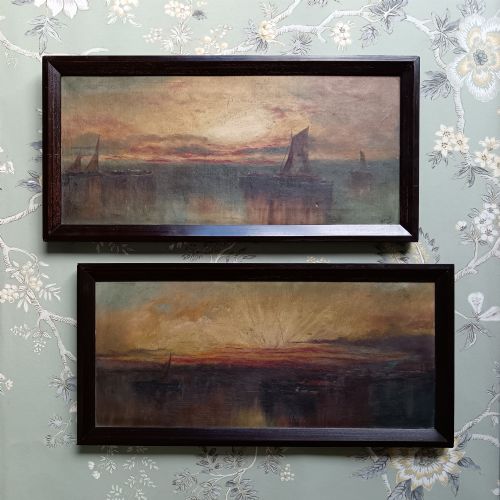
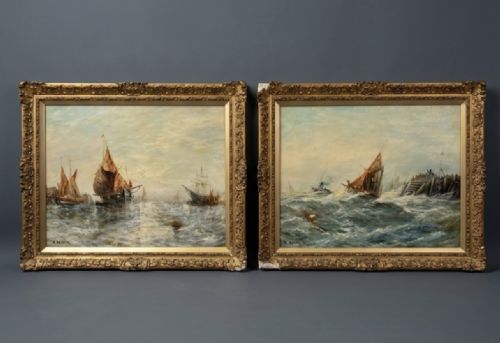
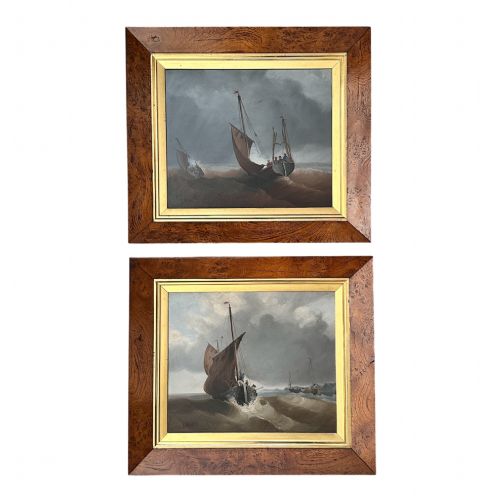
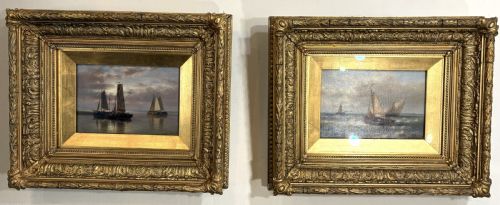


Maritime Artwork Pair
These maritime artwork pair selections capture coastal life, shipping and open seas through matched compositions created to hang together.
Maritime Artwork Pair
A maritime artwork pair brings together two complementary marine scenes, most commonly executed as oil paintings on canvas or board, alongside watercolours and enamel plaques. Buyers hunting this phrase encounter matched views of sunrise and sunset, companion coastal vistas, or paired depictions of shipping and fishing vessels.
The pieces on this page span the Victorian and Edwardian eras down to the early twentieth century, originating from British, Dutch and European hands. Subjects range from bustling harbours and tidal rivers to tranquil coastal shores and dramatic open seas.
Companionship defines the form, with artists typically painting parallel scenes to balance composition, palette and subject matter across two frames. This duality makes them suited for flanking a fireplace or anchoring a symmetrical wall arrangement.
How they were made
Canvas stretched over wooden frames provides the primary ground for these oils, though board and paper watercolours also appear frequently in the selections. Pigments mixed in oil allow for rich atmospheric effects in sky and water, while watercolours rely on fluid washes applied to paper.
Frames play a crucial role in presentation, utilising giltwood and gold leaf moulding or ebonised timber to complement the maritime subject matter. Enamel plaques offer an alternative medium, fired with vitreous colours to create durable pictorial surfaces.
Materials across these listings include oil paint, canvas, wood, giltwood, gold leaf, paper, glass and enamel.
What varies in quality
The handling of light and atmospheric depth distinguishes exceptional works from routine production, particularly in the depiction of turbulent seas, coastal mist and evening skies. Stronger pieces reveal confident brushwork that captures the movement of water and the rigging of vessels with precision.
The integrity of the pairing itself influences the stature of the works, depending on whether the two items were conceived, signed and framed as true companion pieces by the same hand. Original matching frames further elevate the cohesion and visual impact of the matched set.
John Moore of Ipswich·Abraham Hulk I·Gustave De Bréanski·Pieter Cornelis Dommersen·Adrian Van Porten·George Dodgson Callow·Leslie Rackham·Jan van Couver·Thomas Bush Hardy·Ebeneezer Colls·Hubert Thornley·John James Wilson·Walter Meegan·Thomas Rose Miles·John Mc Ghie·Francis Moltino·Walter Williams·Gordon Meadows
The Maritime Artwork Pair Glossary
- Giltwood
- Wood carved and coated with gold leaf or metallic paint to create a decorative frame. This finish is typical for period maritime paintings.
- Seascape
- A painting, watercolour or other artwork depicting the sea, coastal views or marine activity. These compositions form the core of maritime pairs.
- Gouache
- An opaque water-based medium often used alongside watercolour to add highlights and solid colour to coastal scenes. It provides greater opacity than traditional watercolour.
- Board
- A rigid wooden or pasteboard panel used as a painting support instead of stretched canvas. Artists often utilised board for smaller coastal studies.
Maritime Artwork Pair: Frequently Asked Questions
What subjects appear in these pairs?
The compositions record fishing boats, merchant shipping, coastal cliffs and tidal rivers across British and European waterways. Scenes often pair contrasting moments like sunrise and sunset, or departure and return.
Harbours, estuaries and open coastal waters dominate the subject matter, reflecting nineteenth and early twentieth century maritime commerce and leisure.
How should I hang a matched set?
Companion works hang best at eye level, spaced evenly to allow the matching frames and subjects to create a balanced visual focal point on the wall. They suit placement above mantelpieces, sideboards or along hallway expanses.
Keeping both pieces in direct natural light should be avoided to protect canvas, paper and pigments from fading over time.
Are watercolours as durable as oils?
Watercolour paintings utilise paper and pigment protected beneath glass, requiring stable indoor environments away from direct sunlight to prevent fading. Oil paintings on canvas or board offer greater physical resilience against environmental changes.
Both mediums survive well for over a century when framed securely and kept clear of damp conditions.
How do I identify the period of the artwork?
Framing styles, canvas stamps, artist signatures and backing materials provide key indicators of age, pointing towards Victorian or Edwardian manufacture. Subject dress and ship rigging also offer reliable chronological clues.
Comparing signatures against known exhibition dates helps narrow the timeline of execution.