

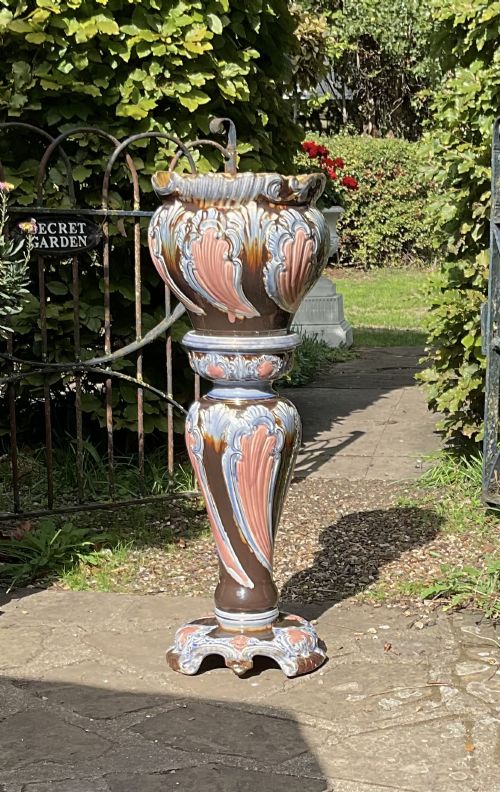
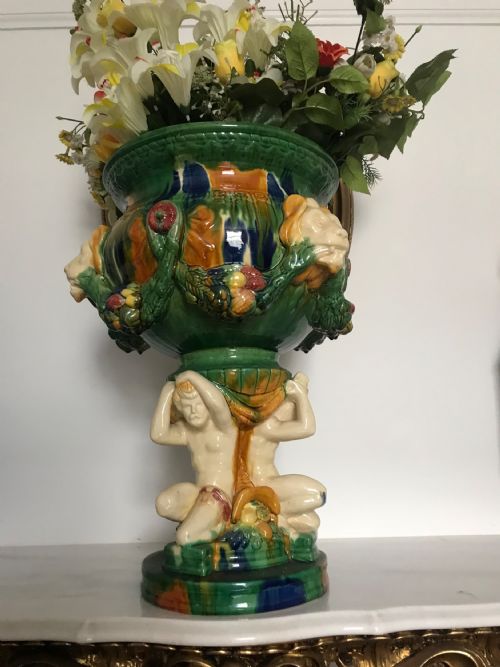


Majolica Pedestal Planter
These majolica pedestal planter examples bring vibrant colour and bold form to interiors, offering striking structural botanical displays.
Majolica Pedestal Planter
A majolica pedestal planter combines a large bowl-form jardiniere with a matching architectural or figural support stand. Pieces appearing here span the Victorian, Edwardian and Art Nouveau eras, alongside Grand Tour Italian examples dating from the nineteenth century into the early twentieth century.
The dominant configurations on this page pair deep circular jardiniere bowls with robust earthenware pedestals. Formats range from naturalistic plant stands featuring swans and griffins to classical Italian Renaissance Revival urns and geometric Secessionist centrepieces.
Materials and production methods
Potters built these substantial vessels using earthenware and terracotta bodies shaped to hold heavy soil and moisture. Artisans applied opaque lead glazes directly onto the clay base, creating the characteristic vibrant coloured surface sheen associated with majolica.
Makers achieved decorative variation through specialised techniques including lustre glazes and hand-painted figural reliefs. Relief mouldings such as lions' heads and animal supports were cast separately before assembly and firing.
Majolica Pedestal Planter Retail Price Guide 2026
Typical asking prices for majolica pedestal planter among the pieces listed under this phrase on Sellingantiques today, from the lower quarter to the upper quarter. They describe what is for sale here now, not the wider market.
Watch for vigilant porcelain swans and fierce earthenware griffins holding up the flowerpots.
Distinguishing quality across examples
Quality rests upon the crispness of moulded detail and the depth of the glaze application. Finer pieces display sharply defined figural elements like griffins and swans, whereas lesser examples show softer contours from worn production moulds.
The sophistication of the glaze palette distinguishes standard production from notable studio output. Rich polychrome finishes and iridescent lustre treatments indicate superior execution compared to flat, uniform colour washes.
Clement Massier·Minton Secessionist·Julius Dressler·Burmantofts·Eichwald
The Majolica Pedestal Planter Glossary
- Majolica
- Glazed earthenware decorated with opaque coloured lead glazes over a white tin enamel or directly on the clay body. This technique produces deep chromatic richness across the surface.
- Jardiniere
- An ornamental pot or stand designed to hold growing plants or flowers. These vessels often sit atop matching pedestals to elevate botanical displays.
- Lustre glaze
- A metallic film applied to pottery that creates an iridescent sheen upon firing. This finish shifts in appearance depending on the angle of light.
- Terracotta
- Fired unglazed or glazed clay of a brownish-red colour used for structural gardenware and planters. The porous material suits both indoor and sheltered outdoor placement.
- Renaissance Revival
- A nineteenth-century design style drawing inspiration from classical Italian motifs and architectural forms. Pieces in this idiom feature formal symmetry and bold relief decoration.
Majolica Pedestal Planter: Frequently Asked Questions
What is a majolica pedestal planter?
A majolica pedestal planter is a two-part ceramic assembly consisting of a large plant bowl and a matching floor support. These pieces are glazed in bright, opaque colours and often decorated with high-relief motifs.
They serve primarily as decorative indoor plant stands or architectural focal points for large entrance halls and reception rooms.
How do I date a majolica pedestal planter?
Dating relies on stylistic clues, manufacturing marks, and glaze characteristics that align with specific production eras. Victorian and Edwardian examples often feature naturalistic animal forms, while later pieces adopt Art Nouveau or Secessionist geometry.
Examining the base and interior clay body also helps determine whether a piece originates from nineteenth-century Italy or later British and European potteries.
Where were these planters placed historically?
Historically, large ceramic jardiniere stands occupied prominent positions in Victorian conservatories, drawing rooms, and hallways. Their substantial height and colourful glazes made them ideal for displaying ferns and palms.
Today, buyers place them in similar high-impact interior spaces where their architectural scale can be fully appreciated.
What materials make up majolica planters?
These planters consist principally of earthenware or terracotta bodies formed into heavy vessel and pedestal components. Artisans coated these porous clay foundations in rich, coloured lead glazes.
Specialist finishes like metallic lustre or tin-opacified coatings were frequently added to enhance the visual depth of the modelled relief work.