






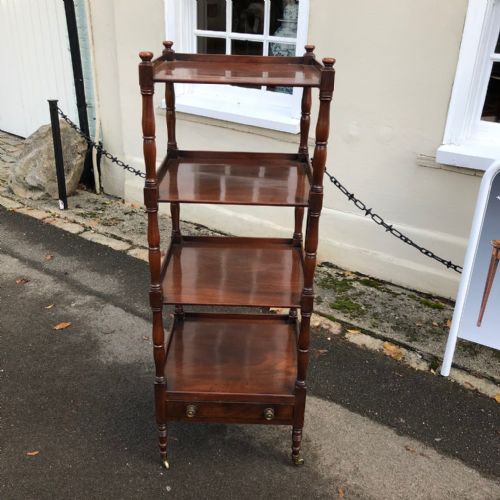
Mahogany Whatnot Unit
A mahogany whatnot unit provides tiered display space for books and ornaments, bringing practical elegance to any room.
Mahogany Whatnot Unit
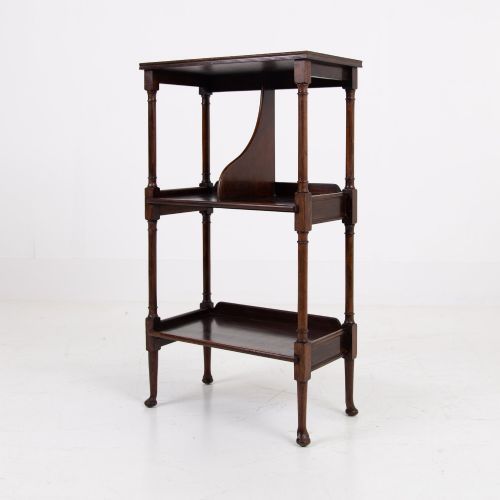
A mahogany whatnot unit functions as a multi-tiered open display stand designed for holding books, ceramics and decorative objects. These pieces appear across several periods, most commonly in Victorian and Regency iterations.
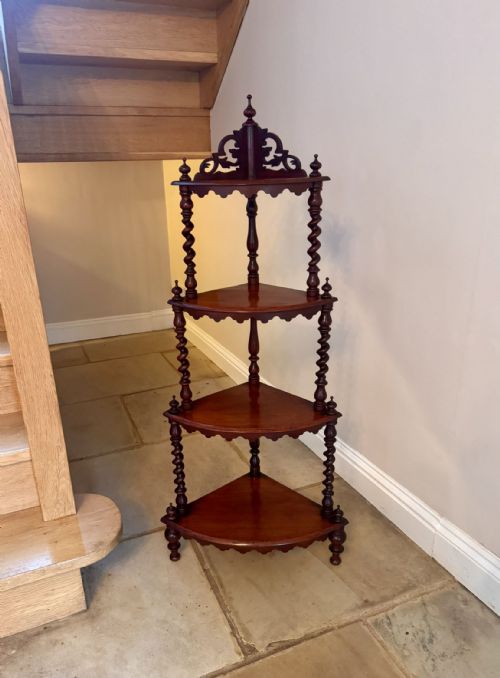
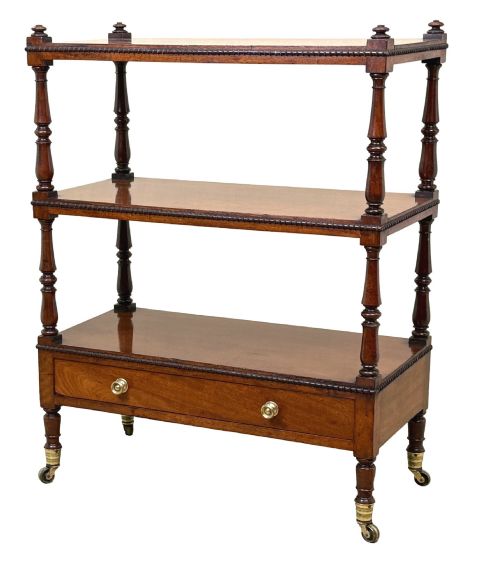
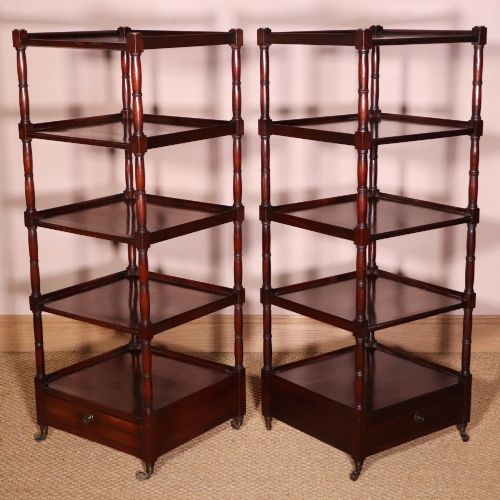
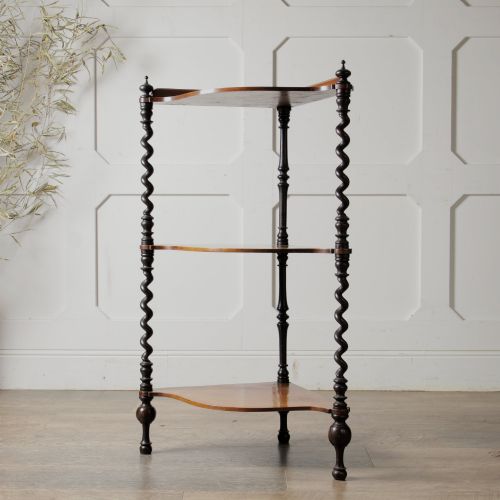
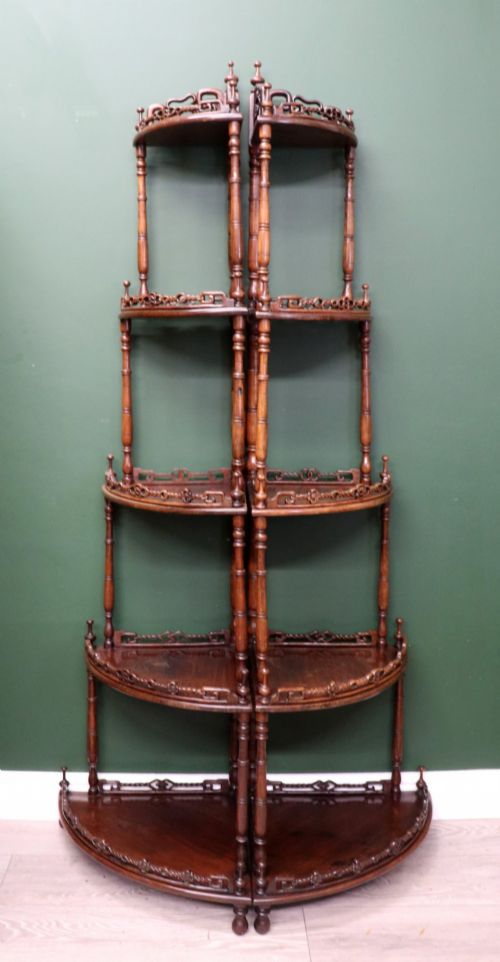
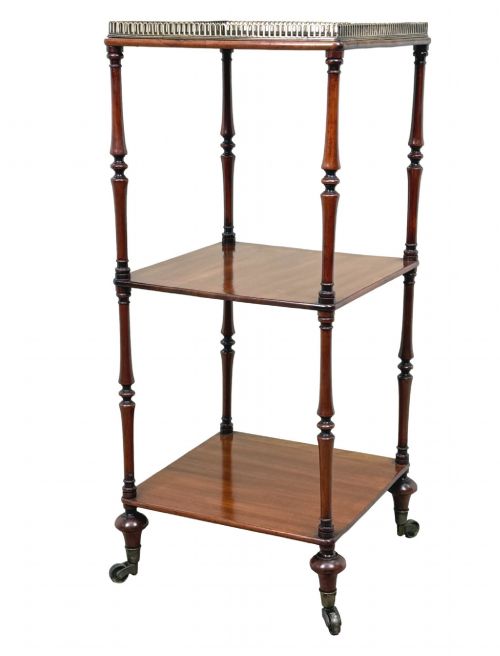
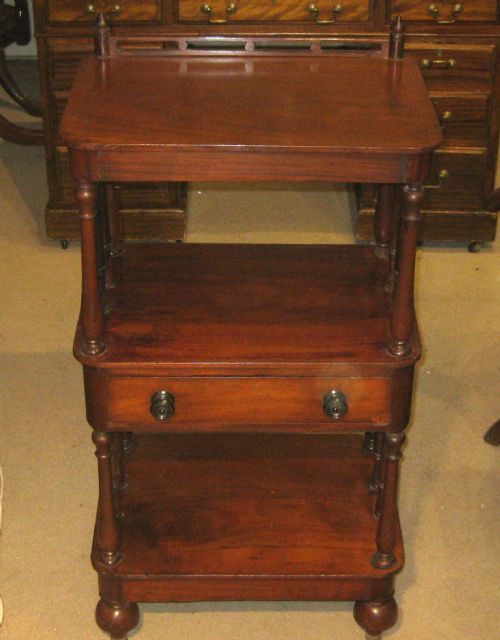
The most frequent version encountered here is the multi-tiered freestanding or corner shelf unit constructed from mahogany. They range from compact three-tier etageres to taller five-tier variants incorporating drawers, cupboards, or mirrors.
Materials and construction
Makers utilised solid and veneered mahogany as the primary timber, sometimes pairing it with secondary woods, brass fittings, and glass. Certain examples feature contrasting satinwood or marquetry inlay to enrich the surfaces.
Structural elements include turned columns, barley twist supports, and A-frame designs that securely hold the stacked shelves. Additional functional components like cellarettes, lower cupboards, and mirrored backs expand the utility of the piece.
Mahogany Whatnot Unit Retail Price Guide 2026
Typical asking prices for mahogany whatnot unit among the pieces listed under this phrase on Sellingantiques today, from the lower quarter to the upper quarter. They describe what is for sale here now, not the wider market.
Some Victorian examples squeezed a mirror and a cupboard into a corner, proving that even shelves appreciate a place to check their reflection.
Distinctions in quality
Quality rests upon the crispness of turned supports, the selection of timber figures, and the integration of functional elements like drawers or mirrors. Superior examples maintain structural integrity across multiple tiers without wobble or loose joints.
Proportion and scale dictate the success of the design, with finer pieces exhibiting balanced tiers and refined mouldings rather than heavy or utilitarian framing.
The Mahogany Whatnot Unit Glossary
- Whatnot
- An open set of tiered shelves used for displaying ornaments and books. It originated in the eighteenth century and remained popular through the Victorian era.
- Étagère
- A French term for a piece of furniture consisting of a set of open shelves for holding small objects or china. It is frequently used interchangeably with whatnot.
- Cellarette
- A cabinet or container built into furniture for holding bottles of wine or spirits. In these pieces, it usually occupies the base.
- Barley twist
- A type of turning shaped like a spiral helix used for table legs and vertical supports. It appears frequently on Victorian pieces.
- A-frame
- A triangular structural configuration that tapers towards the top, providing stability for multi-tiered corner or freestanding units.
Mahogany Whatnot Unit: Frequently Asked Questions
What is a mahogany whatnot unit used for?
These units serve as open display stands for books, ceramics, and small decorative objects in living spaces.
Historically, they provided accessible surface space in drawing rooms and parlours before specialised shelving became common.
How do I date a mahogany whatnot?
Dating relies on stylistic markers, turning types, and construction methods associated with Georgian, Regency, and Victorian periods.
For instance, slender proportions and delicate inlay suggest the Georgian era, while barley twist supports point to Victorian manufacture.
Where should I place a corner whatnot?
A corner whatnot fits neatly into unused room angles to maximise vertical display space without blocking floor circulation.
They work well in studies, hallways, and sitting rooms where standard rectangular shelves might prove too intrusive.
Are all mahogany whatnots freestanding?
While most examples stand independently or fit into corners, certain variations are designed to hang on walls.
Freestanding versions typically feature three to five tiers, occasionally incorporating a cupboard or drawer base for extra storage.