

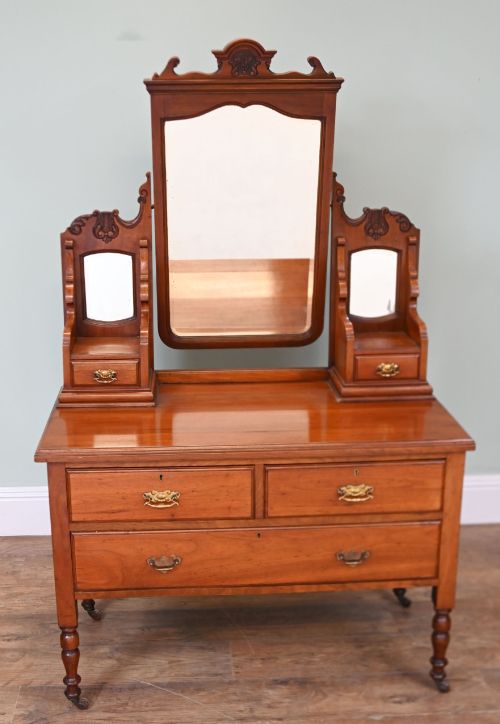
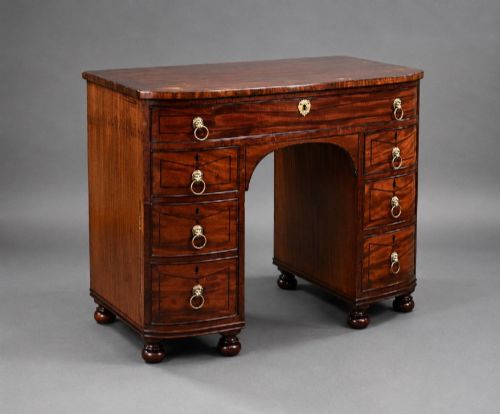
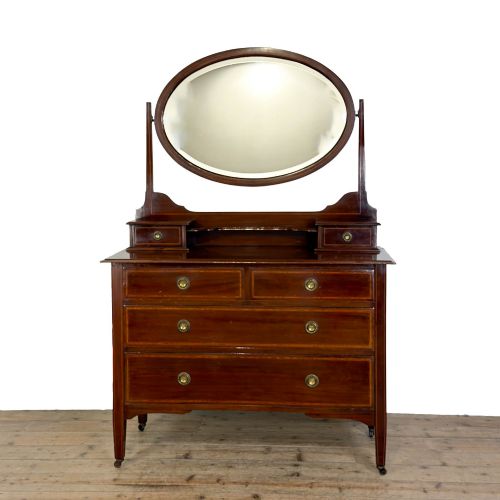


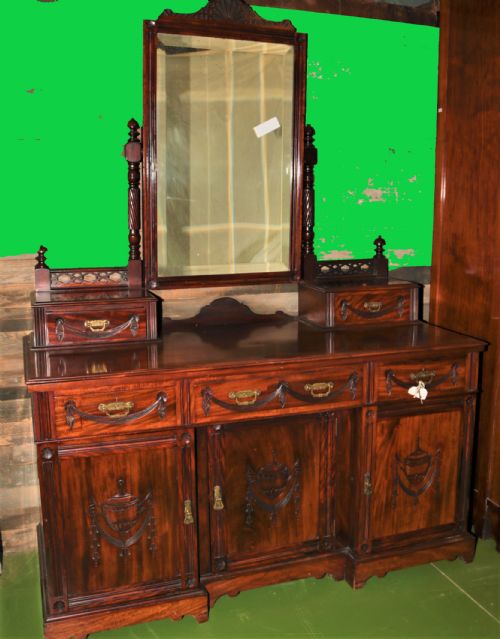


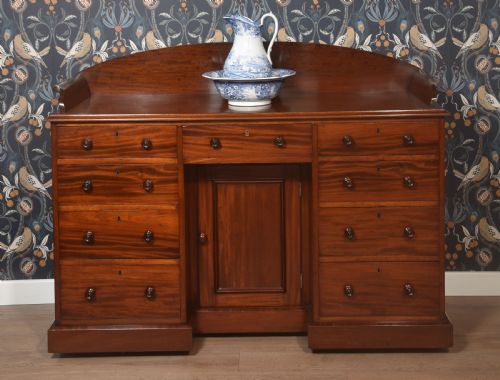
Mahogany Vanity Drawer Chest
These mahogany vanity drawer chest pieces are practical bedroom furnishings designed for grooming and storage, combining rich timbers with fitted drawer compartments.
Mahogany Vanity Drawer Chest
A mahogany vanity drawer chest brings together traditional bedroom storage and personal grooming surfaces, spanning forms from compact boxes with drawers to large dressing chests and washstands. The selection on this page runs through Georgian, Regency, Victorian, and Edwardian periods, alongside revival styles like Chippendale, Empire, and French Rococo.
Buyers seeking a mahogany vanity drawer chest encounter diverse regional interpretations, including British workshop designs and French provincial pieces featuring marble tops and mirror glass. Dressing tables, commodes with writing slides, and lowboys appear alongside smaller boxes, offering various scales to suit domestic spaces.
Materials and Construction
Construction relies primarily on solid mahogany and mahogany veneers, frequently paired with secondary timbers for internal drawer framing. Cabinetmakers shaped these pieces using traditional joinery, incorporating brass hardware for handles and escutcheons.
Surface treatments and secondary elements introduce contrasting materials such as satinwood stringing, glass mirror plates, baize linings, and rouge or white marble tops. These additions served both structural and decorative purposes, protecting washstand surfaces and providing functional mirrors for daily use.
Mahogany Vanity Drawer Chest Retail Price Guide 2026
Typical asking prices for mahogany vanity drawer chest among the pieces listed under this phrase on Sellingantiques today, from the lower quarter to the upper quarter. They describe what is for sale here now, not the wider market.
Listings feature mahogany alongside marble, glass, and brass, spanning the eighteenth century through the Edwardian period.
Determining Quality
Quality rests on the depth of timber figure, the crispness of carved details in revival styles, and the integrity of original secondary woods. Superior examples display thoughtful proportioning, such as well-balanced bowfronts or finely executed satinwood inlay.
The integration of fitted components, including sliding writing surfaces and original brass fixtures, distinguishes finer cabinet work. Condition of marble slabs and mirror glass also dictates overall merit, particularly on washstands and dressing chests.
The Mahogany Vanity Drawer Chest Glossary
- Bowfront
- A convex curved cabinet front that swells outwards towards the centre, popular in Georgian and Regency design.
- Lowboy
- A small side table with one or more rows of drawers, standing on relatively tall legs.
- Commode
- A low cabinet or chest of drawers, often incorporating specialised fitted interiors or marble tops.
- Satinwood
- A durable, yellowish timber often utilised for contrasting stringing and inlay work on mahogany furniture.
- Rouge Marble
- A deep red ornamental limestone frequently used for the tops of washstands and dressing tables.
Mahogany Vanity Drawer Chest: Frequently Asked Questions
What is a dressing chest?
A dressing chest combines the storage capacity of a standard chest of drawers with a dedicated surface or attached mirror for grooming.
These pieces emerged in various sizes across the eighteenth and nineteenth centuries to serve bedrooms where space was at a premium.
How do I identify a Georgian piece?
Georgian furniture typically exhibits restrained classical proportions, solid mahogany construction, and precise hand-cut dovetail joints in the drawers.
Stylistic markers include bracket feet, cockbeaded drawer edges, and understated brass hardware rather than heavy applied ornamentation.
Are marble tops original?
Marble tops on washstands and dressing tables were standard additions for hygiene and water resistance during the Victorian and Edwardian eras.
They sit directly upon the timber frame, sometimes secured by their own weight or resting within a moulded wooden gallery.
Where were these chests used?
These furnishings belonged primarily in the private chambers and dressing rooms of townhouses and country estates.
They provided dedicated storage for linens, powders, and personal items while serving the daily routine of washing and dressing.