

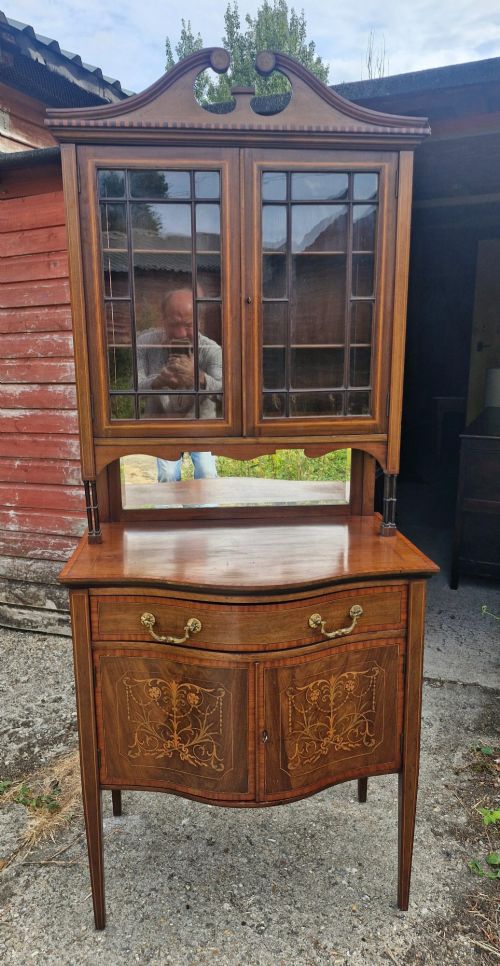


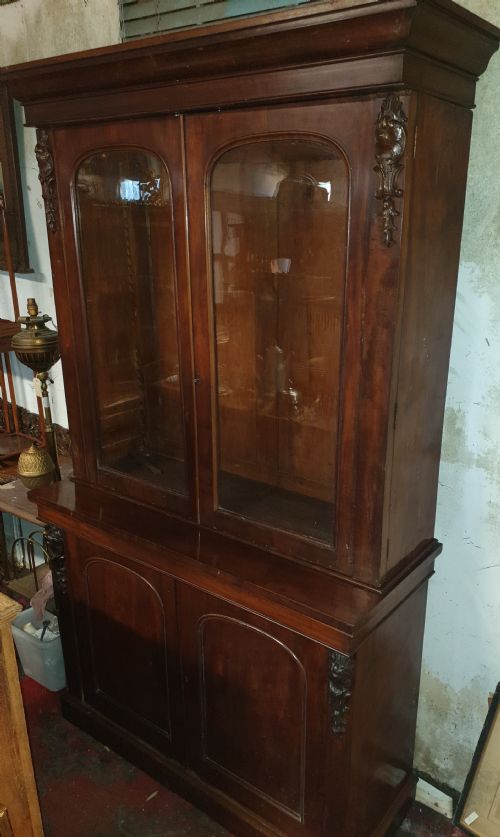


Mahogany Two Part Cabinet
A mahogany two part cabinet brings timber warmth and practical division to any room, offering stacked storage that makes transport manageable.
Mahogany Two Part Cabinet
A mahogany two part cabinet splits into an upper and lower section for easier movement, a practical form seen across Georgian, Victorian, and Edwardian eras. The listings here encompass glazed display cabinets, bookcases, tall boys, chests of drawers, bureau bookcases, and corner cupboards.
The version most commonly met on this page is the bookcase or display cabinet configuration, where a glazed top rests upon a lower chest or base. These pieces combine display space above with enclosed storage below, reflecting the domestic needs of the nineteenth and early twentieth centuries.
Origins stretch from the George III period through the mid-nineteenth century and into Edwardian times. Styles range from plain Regency and Georgian utility to inlaid Edwardian pieces and Victorian campaign designs.
How they were made
Makers utilised solid mahogany and Spanish mahogany, frequently pairing primary show woods with secondary timbers such as pine for internal framing and drawer linings. Brass hardware provides structural fastening and handles, whilst glass panels and mirrors feature in the upper display sections.
Construction relies on the modular two-part format, allowing heavy furniture to separate at a waist moulding for transit. Surface enrichment includes satinwood inlay and marquetry, particularly on Edwardian examples, alongside simpler architectural cornices on Georgian and Victorian pieces.
Mahogany Two Part Cabinet Retail Price Guide 2026
Typical asking prices for mahogany two part cabinet among the pieces listed under this phrase on Sellingantiques today, from the lower quarter to the upper quarter. They describe what is for sale here now, not the wider market.
Some campaign cabinets packed their writing desks to travel the empire, proving that even a bookcase appreciates a gap year.
What varies in quality
Quality rests in the selection of timber figures, where rich Spanish mahogany or detailed satinwood inlay distinguishes superior work from plain utility pieces. The crispness of internal drawer construction and the integration of the two sections also reveal the cabinet maker's hand.
Proportion and proportioned joinery dictate the architectural success of tall forms like bureau bookcases and tall boys. Finer items maintain balanced sightlines between upper glazed doors and lower drawer units without appearing heavy.
The Mahogany Two Part Cabinet Glossary
- Mahogany
- A durable tropical hardwood prized for its deep reddish-brown grain and stability. It serves as the primary structural and surface material across these listings.
- Two-part
- A piece of furniture built in upper and lower sections that separate for movement. This modular design defines tall bookcases and chests.
- Secretaire chest
- A chest of drawers featuring a fitted pull-out writing drawer with small pigeonholes and inner compartments. It combines desk functionality with drawer storage.
- Marquetry
- Decorative woodwork where thin slices of various coloured woods are fitted into a veneer pattern. It appears on Edwardian display cabinets.
- Spanish mahogany
- A dense, highly figured variety of mahogany often associated with finer nineteenth-century cabinet work. It shows distinctive grain patterns.
Mahogany Two Part Cabinet: Frequently Asked Questions
Why were they built in two parts?
Splitting a tall cabinet into an upper and lower section made transport through narrow hallways and staircases feasible. This modular construction was essential for heavy bookcases and tall boys.
The horizontal dividing line sits neatly behind a waist moulding, concealing the join whilst keeping the weight manageable for removal or relocation.
How do I tell a Georgian piece from an Edwardian one?
Georgian pieces generally rely on clean architectural proportions, heavy cornices, and solid timber construction without surface clutter. They reflect earlier utilitarian or classical design priorities.
Edwardian examples frequently incorporate lighter satinwood inlay, marquetry patterns, and refined glazed doors. Their overall appearance tends to be brighter and more decorative.
What is the difference between a bookcase and a display cabinet?
Bookcases typically feature open shelving or wooden-framed glazed doors designed to house volumes. Their internal setup prioritises book storage.
Display cabinets use extensive glass panels, sometimes with mirrored backs, intended to showcase porcelain and decorative objects rather than books.
Can I separate the sections for cleaning?
Yes, the upper section simply lifts off the lower base once any internal fixings or brackets are detached. The two halves rest together by gravity and alignment pins.
Separating them simplifies polishing the top of the base and makes moving the furniture much safer.