


Mahogany Table De Chevet
A mahogany table de chevet brings French bedroom elegance and practical bedside storage into any room through rich timber and fine hardware.
Mahogany Table De Chevet
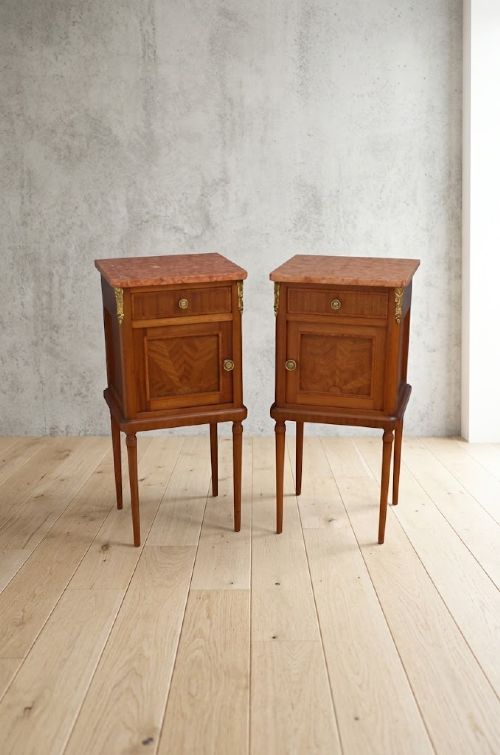
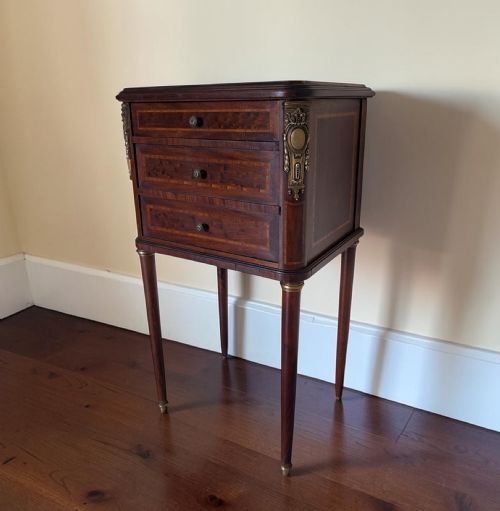
A mahogany table de chevet represents a classic French bedside cabinet or nightstand, built primarily to hold small personal items beside a bed. Buyers searching this phrase will find compact wooden units that often double as pot cupboards or small bedside chests of drawers.
The versions most commonly met on this page date from the nineteenth and early twentieth centuries, spanning periods such as Regency, Victorian, and later 1900 to 1920 Edwardian eras. These pieces typically display French stylistic influences, ranging from provincial designs to grander Louis Philippe and Louis XVI aesthetics.
Many examples appear as matched pairs, offering symmetry for twin beds or larger sleeping quarters. Single pieces also feature frequently, providing distinct character through individual proportions and varying door or drawer configurations.
Materials and construction methods
Makers built these pieces primarily from solid mahogany and mahogany veneers over secondary timbers, valuing the wood for its deep grain and warm tone. Workshops often combined this timber with contrasting accents of rosewood or walnut to highlight specific panels and mouldings.
Surface details relied heavily on integrated white or grey marble tops, which provided a durable and waterproof upper tier for daily use. Craftsmen further embellished the mahogany frames with cast brass mounts, ormolu accents, and occasionally functional tambour doors.
Listings span periods from the Regency era through to the 1920s, featuring materials such as mahogany, marble, brass, and ormolu.
Judging the quality of a table de chevet
Quality rests significantly on the selection of the timber and the precision of the cabinetmaker's joints, where tighter dovetailing and well-matched mahogany grain mark superior execution. The presence of integrated marble slabs that fit flush against the wooden framework also separates standard items from finer productions.
Hardware execution dictates the overall standard of the piece, with finely chased ormolu and substantial brass mounts indicating higher workshop standards. The inclusion of complex mechanisms, such as smooth-running tambour shutters or tightly fitted single doors, reflects the original tier of manufacture.
The Mahogany Table De Chevet Glossary
- Table de chevet
- A French term for a bedside table or nightstand designed to sit next to a bed. These compact pieces typically feature a small cupboard, drawer, or open shelf.
- Ormolu
- Gilt bronze ornamentation applied to furniture mounts and details. This technique adds metallic contrast and decorative relief to mahogany surfaces.
- Tambour
- A flexible shutter made of narrow vertical strips of wood glued to a canvas backing. It slides along a groove to conceal a cabinet interior without swinging outward.
- Louis Philippe
- A mid-nineteenth-century French style characterised by restrained classical proportions and understated curves. Furniture from this period focuses on the natural beauty of the timber rather than heavy carving.
Mahogany Table De Chevet: Frequently Asked Questions
How were these bedside tables used originally?
Originally placed beside a bed in French bedrooms, these cabinets stored chamber pots, personal items, and nighttime reading materials. The enclosed cupboards and drawers kept personal effects neatly hidden out of sight.
Marble tops provided a practical, spill-resistant surface that could withstand the placement of water pitchers and candlesticks.
Do these tables come in pairs?
Many of these bedside cabinets appear as matched pairs, making them suitable for framing a bed symmetrically. Other listings offer single cabinets which work well as standalone accent tables in smaller spaces.
Pairs often share identical marble patterns, wood grains, and brass hardware details.
How do I identify the period of a table de chevet?
Dating relies on observing stylistic markers, construction techniques, and materials associated with specific eras like the Regency period or the early twentieth century. French regional styles such as Louis Philippe or Louis XVI Revival also provide clear chronological indicators.
Hardware styles, timber cuts, and the thickness of marble slabs help confirm whether a piece belongs to the nineteenth or early twentieth century.