



Mahogany Print Stand
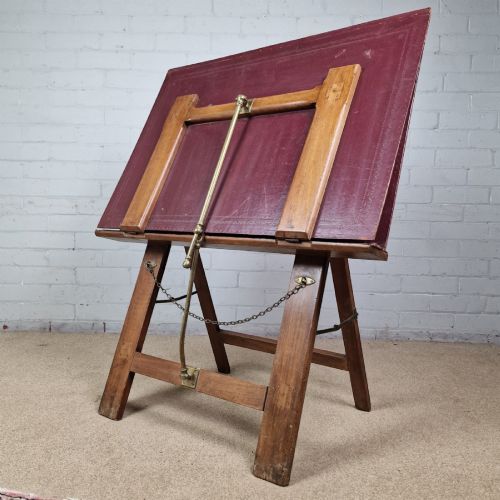
Mahogany print stands are robust timber holders designed to present large engravings, sketches, and maps.
Mahogany Print Stand
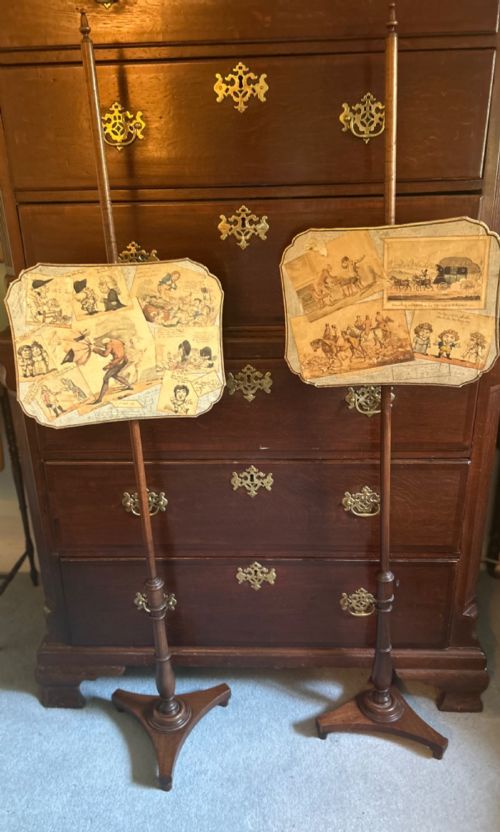
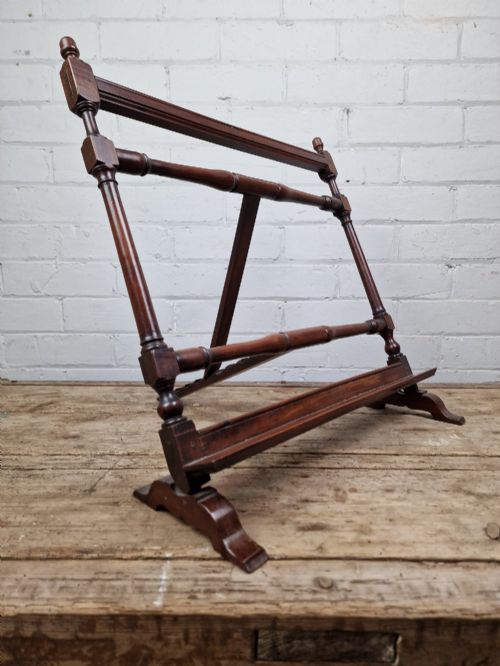
A mahogany print stand serves to display unbound works on paper, prints, and architectural drawings safely in a library, studio, or drawing room. When exploring the category of a mahogany print stand, a buyer encounters forms such as adjustable floor-standing racks, table-top easels, and heavy folio cabinets.
The pieces listed span Georgian, Regency, Victorian, and later interwar periods, with Regency examples appearing frequently alongside late nineteenth-century variations. These items range from grand scale library furnishings to compact tabletop display units made for working artists and collectors.
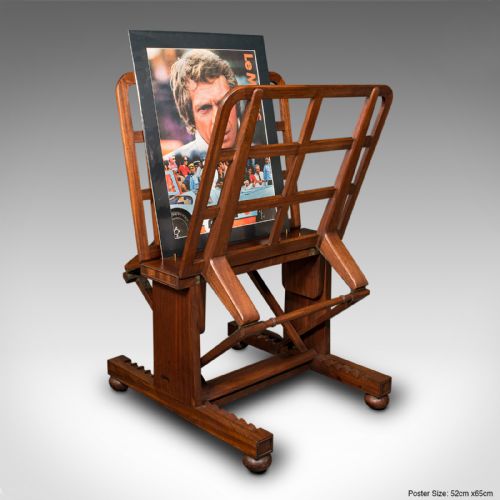
Makers and workshops of the nineteenth century produced these stands to hold delicate folios without creasing the paper. Structural variations include upright panel dividers, adjustable ratchets, and supporting stretchers designed to bear heavy books or mounted artwork.
Materials and construction methods
Makers utilised solid mahogany and mahogany veneers for the main frames, often incorporating brass hinges, castors, and adjustment brackets to allow the rack angle to shift. Secondary timbers such as oak occasionally appear in the internal framework or drawer linings of larger folio cabinets.
Inlay work such as boxwood lines the surfaces of select Regency pieces, while leather and paper components survive within associated library globes and folio accessories. Joinery relied on sturdy tenon and mortise framing to withstand the daily weight and pressure of heavy stacked folios.
Periods represented span from the eighteenth century through the Regency, Victorian, and 1930s eras.
Assessing quality in mahogany print stands
Superior examples demonstrate refined timber selection with rich grain figuring, precise boxwood inlay, and original brass hardware that moves smoothly. The integrity of the adjustable rack mechanism and the stability of the base under weight separate standard production items from master workshop pieces.
The presence of secondary woods, the crispness of turned supports, and the retention of working brass castors dictate the desirability of a piece. Finer versions exhibit careful proportioning and balanced engineering, allowing tall frames to tilt securely without tipping.
Gillow s·G and J Cary
The Mahogany Print Stand Glossary
- Folio stand
- A rack or frame built specifically to hold large sheets of paper, prints, drawings, or maps flat or upright.
- Regency
- A British design period spanning the early nineteenth century, characterised by classical lines, mahogany timber, and brass mounts.
- George III
- The stylistic era of the late eighteenth and early nineteenth centuries, notable for restrained classical proportions and solid cabinetmaking.
- Boxwood inlay
- A decorative technique using thin strips of pale boxwood set into contrasting darker mahogany surfaces.
- Table-top easel
- A smaller supporting desk frame designed to hold books, drawings, or small canvases at a readable angle.
Mahogany Print Stand: Frequently Asked Questions
What is a mahogany print stand used for?
These stands hold large paper folios, engravings, and architectural drawings for viewing without damaging the sheets.
Collectors and artists use them to display plates and maps in libraries or studios.
How do I date a mahogany print stand?
Dating relies on stylistic clues like Regency brass fittings, Georgian timber turning, and Victorian construction methods.
Adjustable mechanisms and brass castors also help narrow down the manufacturing decade.
Are these stands suitable for modern homes?
They function well in modern interiors for displaying large artwork, photography prints, or heavy reference books.
The adjustable frames allow pieces to act as both storage racks and open display units.
What is the difference between a folio stand and a cabinet?
A folio stand uses open upright racks or trestles to hold loose sheets and picture mounts.
A folio cabinet encloses the collection behind doors or drawers for dust-free storage.