
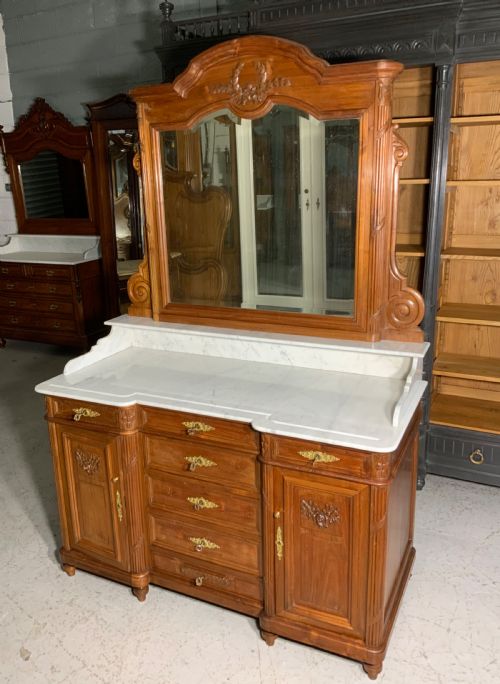

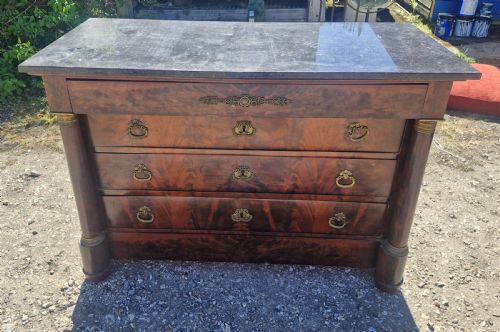


Mahogany Marble Dresser
These mahogany marble dresser examples combine rich timber and stone tops, offering practical surface space and period utility.
Mahogany Marble Dresser
A mahogany marble dresser search brings up robust storage pieces designed for domestic utility. Most examples function as chests of drawers, commodes, or washstands.
The aesthetic leans heavily toward continental design. French Empire, Louis XVI, and Louis Philippe styles dominate the listings, alongside specific pieces like the serpentine-fronted commode.
Dated variations span the eighteenth, nineteenth, and early twentieth centuries. Pieces often feature distinct timber grains such as flame mahogany paired with heavy stone surfaces.
Materials and construction
Heavy stone forms the defining top surface of these pieces. Grey marble and fossil marble slabs sit directly above the cabinetry, sometimes shaped to match serpentine or bow-front profiles.
Metal hardware adds structural and decorative detail. Brass and ormolu mounts appear frequently on handles, escutcheons, and feet across the French Empire and neoclassical examples.
Listings span from the eighteenth century to the early twentieth century, incorporating periods like French Empire, Louis Philippe, and Biedermeier.
Judging quality in mahogany marble pieces
Quality rests heavily on the selection of timber veneers and the matching of grain patterns across drawer fronts. Superior cabinet work displays continuous figure alignment and precise joinery.
The weight, thickness, and mineral patterning of the stone top indicate the grade of the piece. Well-finished marble slabs integrate smoothly with the timber framing beneath.
Hardware execution separates standard utility items from finer workshop output. Cast ormolu and detailed brass mounts reflect higher craftsmanship than plain stamped metal.
Mon Krieger
The Mahogany Marble Dresser Glossary
- Commode
- A low chest of drawers or cabinet originating in France. These pieces typically stand on short legs and feature multiple drawer tiers beneath a stone top.
- Washstand
- A basin-supporting piece of furniture equipped with a protective stone surface. They provide functional height and water-resistant utility.
- Serpentine-fronted
- A cabinet shape featuring a convex centre flanked by concave curves. This contour requires skilled carpentry to match the stone top to the wooden frame.
- Ormolu
- Gilded bronze used for decorative mounts and hardware. It adds metallic contrast to the dark mahogany timber.
- Flame mahogany
- Timber veneer cut from the branch junction where the grain creates a distinctive undulating pattern. It provides high visual movement on drawer fronts.
Mahogany Marble Dresser: Frequently Asked Questions
How do I care for the marble top?
Wipe the stone surface regularly with a damp cloth and mild soap. Avoid acidic cleaners that etch the polished finish.
Keep heavy impacts away from the edges to prevent chipping. Periodic sealing helps protect against liquid absorption.
Can I use a washstand in a modern bedroom?
These washstands function well as bedside tables or hallway storage units. Their compact footprints suit contemporary room layouts.
The stone top offers a durable surface for daily items. Timber frames bring warmth and historical texture to modern interiors.
How do I distinguish Louis XVI from French Empire?
Louis XVI pieces display restrained neoclassical symmetry and straight tapered legs. Carvings tend toward classical motifs like fluting and urns.
French Empire furniture favours heavier proportions and extensive metal mounts. Pilasters, paw feet, and bolder symmetrical lines define the later style.
Are these pieces heavy to move?
The combination of dense timber and thick stone makes these items substantial. Lifting requires multiple people to avoid straining the frame.
Many pieces allow the stone top to lift off separately. Removing the marble slab reduces weight significantly during transport.