
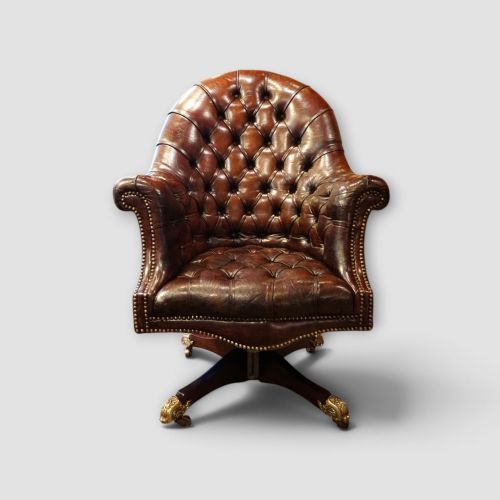
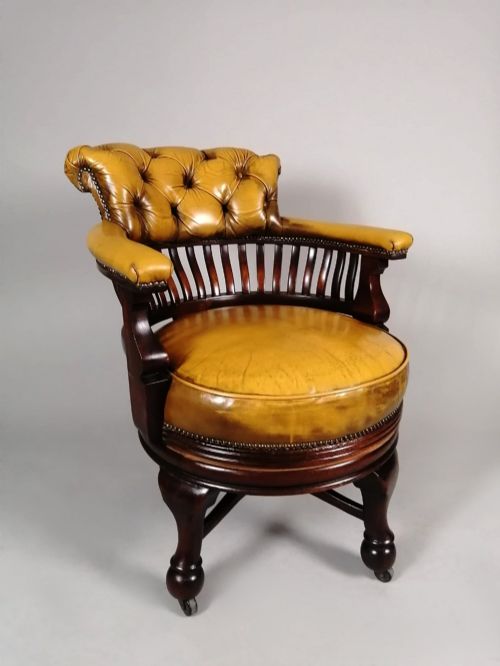

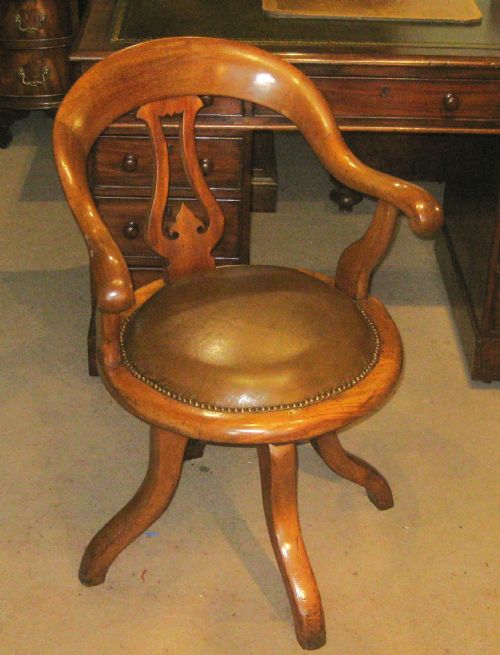
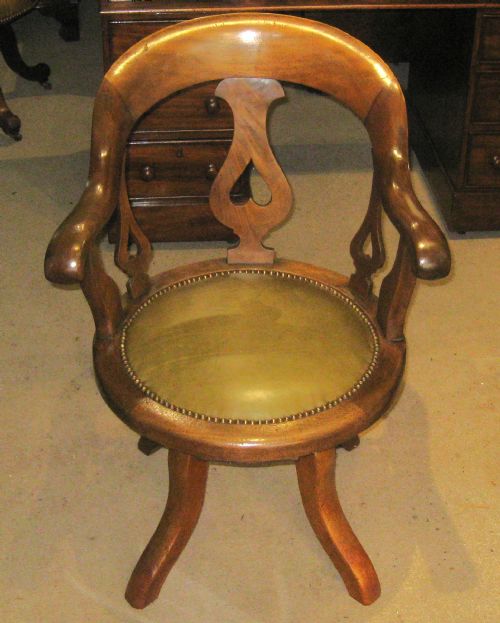
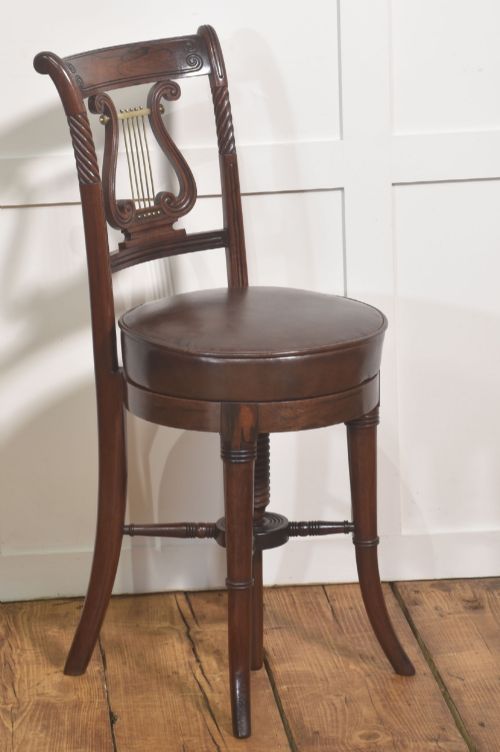
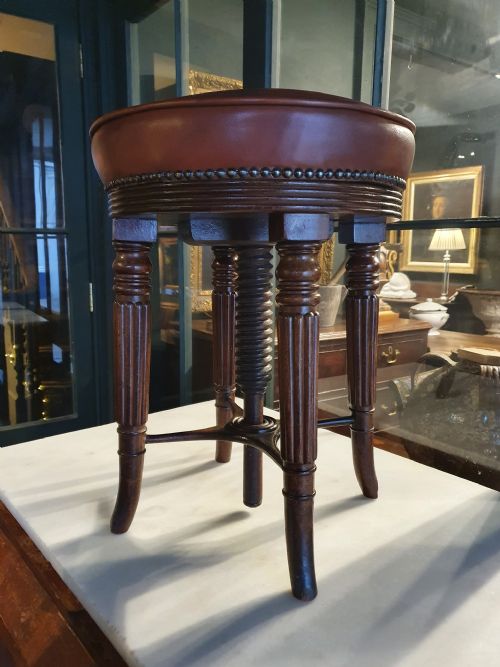
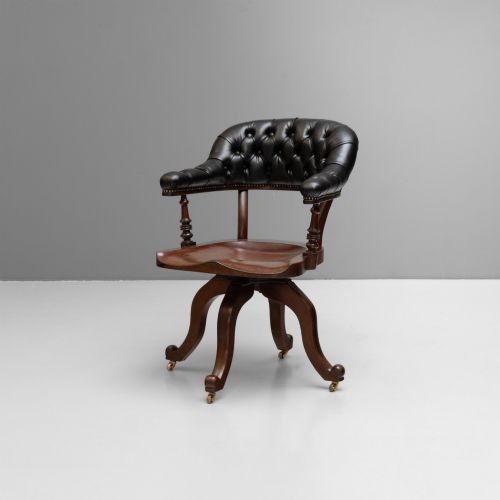


Mahogany Leather Swivel Chair
These mahogany leather swivel chair options combine timber frames with adjustable revolving mechanisms for daily workspace use.
Mahogany Leather Swivel Chair
A mahogany leather swivel chair serves as a practical seating choice for studies and offices, combining a sturdy timber frame with a revolving base. Most examples met on this page date from the Victorian and Edwardian periods, stretching from the late nineteenth century into the early decades of the twentieth century.
The selection includes revolving desk chairs, office armchairs, and adjustable dressing chairs alongside piano stools and ships chairs. Makers utilised rich timbers including golden mahogany, walnut, and satinwood alongside beech and hardwood components to build these rotating seats.
Victorian and Edwardian models dominate the current listings, alongside pieces attributed to the broader nineteenth century and the 1920s. These revolving seats bridge the gap between antique cabinet-making and functional office furniture designed for prolonged sitting.
Materials and Construction
Craftsmen shaped solid mahogany, walnut, and alternative hardwoods into curved armrests and supportive back rails. Brass and cast iron mechanisms provided the underlying swivel and height-adjustment functions hidden beneath the seat.
Upholsterers stretched leather across padded seats and backrests, often securing the edges with brass studs. Some pieces feature re-leathered surfaces or distressed green, brown, and burgundy hides applied to the timber framework.
Listings feature mahogany, walnut, and hardwood frames paired with leather upholstery, supported by brass and cast iron swivel mechanisms.
Assessing Quality
Quality rests in the smoothness of the revolving mechanism and the sturdiness of the timber joints connecting the seat to the base. Finely turned spindles and well-fitted wooden frames distinguish superior workshop production from standard commercial output.
The grade of leather upholstery and the preservation of the original polish on the mahogany timber influence the overall integrity of the piece. Subtle details in the carving and the robustness of the iron or brass swivel hardware mark the difference between standard utilitarian seating and finer examples.
WM Heywood Chair Co·Maple & Co
The Mahogany Leather Swivel Chair Glossary
- Revolving desk chair
- A seat fitted with a central pivot that allows the user to turn in a complete circle while seated at a desk. These chairs often include adjustable height functions.
- Captain's chair
- A sturdy wooden armchair featuring a low back rail supported by turned spindles above the seat. Many versions incorporate swivel mechanisms and leather upholstery.
- Satinwood
- A lustrous hardwood often used for decorative inlay work on mahogany furniture frames. It provides a pale, contrasting grain against darker cabinet timbers.
- Re-leathered
- A descriptor for a piece that has received new leather upholstery to replace worn or damaged historical hide. This maintenance restores the functional surface of the seat.
Mahogany Leather Swivel Chair: Frequently Asked Questions
How do I adjust the height on these chairs?
Many of these swivel chairs rely on a threaded central iron spindle beneath the seat. Turning the seat clockwise or anti-clockwise raises or lowers the sitting position.
More complex mechanical hubs from the early twentieth century may utilise levers or collars to control movement. Check the undercarriage carefully before attempting adjustments to avoid damaging older threads.
Are these chairs suitable for daily computer use?
These historical revolving seats function well at modern desks provided the seat height aligns with your workspace. Their sturdy timber frames and leather pads offer solid lower-back support for reading and writing.
Keep in mind that older swivel mechanisms lack the pneumatic suspension and tilt-locks found in modern task seating. Users intending long daily sessions often test the pivot action and cushion depth beforehand.
How should I clean the leather upholstery?
Wipe the surface gently with a dry or slightly damp cloth to remove dust and surface debris. Avoid harsh chemical detergents that strip natural oils from historical hide.
Applying a specialist leather balsam periodically helps maintain suppleness and prevents cracking. Test any conditioning product on a hidden area beneath the seat first.
How do I distinguish Victorian from Edwardian models?
Victorian examples built around 1880 to 1890 frequently employ heavy golden mahogany with deep buttoned leather and robust cast-iron undercarriages. They tend to feature darker finishes and heavier proportions.
Edwardian pieces from the early 1900s often display lighter framing, subtle inlay work, and streamlined woodwork. The turned spindles and arm geometries also reflect the changing design preferences of the later period.