




Mahogany Floor Cabinet
These mahogany floor cabinet pieces are substantial timber vessels built to anchor a room, offering both display and storage for the discerning collector.
Mahogany Floor Cabinet
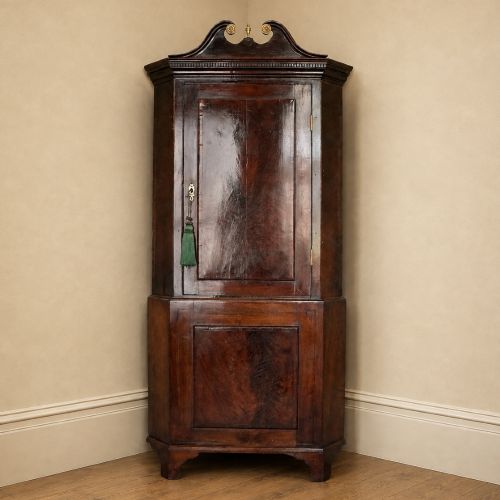
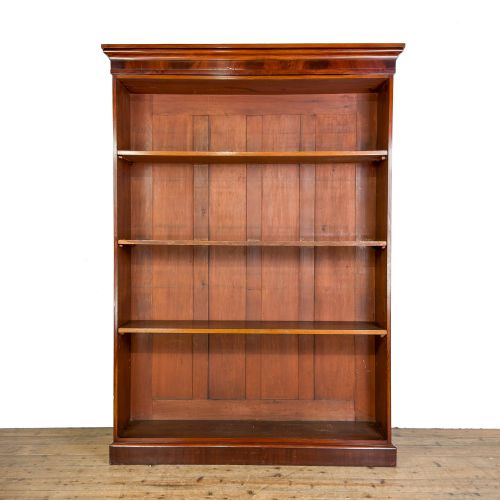
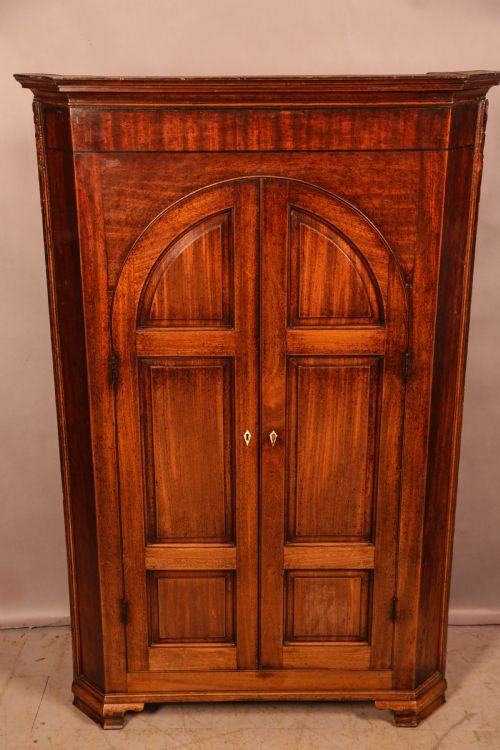
A mahogany floor cabinet encompasses tall bookcases, display cabinets, folio cabinets and standing corner cupboards designed to rest directly upon the ground. The most common iteration encountered on this page is the standing corner cupboard, appearing frequently across the Georgian, Victorian and Edwardian periods.
Makers constructed these floor-standing vessels in diverse forms, from breakfront bookcases to corner cupboards on stands and traditional Chinese variants. They serve to utilise awkward room angles or provide upright storage for substantial volumes and folio collections.
The origins span the eighteenth and nineteenth centuries, including specific periods such as the George III and Regency eras. Buyers will encounter both simple country house examples and finely figured urban pieces.
How they were made
Cabinetmakers utilised solid mahogany and hardwood timbers, frequently combining them with secondary woods like oak. Surfaces often display decorative boxwood inlay and satinwood banding to accentuate the grain.
Glazed doors, brass hardware and panelled construction define the structural execution of these standing cabinets. Joiners built them to bear significant weight, particularly in larger bookcases and folio cabinets.
Mahogany Floor Cabinet Retail Price Guide 2026
Typical asking prices for mahogany floor cabinet among the pieces listed under this phrase on Sellingantiques today, from the lower quarter to the upper quarter. They describe what is for sale here now, not the wider market.
Some corner cupboards are so deeply wedged into history they practically demand to be filled with old brandy bottles.
What varies in quality
Quality rests in the selection of the mahogany timber and the crispness of any boxwood inlay work. Superior examples exhibit finely figured grain patterns and thoughtful proportion across the cornice and plinth.
The integrity of the original brass mounts, glass panes and internal shelving dictates the standing of a piece within the range. Structural execution in the carcase joints separates workshop-produced furniture from basic utility builds.
The Mahogany Floor Cabinet Glossary
- Breakfront
- A piece of furniture where the central section projects forward from the flanking wings. This architectural layout creates depth and visual rhythm across large bookcases.
- Cornice
- The moulded horizontal projection that crowns the top of a cabinet. It provides a finished architectural transition between the wall and the timber structure.
- Inlay
- A technique where contrasting materials such as boxwood are inserted into recesses within the mahogany surface. This ornamentation defines borders and geometric panels.
- Plinth
- The heavy base or platform upon which a floor cabinet stands. It elevates the main body and grounds the visual weight of the piece.
- Folio cabinet
- A specialised standing piece designed to store large paper sheets, prints or maps flat. These items require broad, shallow internal compartments.
Mahogany Floor Cabinet: Frequently Asked Questions
Where should I place a floor cabinet?
Standing corner cupboards suit unused room angles, utilising vertical space effectively without dominating a floor plan.
Larger bookcases and breakfront cabinets require prominent wall space where their timber grain and architectural cornices can be appreciated.
How do I care for mahogany timber?
Keep the wood away from direct heat sources and strong sunlight to prevent the mahogany surface from drying out or fading unevenly.
Apply a traditional beeswax polish sparingly to maintain the natural lustre of the hardwood over time.
What is a standing corner cupboard?
A standing corner cupboard is a tall floor cabinet built with a triangular cross-section designed to fit snugly into the corner of a room.
These pieces typically feature panelled or glazed upper doors enclosing shelves, sometimes paired with a lower cupboard section.
How do I identify a Georgian cabinet?
Georgian cabinets often display classical proportions, subtle boxwood stringing, and solid mahogany construction characteristic of eighteenth-century workshops.
Look for period-appropriate joinery techniques and hardware that align with the George III or Regency eras.