

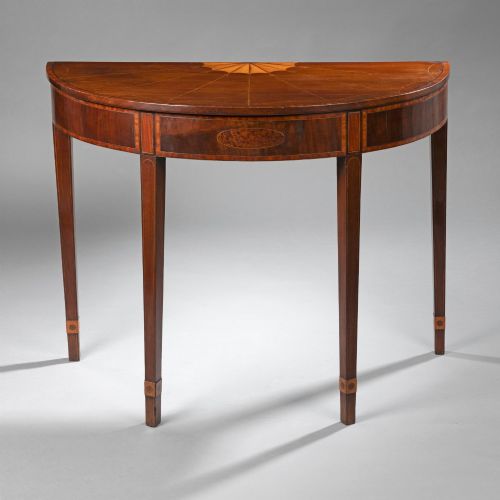


Mahogany Entrance Table
A mahogany entrance table greets visitors with rich timber grain and enduring utility, making it the ideal focal point for any hallway.
Mahogany Entrance Table
A mahogany entrance table serves as the primary surface in a hallway, combining practical utility with formal display. The selection here spans console tables, hall stands, centre tables, and side tables designed to furnish an entryway.
Most examples hail from the Georgian, Victorian, and nineteenth-century periods, capturing the shift from classical proportions to heavier decorative forms. Buyers will encounter both console tables and hall stands equipped with marble shelves or tile work.
Forms range from demi-lune console shapes and bow-fronted side tables to French Empire centre tables and Arts and Crafts hall stands. These pieces establish the character of an interior the moment someone steps through the front door.
How they were made
Makers utilised solid mahogany and mahogany veneers, often enhanced with contrasting boxwood and satinwood inlay to create geometric and floral patterns. Timber selection dictated the depth of the figure and the richness of the polished finish.
Structural embellishments frequently incorporated ormolu mounts, brass details, and carved wooden bases to elevate the visual weight of the furniture. Marble tops and ceramic tiles, such as Minton tiles, provided durable and decorative surfaces suited to heavy daily use in entrance halls.
Mahogany Entrance Table Retail Price Guide 2026
Typical asking prices for mahogany entrance table among the pieces listed under this phrase on Sellingantiques today, from the lower quarter to the upper quarter. They describe what is for sale here now, not the wider market.
The listings span the Georgian, Victorian, and Arts and Crafts periods, featuring materials such as ormolu, marble, and boxwood inlay.
What varies in quality
Quality rests upon the crispness of the timber carving, the precision of the wood inlay, and the integration of secondary materials like marble and ormolu. Finer examples display meticulous attention to detail in the joinery and the grain selection of the mahogany.
The sophistication of the silhouette defines the upper tier of pieces, whether through a graceful bow front, a balanced demi-lune curve, or the sculptural ambition of a French Empire design. Lesser pieces rely on simpler construction without the refined decorative accents seen on grander hall furniture.
Ellen E. Houghton of Minton
The Mahogany Entrance Table Glossary
- Console table
- A table designed to be fixed against a wall, frequently supported by ornate legs or brackets rather than four freestanding posts.
- Demi-lune
- A half-moon shape characteristic of tables built to fit flush against an entrance wall while projecting minimally into the floor space.
- Ormolu
- Gilded bronze or brass applied as decorative mounts and feet on nineteenth-century furniture.
- Hall stand
- A piece of entrance furniture incorporating coat hooks, umbrella wells, and frequently a shelf or mirror for hallway convenience.
Mahogany Entrance Table: Frequently Asked Questions
How do I distinguish Georgian from Victorian tables?
Georgian pieces generally display restrained classical proportions, lighter structures, and refined mahogany veneers with subtle inlay work. They reflect an architectural symmetry and elegance typical of the eighteenth and early nineteenth centuries.
Victorian examples tend to be heavier and more heavily carved, occasionally incorporating mixed materials like marble tops, ceramic tiles, or elaborate brass and ormolu mounts that reflect industrial-era manufacturing confidence.
Where should I place a console table?
Console tables sit flush against a wall in hallways, corridors, or reception rooms where floor space is limited. Their shallow profile allows them to anchor a mirror or painting above without obstructing foot traffic.
Placing one near the front door creates an immediate decorative statement while serving the practical needs of daily comings and goings.
Are marble tops original to these tables?
Many nineteenth-century console tables and hall stands were manufactured with inset marble or porphyry tops to provide a durable, stain-resistant surface for wet umbrellas and heavy items. These stone surfaces were integrated into the primary design of the piece.
Examining the underlying timber framing and edge mouldings helps confirm that the stone corresponds to the period of the base.