
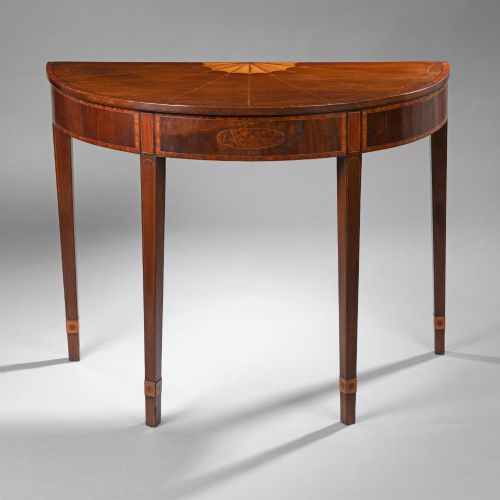


Mahogany Entrance Hall Table
A mahogany entrance hall table commands the space the moment the front door opens, offering both practical surface area and stately presence.
Mahogany Entrance Hall Table
A mahogany entrance hall table serves as the primary greeting point in a home, combining utility with distinct architectural presence. When searching for a mahogany entrance hall table, buyers encounter a variety of forms designed to anchor a hallway, including console tables, hall stands, and side tables.
The selection ranges across several periods, drawing heavily from Georgian and Victorian eras alongside the French Empire style. Console tables often feature demi-lune shapes designed to sit flush against a wall, while hall stands incorporate practical elements like marble shelves and tiled panels.
Makers and designers from the nineteenth century onward shaped these pieces to suit formal entryways, utilising rich timber and decorative inlays. Centre tables also appear in this category, offering a freestanding option for larger vestibules with carved timber bases.
Materials and construction
Makers relied primarily on solid mahogany and rich mahogany veneers to build the structural framework of these hall tables. This dense timber provided the durability required for heavy daily use in busy entranceways while taking a deep polish.
Accents of boxwood, satinwood, and wood inlay introduced subtle contrast to the dark timber surfaces, particularly on Georgian and Victorian pieces. Ormolu mounts and brass details further decorated French Empire pieces, elevating the formality of the furniture.
Functional surfaces frequently integrated contrasting materials such as marble and glass. Certain specialised hall stands paired the mahogany structure with ceramic tiles, combining utilitarian resilience with decorative artistry.
One extraordinary hall stand proudly records the days of the week through painted Minton tiles.
Assessing quality and design
Quality in these hall tables rests upon the selection of the timber grain and the precision of the joinery. Superior examples display carefully matched mahogany veneers and crisp carving along the timber bases and friezes.
The inclusion of secondary materials dictates the tier of craftsmanship, where genuine porphyry marble tops or hand-painted ceramic tiles elevate a piece beyond standard production. Finer proportioning in demi-lune consoles and balanced proportions in bow-fronted side tables signal thoughtful design intent.
Ellen E. Houghton of Minton
The Mahogany Entrance Hall Table Glossary
- Demi-lune
- A half-moon shape used for console tables designed to stand flat against a wall. This profile saves floor space in narrower hallways.
- Console table
- A table supported by wall brackets or console legs, typically placed in a hallway or reception room. It provides a shallow surface for decorative objects.
- Ormolu
- Gilded bronze ornamentation applied to furniture, popular in French Empire design. It adds metallic contrast to dark mahogany surfaces.
- Porphyry
- A purple-red igneous rock with large crystals, often used for decorative table tops. It imparts a classical, weighty appearance.
- Bow front
- A convex curved front on a cabinet or table. This stylistic choice softens the rectangular lines of hallway furniture.
Mahogany Entrance Hall Table: Frequently Asked Questions
What is a console table?
A console table is a narrow table designed to stand flat against a hallway wall. It provides a convenient surface without obstructing the thoroughfare.
Historically, these tables served as elegant ledges for holding calling cards or decorative lamps upon entering a residence.
How do I style a hall stand?
A hall stand functions as a multifaceted entryway piece, often incorporating hooks, umbrella holders, and marble shelves. Keep the surfaces uncluttered to let the timber and tilework remain the focal point.
Pairing a stand with matching hallway seating creates a cohesive and welcoming arrival space.
What is the difference between Georgian and Victorian tables?
Georgian tables generally favor restrained classical lines, proportion, and understated mahogany grain. They often feature clean demi-lune shapes and subtle inlay work.
Victorian pieces tend to be heavier and more ornate, incorporating carved wooden bases, marble inserts, and more dramatic silhouettes.
Where should I place a centre table?
A centre table requires a spacious entrance hall with room to walk entirely around the piece. It acts as a dramatic focal point in the middle of the floor.
Placing a floral arrangement or a bronze sculpture on top completes the grand presentation.