


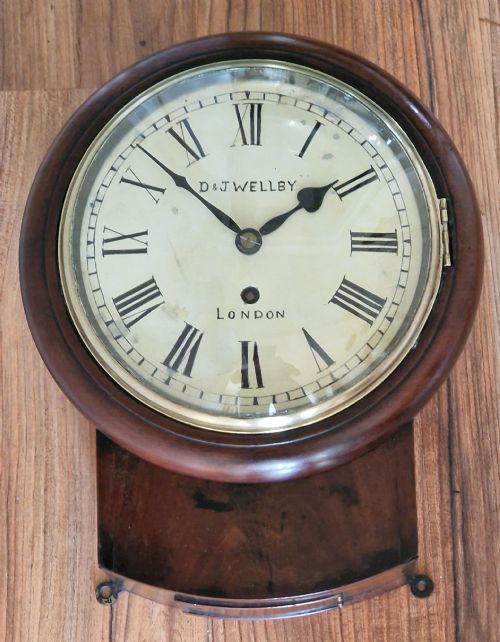


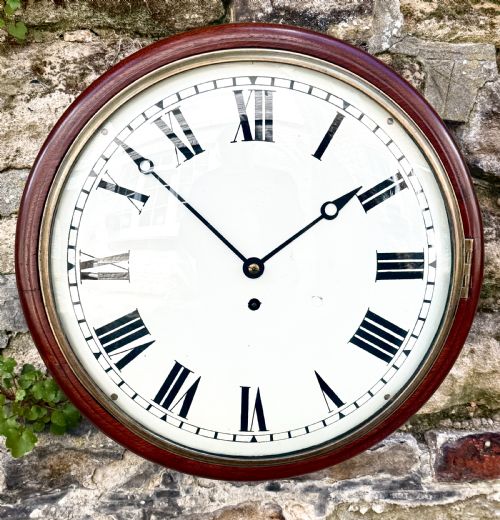
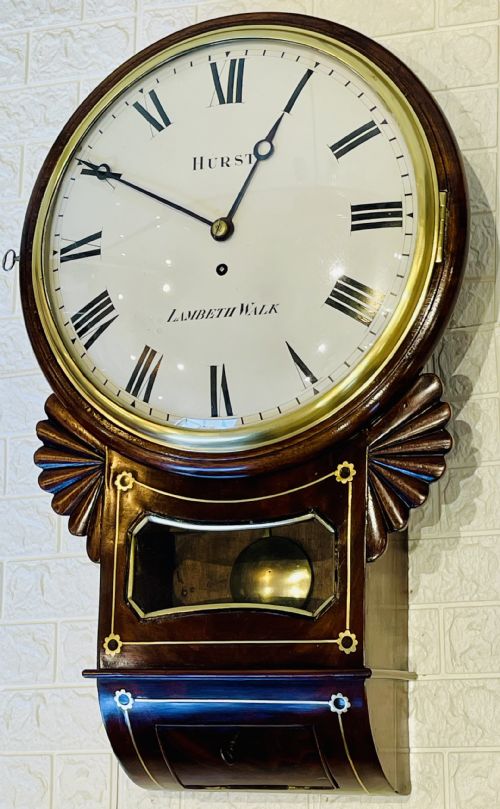


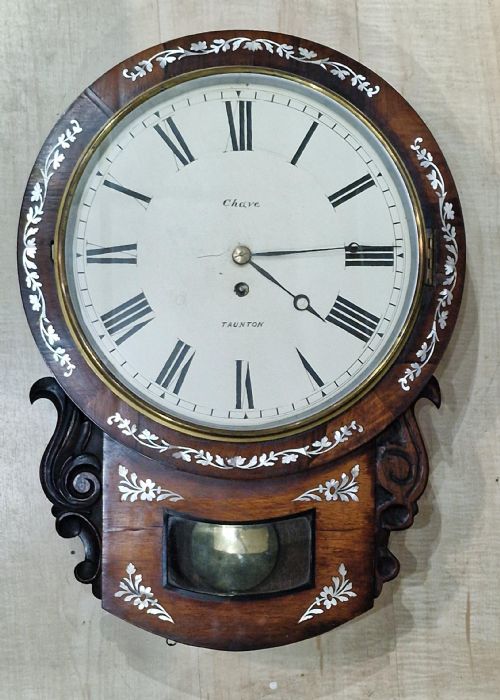


Mahogany Drop Dial Wall Clock
A mahogany drop dial wall clock combines precise timekeeping with practical architectural form, offering reliable utility and handsome timber presence for domestic or public interiors.
Mahogany Drop Dial Wall Clock
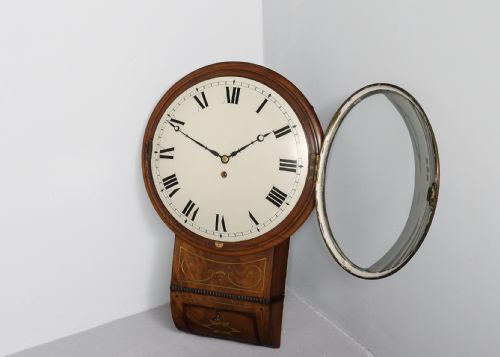
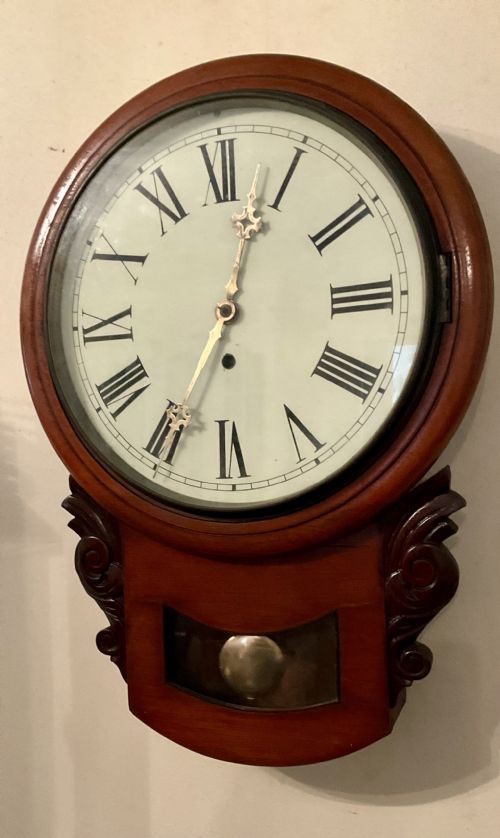
A mahogany drop dial wall clock is a timekeeper featuring a circular dial above an extended lower case designed to house the pendulum swing. These wall-mounted pieces originate primarily across the 19th century, including Regency, Georgian, and Victorian periods.
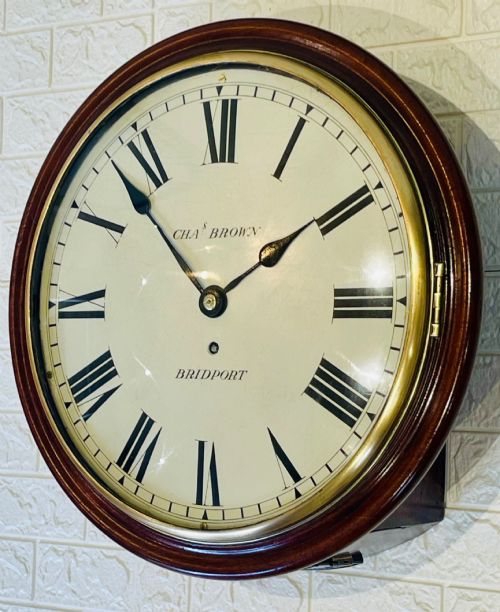
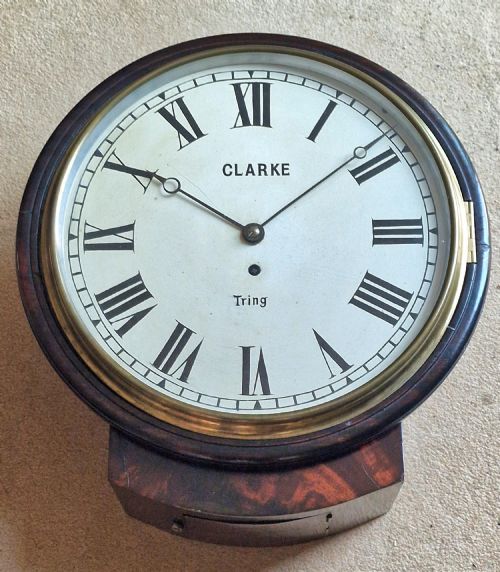
The version most commonly encountered on this page combines a rich mahogany timber case with a fusee movement and a protective glass bezel. Dial formats range from standard flat faces to convex or bowed designs framed within octagonal or rounded wooden surrounds.
Materials and technique
Cases are constructed from solid mahogany, occasionally accented with brass inlay, mother of pearl, or rosewood details. Movements rely on fusee or twin-fusee mechanisms powered by brass gears and iron components to regulate time.
Dials are typically painted metal or constructed from wood, protected by hinged glass bezels fitted into the timber frame. Craftsmanship involves precise joinery in the drop case to securely house the pendulum while maintaining structural balance on the wall.
Mahogany Drop Dial Wall Clock Retail Price Guide 2026
Typical asking prices for mahogany drop dial wall clock among the pieces listed under this phrase on Sellingantiques today, from the lower quarter to the upper quarter. They describe what is for sale here now, not the wider market.
Listings span the Georgian, Regency, and Victorian periods, constructed primarily from mahogany with brass and glass components.
Variations in quality
Quality rests in the precision of the fusee movement, the crispness of the dial lettering, and the fidelity of the mahogany timber. Maker signatures from known watch and clockmakers elevate the standing of a piece.
Proportion and case execution also determine worth, with refined brass inlay or carved bracket elements demonstrating superior workshop output compared to plain utility models.
George Clarke Tring·D and J Wellby·Samuel Chave Taunton·Joseph Mansfield·John Walker·J A Wheatley Carlisle·Balbiani Brookley·R Roberts of London
The Mahogany Drop Dial Wall Clock Glossary
- Fusee
- A conical pulley used in clock movements to maintain even tension on the chain as the mainspring winds down. This mechanism helps ensure steady timekeeping accuracy across the running period.
- Drop dial
- A clock case featuring a circular dial at the top and an extended lower drop box to accommodate the pendulum. This configuration maximises dial visibility while conserving floor space.
- Convex dial
- A clock face that curves outward toward the viewer rather than sitting flat. This design reduces glare and improves legibility from various viewing angles across a room.
- Twin fusee
- A movement incorporating two separate fusee cones, typically dividing timekeeping from striking functions. This setup powers both the clockwork and the bell strike independently.
- Wall clock
- A timekeeper designed to be hung directly upon a vertical surface rather than resting on a mantel or floor. These pieces are secured via robust mounting points integrated into the rear case.
Mahogany Drop Dial Wall Clock: Frequently Asked Questions
How do fusee movements work?
A fusee movement uses a conical pulley connected to a chain or gut line to equalize the decreasing power of the mainspring. As the spring unwinds, the chain pulls on a wider radius of the cone, maintaining constant torque.
This mechanical cleverness ensures the clock maintains consistent timekeeping accuracy from the moment it is fully wound until it runs down.
Where were these clocks originally used?
These wall timekeepers were historically placed in public spaces, railway stations, offices, and large domestic hallways where reliable time visibility was essential. Railway companies such as the GWR utilised them extensively for operational synchronisation.
In domestic settings, their commanding dial presence made them practical timepieces for kitchens, libraries, and stairwells.
How do I wind a wall clock?
Winding requires inserting a appropriate key into the winding hole on the dial face and turning it carefully until resistance is felt. Care must be taken not to overwind the spring, which can cause damage to the internal mechanism.
Most models seen here are eight-day movements, meaning they require attention roughly once a week to keep running continuously.
How do I distinguish Regency from Victorian examples?
Regency pieces typically date from the early nineteenth century, exhibiting restrained classical proportions, finer mahogany grain selections, and often simpler, elegant dial surrounds. Victorian iterations, emerging later in the century, frequently feature heavier mouldings, railway markings, or more robust drop cases.
Examining the internal movement signatures and timber finishing helps confirm the manufacturing era.