

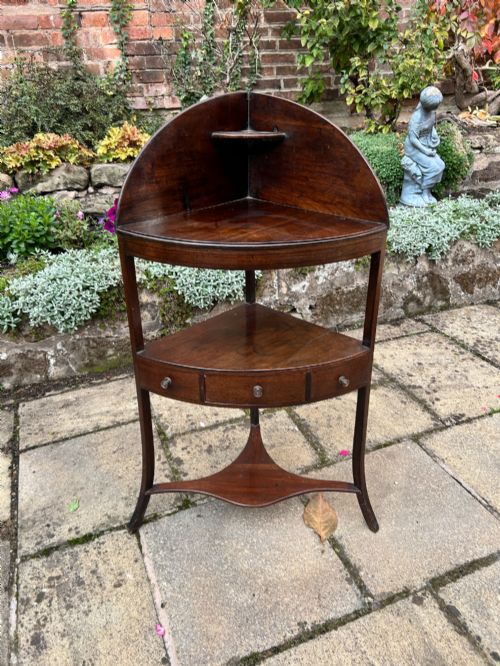
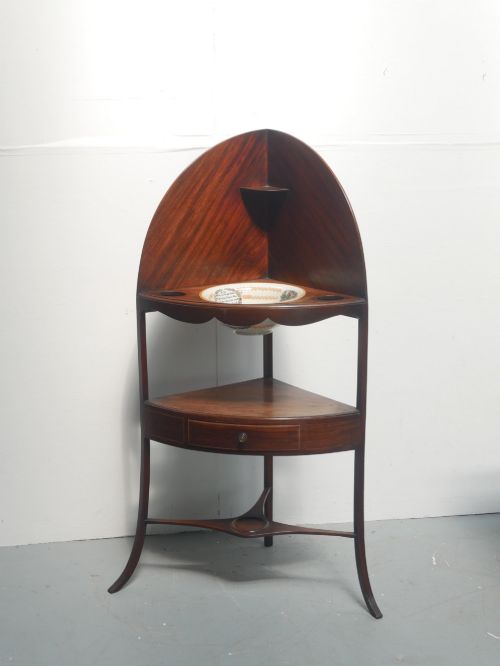
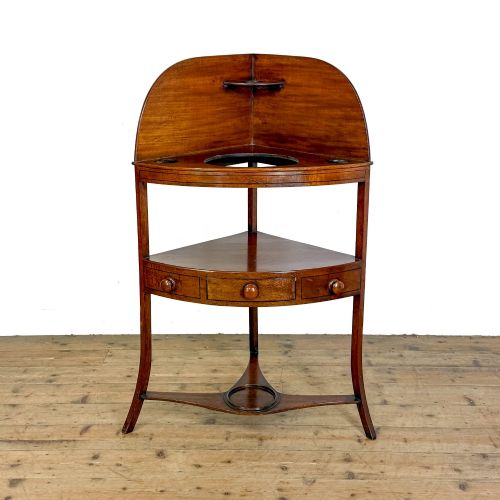
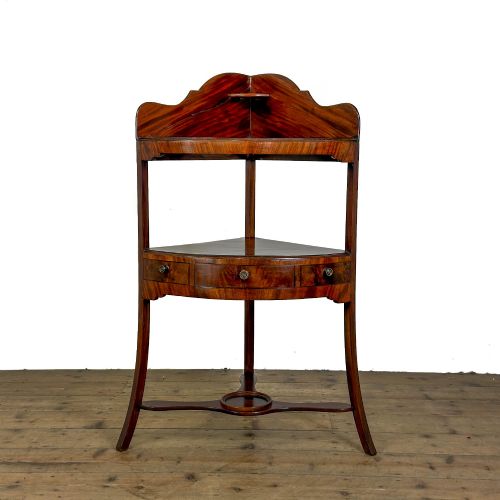
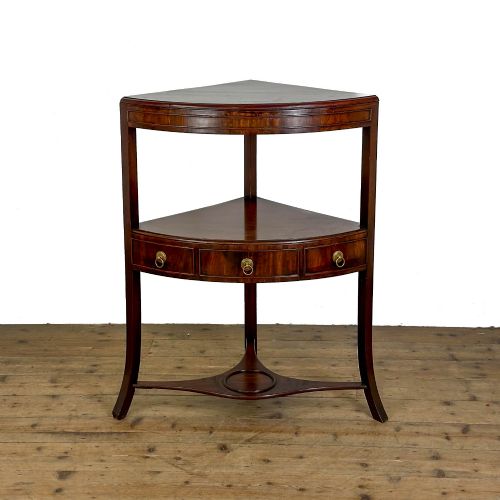
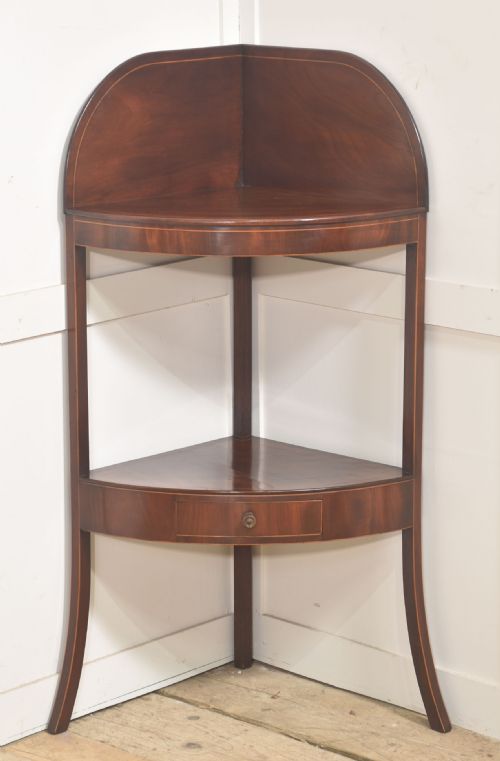


Mahogany Corner Wash Stand
Mahogany corner wash stands are clever space-saving bedroom pieces designed to fit neatly into room angles, bringing period timber warmth to modern interiors.
Mahogany Corner Wash Stand
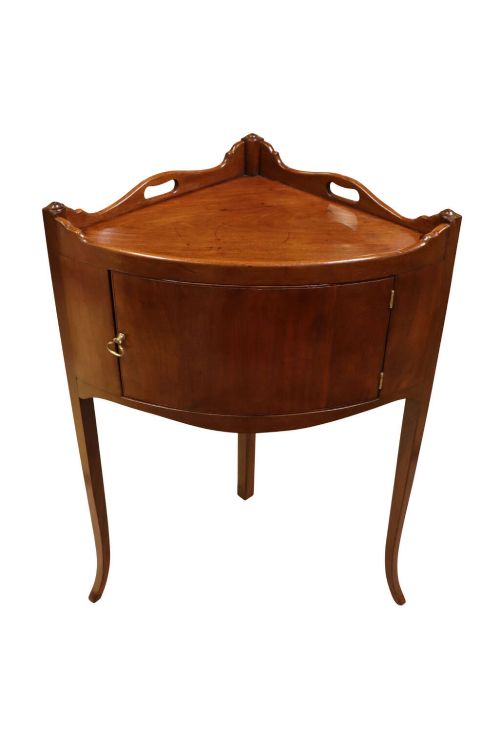
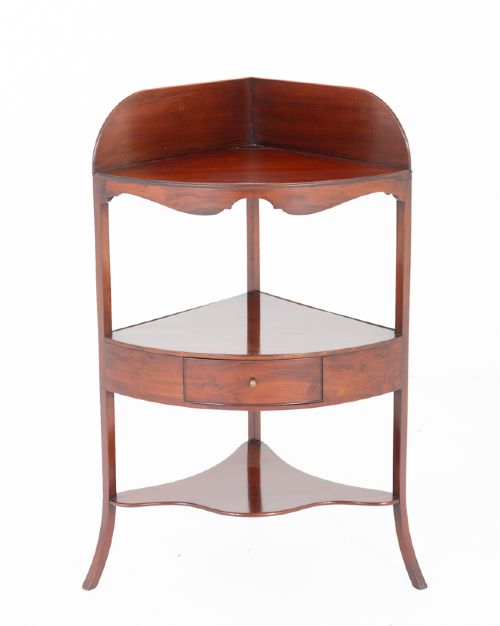
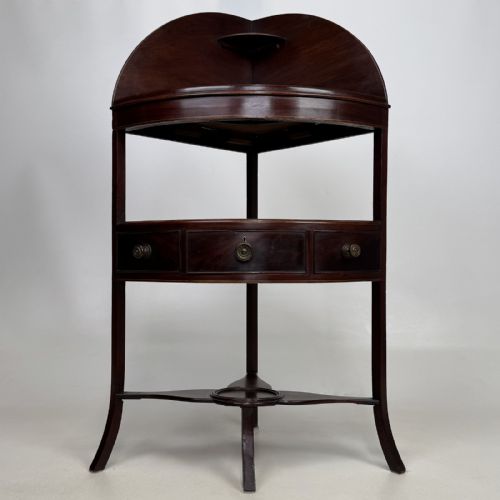
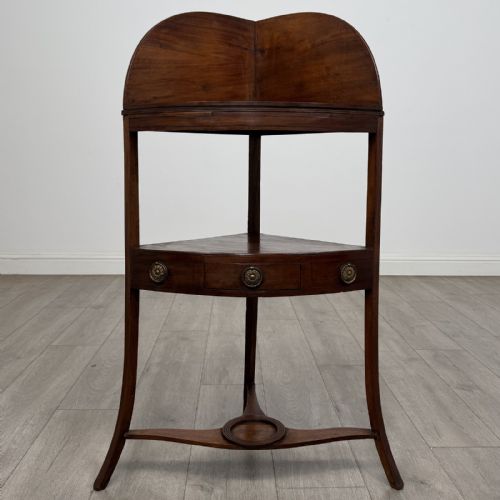
A mahogany corner wash stand is a triangular or bow-fronted bedroom cabinet built specifically to utilise unused room corners during the Georgian and Regency periods. These items typically feature tiered platforms designed to hold washbasins, water jugs, and shaving gear, while later examples often adapt these surfaces for use as occasional tables or plant stands.
The pieces appearing on this page span the 18th century, 19th century, Georgian, and Regency eras, with George III items frequently represented alongside Victorian and 1910 adaptations. Buyers encounter both straightforward functional stands and variant forms equipped with fold-down tops, raised galleries, or enclosed cupboard bases.
Materials and construction methods
Makers constructed these corner stands primarily from mahogany, frequently embellishing the timber with fine boxwood inlay to accent the edges and doors. Cabinet makers utilised native hardwoods alongside imported tropical timber to achieve robust structural frames capable of supporting heavy ceramic basins and water containers.
Joinery techniques involved precise corner framing to ensure stability against bedroom walls, while auxiliary elements incorporated brass fittings and ceramic components. Selected pieces feature specialised hardware such as makers' stamps pressed directly into the wood.
Mahogany Corner Wash Stand Retail Price Guide 2026
Typical asking prices for mahogany corner wash stand among the pieces listed under this phrase on Sellingantiques today, from the lower quarter to the upper quarter. They describe what is for sale here now, not the wider market.
Listings for mahogany corner wash stands feature items spanning the Georgian period, 18th century, 19th century, Regency era, and Victorian times.
Assessing quality in construction and detail
Quality in a mahogany corner wash stand rests on the crispness of the timber figuring, the precision of the boxwood inlay, and the retention of original structural tiers. Pieces that display finer grain selection and carefully fitted drawers or fold-down tops stand apart from simpler utilitarian versions.
The integrity of the raised gallery and the presence of authentic period brassware or maker signatures elevate certain items within the range. Differences in proportion and the subtlety of edge mouldings distinguish standard workshop production from finer cabinet work.
Gillows Lancaster
The Mahogany Corner Wash Stand Glossary
- Raised gallery
- A low decorative wooden upstand fixed around the top tier to prevent washing equipment from sliding off against the wall. This feature frequently incorporates shaped cut-outs designed to hold water jugs and basins securely.
- Bow front
- A convex curved cabinet front that softens the sharp angles of the room corner. This curved profile requires skilled timber bending or shaping from solid mahogany.
- Boxwood inlay
- Contrasting pale wood inserted into shallow channels carved into the dark mahogany surface. Cabinet makers used this technique to create fine geometric borders and decorative stringing lines.
- Tiered stand
- A piece of furniture constructed with multiple horizontal platforms set at different heights. In wash stands, these levels accommodated water storage above and wash accessories below.
Mahogany Corner Wash Stand: Frequently Asked Questions
What were mahogany corner wash stands used for?
These items served as personal washing stations in bedrooms before the installation of plumbed indoor bathrooms. Upper tiers held ceramic basins and pitchers of water, while lower shelves or small cupboards stored soap, sponges, and shaving paraphernalia.
Over time, many of these stands transitioned into decorative furniture. Today, owners frequently utilise them as corner display tables, lamp stands, or plant pedestals in modern living spaces.
How do I fit a corner stand into a modern room?
Because of their triangular footprint, these stands slide directly into empty 90-degree room junctions, occupying space that standard rectangular furniture cannot use. They anchor awkward corners while providing a compact surface for lamps or trailing plants.
When positioning a stand, consider the height of the gallery or tiered levels to ensure it complements surrounding wall art or window sills. Bow-fronted variants offer slightly more forward projection into the room, creating a softer visual profile than sharp right-angled edges.
How can I tell a Georgian wash stand from a later copy?
Georgian and Regency examples display period timber characteristics, such as dense, heavy mahogany with patination gained over two centuries of age. Construction methods often rely on hand-cut dovetails in drawer construction and traditional timber fixings rather than modern metal screws.
Later Victorian interpretations and 1910 reproductions typically exhibit different secondary woods inside the drawers and sharper, less worn edge profiles. Examining the interior framework and the style of the boxwood inlay helps distinguish original 18th-century production from subsequent revival pieces.