
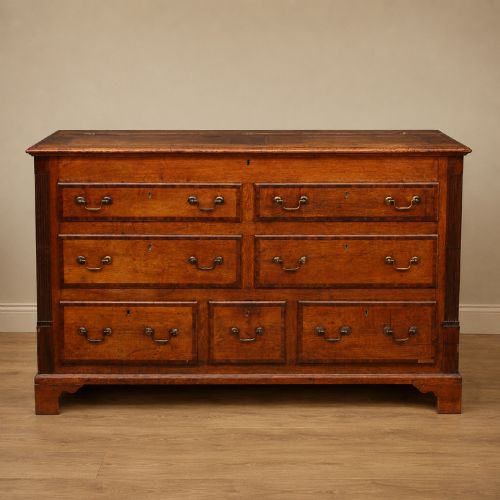
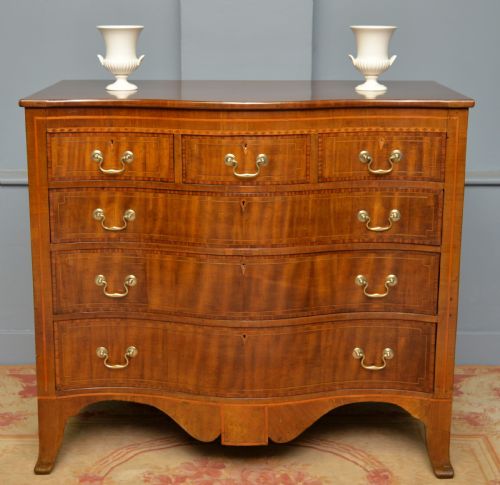


Mahogany Blanket Box Drawers
Mahogany blanket box drawers combine deep storage with the utility of a chest, offering sturdy timber work made for everyday Georgian utility.
Mahogany Blanket Box Drawers
When you search for mahogany blanket box drawers, you encounter practical storage furniture that bridges the gap between deep blanket chests and compartmented chests of drawers. Most pieces appearing here belong to the Georgian and Regency periods, spanning the eighteenth and early nineteenth centuries.
The form frequently manifests as a mule chest or Lancashire mule chest, incorporating a spacious lidded compartment above one or more working drawers at the base. These hybrid items served households as linen stores and wardrobe space combined, often labelled locally as housekeepers trunks or hall chests.
You will also find configurations like chests on stands or serpentine chests of drawers that share the robust proportions and dark timber tones characteristic of the era. They represent the durable craftsmanship of English cabinet makers working before the Victorian transition to pine and shellac.
How they were made
Makers constructed these pieces primarily using solid mahogany, frequently supported by internal carcases of oak and secondary linings of fruitwood. Surfaces often display decorative treatments like flame mahogany veneer and contrasting satinwood or fruitwood inlay.
Detailing relied on precision joinery and metalwork, featuring brass handles and escutcheons alongside crossbanded borders. Cabinet makers selected figured grain patterns to accentuate the drawer fronts and lid panels, balancing structural strength with visual warmth.
Some chests served both domestic linens and travelling gear, carrying the faint scent of cedar and old brass polish down through the centuries.
What varies in quality
Superior examples distinguish themselves through the choice of timber figure, such as fiddleback grain or rich flame mahogany veneers, paired with crisp crossbanding and inlay. The integration of the lower drawers into the main box structure requires careful alignment of the internal framing.
Original brass hardware and well-preserved secondary timbers like oak and fruitwood elevate a piece above simpler alternatives. Proportion and restraint in the decorative inlay separate the finest Georgian workshop output from utilitarian regional work.
The Mahogany Blanket Box Drawers Glossary
- Mule Chest
- A traditional storage chest featuring one or more drawers built into the base beneath a lidded upper compartment. It developed during the seventeenth and eighteenth centuries to hold linens and garments.
- Crossbanding
- A decorative border technique where thin strips of veneer are laid with the grain running perpendicular to the main panel. This frames drawer fronts and lids on better cabinet work.
- Serpentine
- A curved furniture front characterised by a convex centre flanked by concave ends. It demands advanced woodworking skill to shape solid timber or thick veneers accurately.
- Fiddleback
- A highly figured timber grain showing wavy horizontal ripples resembling the back of a violin. Cabinet makers prized this pattern for prominent drawer fronts.
- Escutcheon
- A protective metal plate surrounding a keyhole. On these pieces, they are typically cast in brass to match the drop handles.
Mahogany Blanket Box Drawers: Frequently Asked Questions
What is a mule chest?
A mule chest is a hybrid piece of furniture that places storage drawers beneath a traditional lidded blanket box. This design allowed users to access smaller garments without opening the main top compartment.
Cabinet makers produced them extensively during the Georgian period for domestic linen and clothing storage.
How do I date a mahogany chest?
Dating relies on examining construction methods, timber choices, and hardware styles across the piece. Georgian and Regency examples typically feature hand-cut dovetails and secondary woods like oak alongside solid mahogany.
Secondary indicators include the presence of original brasses, inlay work, and the specific proportions of the base drawers.
Where were these pieces used?
Households placed these large timber chests in bedrooms, hallways, and dedicated storage rooms. They functioned as primary wardrobes and linen repositories before fitted closets became common.
Housekeeper trunks served domestic staff for keeping household textiles secure and organised.
What is flame mahogany?
Flame mahogany is a highly decorative veneer cut from the branch junctions of the tree. It creates a distinctive, feather-like pattern with rich light reflection.
Cabinet makers reserved this prized material for the primary visual surfaces of high-status drawer fronts and lids.