
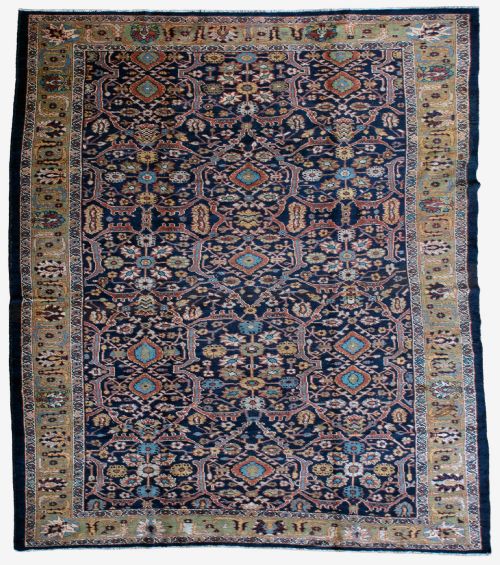
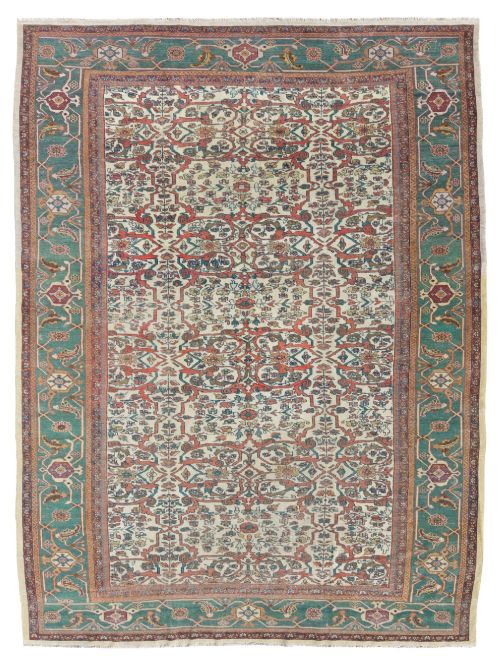
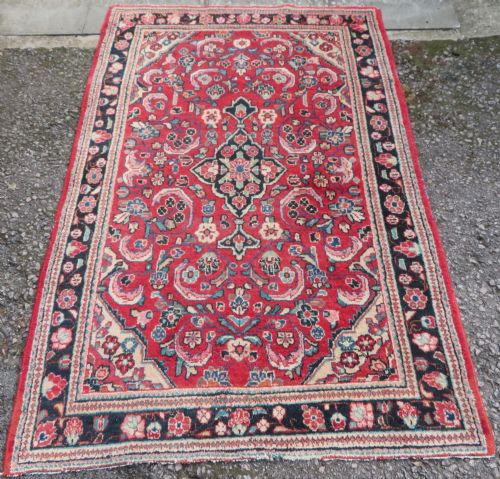
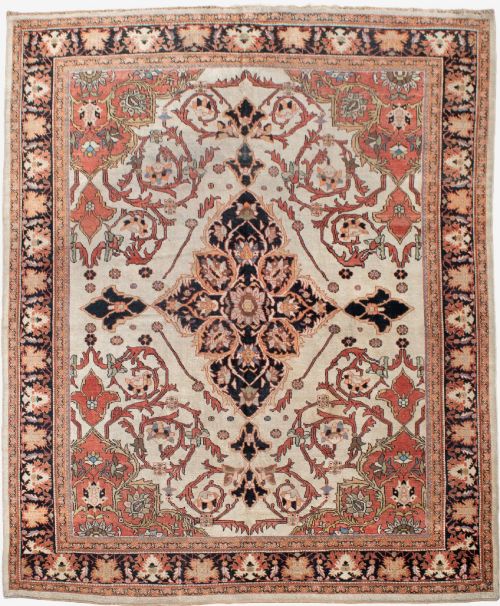


Mahal Sultanabad Carpet
A mahal sultanabad carpet brings grand Persian design into a room, offering large-scale floral patterns woven to last.
Mahal Sultanabad Carpet
A mahal sultanabad carpet is a substantial floor covering originating from West Persia, produced across the nineteenth and early twentieth centuries. These pieces typically present generous room sizes or village rug proportions suited for expansive living spaces.
You will most frequently meet pieces attributed to the Mahal, Sultanabad, and Ziegler traditions on this page. These floor coverings share roots in Persian workshops and village production, featuring traditional oriental motifs scaled for Western tastes of the period.
The aesthetic centres on oversized floral patterns and palmettes arranged across open fields. Such designs allow the floor covering to anchor a room without overwhelming the surrounding interior.
How they were made
Makers utilised resilient wool for the pile, hand-knotting the fibres onto sturdy cotton foundations. This combination provided the necessary weight and flexibility for large carpets to lie flat under heavy use.
Natural dye stuffs supplied the rich colour palette, yielding deep blues, reds, and occasional blue or green grounds. The application of these dyes ensures the colours age gracefully over the decades.
Listings span production dates from the 1870s through the 1930s, constructed entirely from wool and cotton.
What varies in quality
The sophistication of the drawing and the proportion of the floral motifs dictate the visual success of the piece. Master weavers achieved a balanced rhythm across the field, whereas simpler village examples display a more rustic charm.
Foundation integrity and wool density determine the physical durability of the rug. Tightly packed knots secure the pile against heavy foot traffic, preserving the clarity of the design over generations.
The Mahal Sultanabad Carpet Glossary
- Mahal
- A West Persian carpet style known for robust wool and scaled-up floral designs. These pieces often served export markets in Europe and Britain during the nineteenth century.
- Sultanabad
- A regional centre of carpet production in Persia associated with large-scale commercial weaving. Carpets from this area frequently share stylistic traits with Mahal and Ziegler productions.
- Ziegler
- A specific classification of nineteenth-century Persian carpets produced for international firms. They typically feature softened colour palettes and expansive, open field designs.
- Pile
- The upright yarn loops forming the soft upper surface of the carpet. This layer takes the wear of footsteps while displaying the woven pattern.
- Foundation
- The underlying structure of warp and weft threads that supports the knotted pile. Cotton forms the standard base material for these West Persian room-size carpets.
Mahal Sultanabad Carpet: Frequently Asked Questions
Where did these carpets originate?
These pieces were woven in West Persia, specifically in and around the district of Sultanabad and surrounding villages. Local workshops produced them largely for export to Western markets during the late nineteenth and early twentieth centuries.
The town served as a major commercial hub for carpet manufacturing, coordinating village weavers to supply large room-size floor coverings tailored to European drawing rooms.
How do I care for a large carpet?
Protect the wool pile by placing a quality underlay beneath the carpet to prevent slipping and reduce friction against hard floors. Vacuum gently using suction only, avoiding the rotating brush bars that can pull at antique fibres.
Rotate the piece every year to ensure even exposure to foot traffic and sunlight. Professional cleaning by specialists in antique textiles remains essential every few years.
What is a Ziegler carpet?
A Ziegler carpet represents a specific nineteenth-century commercial classification produced by foreign firms operating in Persia. These works adapted traditional Persian designs for Western tastes by employing softer, muted colour palettes and more open compositions.
They share technical similarities with standard Mahal and Sultanabad productions but are distinguished by their refined, spacious aesthetic.
How do I distinguish a village rug?
Village rugs generally appear in smaller dimensions compared to grand room-size carpets. They exhibit slightly more geometric interpretations of floral motifs due to the independent nature of domestic weaving.
These pieces carry the personal touches of individual makers working outside large workshop supervision, resulting in charming irregularities in the design.