






Madonna and Child Jewellery
Madonna and child jewellery comprises devotional medals, pendants, and brooches crafted in gold, silver, and enamel, offering intimate expressions of faith and artistry from the early twentieth century.
Madonna and Child Jewellery
Madonna and child jewellery centres upon religious pendants, medals, and brooches originating predominantly from France during the early twentieth century. These pieces serve as portable devotional items, often combining traditional sacred imagery with the distinct design movements of the period.
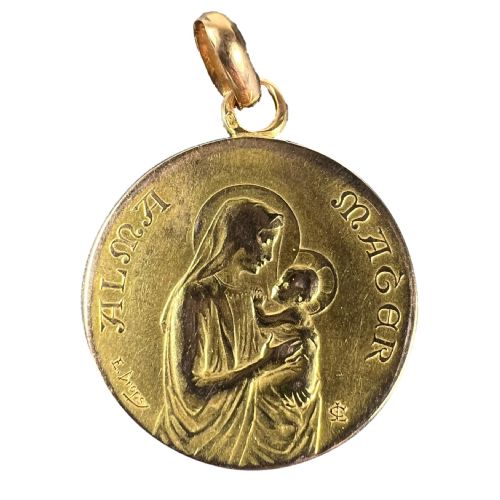
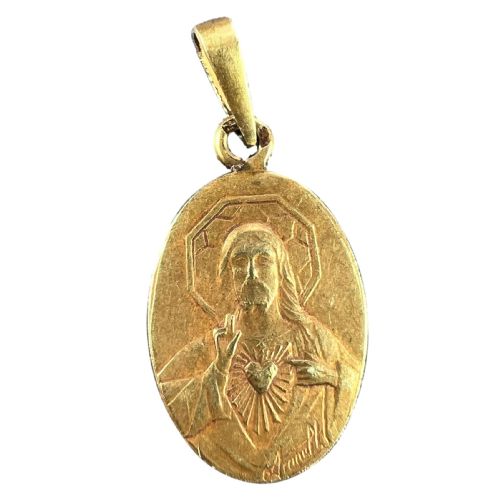
The most common examples encountered on this page are French religious medal pendants fashioned from 18ct yellow gold. These items frequently incorporate motifs such as the Sacred Heart alongside the traditional depiction of the Madonna and Child.
The material and stylistic range includes Edwardian silver brooches featuring enamel work alongside gold charms and pendants dated across the 1900s, 1910s, 1920s, and 1930s. Art Nouveau influences appear frequently, shaping the borders and frames of these small works of religious art.
Quality and Craftsmanship
The refinement of the relief carving on the gold figures determines much of the visual merit in these medals. Superior examples display sharp detail in the expressions and garments of the Madonna and Child, whereas simpler pieces show softer contours and flatter stamping.
The application of enamel introduces another distinction in quality, particularly where translucent plique-à-jour or rich colour fields are employed without flaws or cloudiness. Skilled hand-finishing and engraving on the reverse inscriptions elevate individual pieces above standard mass-produced devotional items.
Madonna and Child Jewellery Retail Price Guide 2026
Typical asking prices for madonna and child jewellery among the pieces listed under this phrase on Sellingantiques today, from the lower quarter to the upper quarter. They describe what is for sale here now, not the wider market.
Enamel work appears alongside stamped medals, demonstrating both plique-a-jour techniques and opaque coloured applications in Edwardian and Art Nouveau styles.
Mazzoni·Dropsy·Perriat·Arnault
The Madonna and Child Jewellery Glossary
- Medal pendant
- A devotional medallion fitted with a suspension loop for wearing on a chain. These objects frequently carry religious iconography on both sides.
- Plique-a-jour
- An enamelling technique where enamel is applied to open cells without a backing, creating a stained-glass effect that lets light pass through.
- Sacred Heart
- A Christian symbol representing the heart of Jesus Christ as a central motif for divine love, often paired with Madonna and Child imagery.
- Art Nouveau
- A design style characterised by flowing, organic lines and natural forms, visible in the decorative borders of early twentieth-century pendants.
Madonna and Child Jewellery: Frequently Asked Questions
What is madonna and child jewellery?
These pieces are small devotional items, including pendants, medals, and brooches, designed to be worn close to the body as expressions of faith. They depict the Virgin Mary and the infant Jesus within various gold and silver settings.
Originating largely from France during the early decades of the twentieth century, the form encompasses both simple stamped medals and intricately enamelled Art Nouveau pendants.
How were these devotional pieces worn?
Medals and pendants were typically suspended from gold chains to be worn around the neck as personal talismans or statements of religious devotion. Brooches were pinned to garments, serving a decorative as well as a spiritual function.
The inclusion of loops and charms indicates they were also adapted for chatelaines, bracelets, or specialised pendant mountings depending on the fashion of the decade.
How do I identify the period?
Dating relies heavily on stylistic markers such as Art Nouveau curving lines or Edwardian silver work, alongside hallmarks stamped into the gold components. French pieces from this era often carry specific assay marks on the external rings or edges.
The presence of specific named artists or medallists inscribed on the metal surface helps anchor pieces within the 1900 to 1930 timeframe.
What materials are most common?
Eighteen-carat yellow gold is the predominant material seen across these items, frequently accompanied by rose gold accents within specific medal designs. Silver and coloured enamel also appear in pieces from the Edwardian period.
The combination of precious metals with vitreous enamel represents the standard palette used by early twentieth-century French religious jewellers.