





Louis XVI Mantle Clock
A louis xvi mantle clock brings architectural restraint and gilded neoclassical form into a room.
Louis XVI Mantle Clock
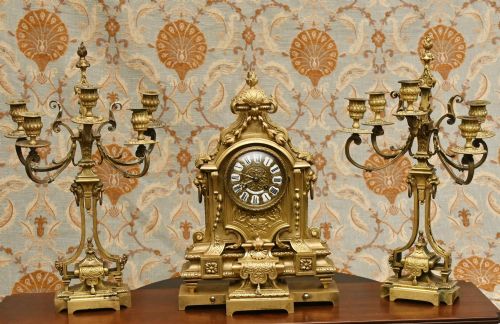
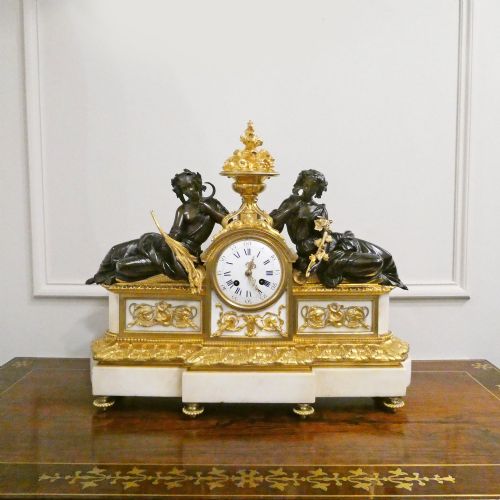
A louis xvi mantle clock embodies the structured symmetry and classical ornamentation characteristic of the revival period, often manifesting as upright mantel pieces, architectural drum heads, or lyre-shaped timepieces. The pieces encountered on this page span the Victorian era, the nineteenth century, and the Edwardian period, reflecting nineteenth-century European interpretations of earlier French design.
Makers and workshops of the period produced both standalone clocks and expansive clock garniture sets accompanied by matching candelabras. Cases range from petite proportions in pink marble and ormolu to substantial crystal regulators and cartel wall clocks.
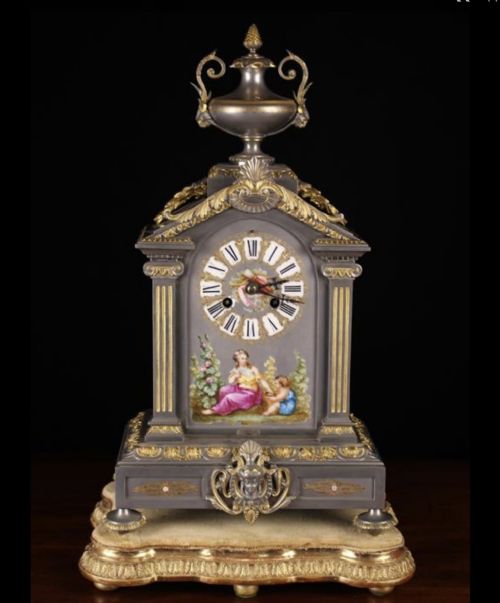
The dominant styles combine Louis XVI revival aesthetics with French neoclassical motifs, utilising porcelain panels, enamel dials, and bronze mounts. Buyers select these objects for their decorative presence and mechanical eight-day striking movements.
Materials and construction
The construction relies on heavy metal casting, combining gilt bronze and ormolu mounts with natural stone bodies such as white marble, pink marble, and brass framing. Enamel is utilised for the clock faces, often paired with hand-painted porcelain panels in the Sevres style.
Makers employed mechanical eight-day striking movements housed within bronze or marble cases, flanked by glass panels in crystal regulators or sculptural elements like cherubs and doves.
Louis XVI Mantle Clock Retail Price Guide 2026
Typical asking prices for louis xvi mantle clock among the pieces listed under this phrase on Sellingantiques today, from the lower quarter to the upper quarter. They describe what is for sale here now, not the wider market.
Listings feature movements spanning the Victorian era, the Edwardian period, and the nineteenth century, utilising white marble, pink marble, porcelain, and gilt bronze.
Evaluating quality and execution
Quality rests in the crispness of the gilt bronze chasing, the weight and uniformity of the marble or crystal housing, and the refinement of the painted porcelain panels. Finer examples display deeper detail in cast motifs like lion masks, doves, and classical architectural framing.
The integration of the movement within the decorative case distinguishes standard production from exceptional garniture sets and specialised lyre or cartel forms.
Vincenti·Leroy and Fils
The Louis XVI Mantle Clock Glossary
- Ormolu
- Gilded bronze produced through a mercury amalgamation technique. It provides a rich, warm metallic finish on decorative mounts.
- Garniture set
- A matched group consisting of a central clock flanked by side pieces such as candelabras or urns. These sets create a balanced arrangement for a mantelpiece.
- Crystal regulator
- A clock encased in glass panels that exposes the internal movement and pendulum from multiple angles. This style gained popularity in the later nineteenth century.
- Cartel clock
- A wall-mounted clock featuring an ornate frame of bronze or wood. It suspends directly from a wall fixture rather than resting on a mantel.
- Lyre clock
- A timepiece shaped like the ancient musical instrument, typically constructed with marble and ormolu mounts. The pendulum is often visible through the open centre of the frame.
Louis XVI Mantle Clock: Frequently Asked Questions
What is a clock garniture set?
A clock garniture set comprises a central mantel clock paired with matching side ornaments, typically candelabras or decorative vases. These matching components were designed to create a symmetrical display on a fireplace mantel or console table.
They share identical decorative motifs, materials such as ormolu and marble, and period stylistic details to unify the arrangement of a room.
How do crystal regulators work?
Crystal regulators are mantel clocks enclosed by glass panels on the front, back, and sides, allowing light to pass entirely through the case. This design showcases the mechanical movement and the swinging pendulum from all viewing angles.
The brass or gilt frames hold heavy bevelled glass plates, combining mechanical transparency with architectural presence.
Where were these clocks made?
The pieces recorded here are predominantly of French origin, produced during the nineteenth century and the Victorian era. Workshops in France exported these clocks widely, incorporating local styles such as the Louis XVI revival.
Specific makers recorded on this page, such as Vincenti and Leroy and Fils, operated within this French manufacturing tradition.
How do I maintain an eight-day movement?
An eight-day mechanical movement requires manual winding using a suitable key every week to keep the clock running. The mechanism relies on tension from internal springs or suspended weights to drive the gear train and strike the hours.
Care should be taken to place the clock on a stable, level surface so the pendulum swings evenly and keeps accurate time.