
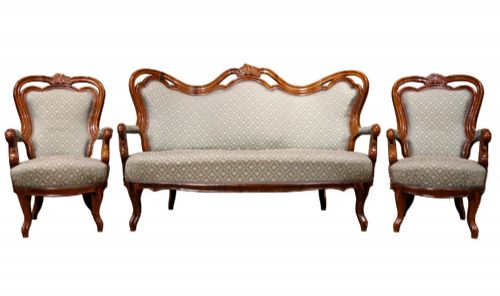


Louis XV Style Suite
These pieces for a louis xv style suite bring French Rococo curves and carved walnut elegance into modern drawing rooms and bedrooms.
Louis XV Style Suite
When you search for a louis xv style suite, you encounter matching sets of seating or bedroom furniture shaped by French Rococo revival aesthetics. These groups range from three-piece salon arrangements comprising a small sofa and two armchairs to larger five-piece drawing-room sets and complete bedroom suites featuring king-size beds and matching bedside cabinets.
The pieces appearing on this page originate predominantly from the nineteenth and early twentieth centuries, spanning periods such as 1860, 1890, 1900, 1910, and 1920. You find salon suites, seating suites, duchesse brisée forms, and bedroom furniture bearing the characteristic asymmetrical curves and naturalistic carvings of the style.
Makers and workshops of the nineteenth and early twentieth centuries produced these matched groups to recreate the grand interiors of French chateaux. Walnut, giltwood, beech, and painted wood provide the structural framework for upholstered chairs, settees, and bedsteads.
How they were made
Craftsmen built these suites using solid timbers like walnut, beech, and giltwood, carving organic motifs directly into the showwood frames. Upholstered elements utilised traditional textiles, fabric, and tapestry to cover seating and bed components.
Makers shaped the structural timber with hand tools to achieve the characteristic cabriole legs and flowing serpentine lines of the Rococo revival. Surface finishes included gilding, polishing, and painted wood treatments applied to match the various seating and bedroom pieces within a single suite.
Listings feature pieces from the nineteenth and early twentieth centuries, including specific years like 1860, 1890, 1900, 1910, and 1920.
What varies in quality
The refinement of the hand-carved woodwork dictates the distinction between standard and superior examples within these suites. Crisp relief work on walnut frames and finely gilded surfaces indicate greater artisan skill during production.
The cohesion of the matched pieces also defines the caliber of a suite, particularly where bedroom sets integrate beds, bedside cabinets, and armoires into a unified design. The integration of original tapestry or high-grade textile upholstery further elevates the standing of a salon or parlour set.
Mercier
The Louis XV Style Suite Glossary
- Duchesse brisée
- A chaise longue split into two or three parts, typically a chair and one or two footstools, designed for reclining in a salon.
- Giltwood
- Timber coated with gold leaf or gold paint to provide a brilliant decorative surface on frames and mouldings.
- Cabriole leg
- A furniture leg that bends outward and then tapers downward, echoing natural animal shapes common in Rococo design.
- Showwood
- Polished or carved wooden framing left exposed around the upholstered sections of chairs, sofas, and settees.
- Bergère
- An enclosed upholstered armchair with wooden framing and a built-in or loose seat cushion.
Louis XV Style Suite: Frequently Asked Questions
What is included in a salon suite?
A salon suite typically consists of a small settee or sofa accompanied by matching armchairs designed for drawing-room seating. Some larger configurations extend to five pieces with additional chairs.
These groups share identical carved wooden frames and upholstery fabrics to create a unified aesthetic for formal entertaining spaces.
How do I identify a revival piece?
Nineteenth-century and early twentieth-century revival pieces utilise nineteenth-century construction methods and timber preparation beneath Rococo-style carved ornamentation. You observe machine-cut elements alongside hand-finishing characteristic of the 1860 to 1920 periods.
Makers of this era interpreted eighteenth-century French designs with heavier timber dimensions and specific nineteenth-century finishing techniques.
Where were these bedroom suites used?
These bedroom suites furnished large principal chambers in period homes, pairing a king-size bedstead with matching bedside cabinets and sometimes armoires. The coordinated timber and carved motifs established a grand scheme across every item in the room.
They served as both functional sleeping furniture and prominent displays of decorative taste.
What woods were used for these frames?
Walnut, beech, and giltwood form the primary structural materials for the frames of these suites. Craftsmen selected walnut for its strength and rich grain, while beech provided a stable base for painted or gilded finishes.
Selected pieces also incorporated timber finished with paint or parcel-gilt accents to highlight specific carved details.