

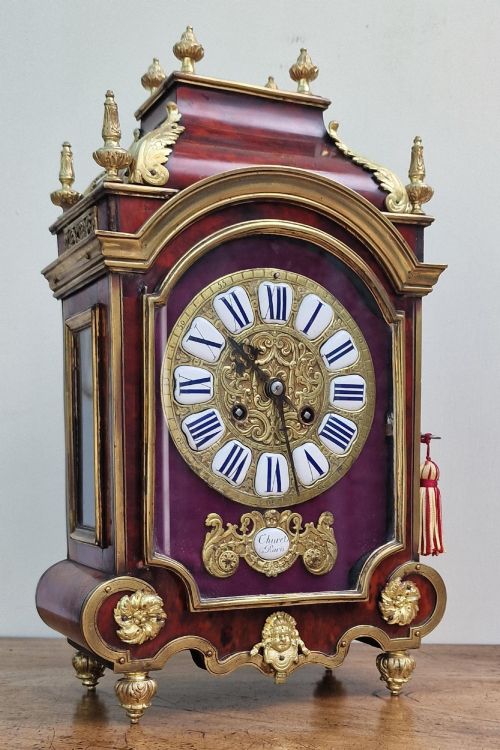


Louis XIV Bracket Clock
These louis xiv bracket clock examples bring monumental French Baroque presence into a room through elaborate marquetry and gilt mounts.
Louis XIV Bracket Clock
A louis xiv bracket clock combines a substantial tabletop or wall-mounted timekeeper with a matching shelf, bringing heavy architectural presence into a room. These pieces draw on French Baroque and revival aesthetics, establishing a formal focal point through grand proportions and rich surface decoration.
On this page, you are most likely to meet nineteenth-century interpretations of these forms, particularly Victorian examples executed in the Louis XIV revival style. Makers often utilised Boulle marquetry and ebonised timber to echo the grand workshops of the seventeenth-century French court.
How they were made
The construction relies on timber carcasses shaped as brackets and clock cases, frequently overlaid with tortoiseshell and brass in the Boulle technique, or finished in ebonised wood and mahogany. Enamel dials provide the face, often featuring individual cartouches for the numerals.
Gilt bronze and ormolu mounts punctuate the exterior, cast with classical motifs and scrolling foliage that frame the glazed doors and glass panels. Brass details reinforce the edges and corners, marrying structural joinery with ornamental metalwork.
Louis XIV Bracket Clock Retail Price Guide 2026
Typical asking prices for louis xiv bracket clock among the pieces listed under this phrase on Sellingantiques today, from the lower quarter to the upper quarter. They describe what is for sale here now, not the wider market.
The listings here span nineteenth-century Victorian pieces alongside mid-twentieth-century examples, utilising mahogany, ebonised wood, and tortoiseshell.
What varies in quality
Quality rests in the precision of the Boulle marquetry and the crispness of the bronze or ormolu cast work. Finer examples display deeply chased mounts and meticulously fitted tortoiseshell panels that align seamlessly with the underlying timber.
The presence of an original matching bracket elevates a piece significantly, as these supporting shelves frequently became separated from their clocks over the centuries. Furthermore, attribution to known makers like Thuret, Samuel Marti or Henri Dasson shifts a piece into a higher tier of craftsmanship.
Thuret·Samuel Marti·Henri Dasson
The Louis XIV Bracket Clock Glossary
- Boulle
- A method of marquetry using contrasting veneers of tortoiseshell and brass, named after the famous cabinetmaker to Louis XIV. This technique creates a rich, metallic tortoiseshell pattern that catches the light from different angles.
- Ormolu
- Gilded bronze used for decorative mounts and architectural details on furniture and clocks. The process involves applying a gold amalgam to a bronze base before heating.
- Bracket clock
- A portable clock designed to sit on a bracket or shelf attached to the wall, or upon a table. Originally heavy enough to require a dedicated wall bracket for support.
- Cartouche
- A small enamelled plaque bearing a single numeral on the clock face. These individual pieces are pinned to the dial surround rather than painted directly onto a single plate.
- Ebonised wood
- Timber treated to resemble ebony through staining and polishing. This dark finish provides a stark, dramatic contrast against bright ormolu mounts and brass marquetry.
Louis XIV Bracket Clock: Frequently Asked Questions
What is a louis xiv bracket clock?
A louis xiv bracket clock is a tall, ornate timepiece usually accompanied by a matching wall shelf, rooted in French Baroque design. These pieces combine elaborate marquetry and cast metal mounts to create a commanding decorative object.
Most examples found today date from the nineteenth century, when European workshops revived the grand styles of the French court for Victorian interiors.
How do these clocks mount to walls?
These clocks typically rest upon a dedicated wooden wall bracket, designed specifically to bear the substantial weight of the timber and bronze case. The shelf itself often mirrors the decorative veneers and mounts of the clock above.
Securing the bracket requires solid wall fixings, as the combined weight of the bronze, wood and glass demands robust structural support.
What materials make up Boulle work?
Boulle marquetry consists of tortoiseshell and brass cut together in intricate interlocking patterns, then applied to a wooden carcass. This method produces two contrasting versions known as premier partie and contre partie.
The rich amber tones of the shell combined with polished brass create a shimmering surface texture characteristic of grand French horology.
How do I distinguish revival periods?
Nineteenth-century revival pieces often display machine precision in their mounts and slight variations in wood seasoning compared to seventeenth-century originals. Makers working during the Victorian era and Napoleon III period adopted these classical motifs with renewed industrial capability.
Examining the internal movement, dial construction and backing plates helps determine whether a piece belongs to the original Baroque era or later nineteenth-century revivals.
Where should I place a bracket clock?
A bracket clock commands attention, making it well-suited as a focal point in a hallway, drawing room or formal study. Placing it at eye level allows the detail of the dial and the lower ormolu mounts to be appreciated fully.
Ensure the wall location is free from direct sunlight and dampness to protect the delicate tortoiseshell veneer and gilt bronze surfaces.